|
8 Tontine Street
Folkestone
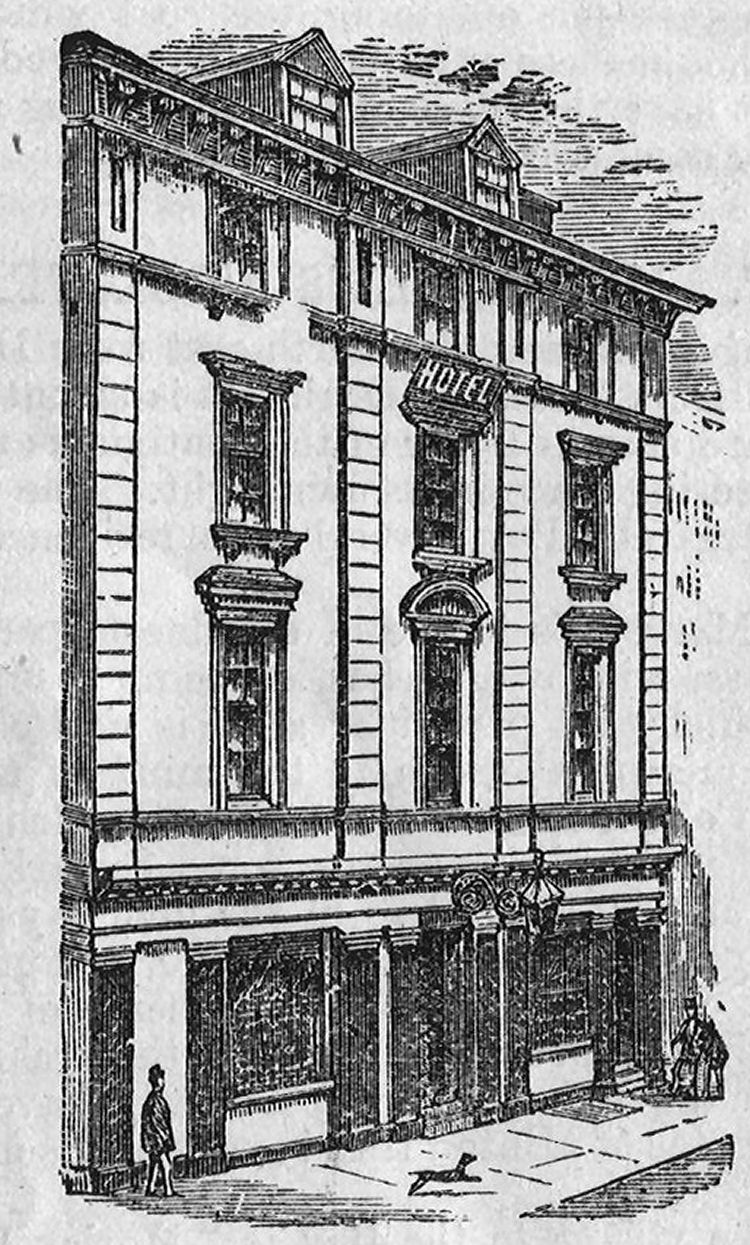
Above shows the "Clarendon Hotel" in 1898. |
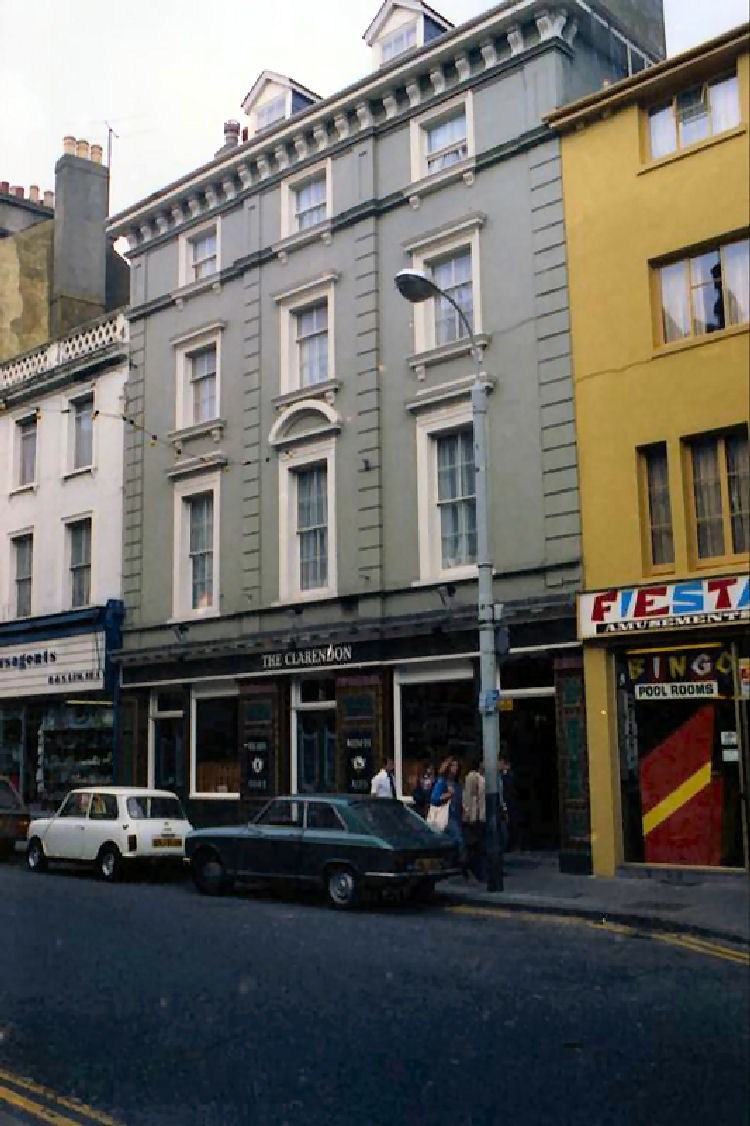
Above photograph kindly supplied by Jan Pedersen, 1978. |

Above photo, 17 October 1989, by Jim Ashby. |
Traced as early as 1850 and as late as 1993, this hotel was situated
right next to the "Duke of
Edinburgh."
Information has just been found that suggests this was previously called
the "City of
Boulogne."
|
Maidstone Gazette 3 September 1850
Annual Licensing, Tuesday; Before J. Bateman, W. Major, C. Golder
and T. Golder Esqs.
The new hotel, called the "Clarendon," will open under favourable
auspices in the early part of this month.
The licence granted to Christopher Porter for the "City of Boulogne"
was transferred to Alfred Rayment, and the sign altered to the
Clarendon.
|
|
Canterbury Journal 7 September 1850.
The new hotel, called the "Clarendon," will open under favourable
auspices in the early part of this month.
The 29th was the General Annual Licensing day, when all the old
licences were renewed, and a new one granted to John Back for the
Jolly Sailor.
The licence granted to Christopher Porter for the "City of Boulogne"
was transferred to Alfred Rayment, and the sign altered to the
"Clarendon."
Note: No previous record of Porter or the proposed City of Boulogne.
|
|
Dover Chronicle 7 September 1850
The new hotel, called the Clarendon, will open under favourable
auspices in the early part of this month.
|
|
Kentish Gazette 10 September 1850.
Tontine Building Company.
This company appear to carry out the original plan of making a spacious
street with much vigour. Not only is there a number of shops completed
and ready for tenants, but some are already let. The new hotel, called
The Clarendon, will open under favourable auspices in the early part of
this month. Eleven more houses will be erected this year, forming at
once an elegant and level thoroughfare. The company have taken the large
workshops, &c., in the Sandgate Road, lately in the occupation of Mr.
Thomas Lucas, who has removed to Lowestoft, in Norfolk (sic).
|
|
Maidstone Gazette 17 September 1850
A gang of fellows, under various names, are going about from town to
town in this county, pretending to be assignees of a large firm in
Paris, and holding out inducements to the fair sex of purchasing
“costly and rare productions”. Six of the gang lately visited
Folkestone, and obtained the use of the large room at the Clarendon
Hotel. The manner in which it was obtained is worthy of a mention as
a caution to other towns they may visit. An elderly man, of good
address, acts as the “pioneer”, and under pretence of exhibiting
tapestry models and works of art for the “Art Exhibition of 1851”,
and mentioning some respectable place in the next town, obtains the
use of them, and afterwards endeavours by circulars to families to
induce them to become purchasers.
|
|
Canterbury Journal 21 September 1850.
A gang of fellows, under various names, are going about from town to
town in this county, pretending to be assignees of a large firm in
Paris, and holding out inducements to the fair sex of purchasing
“costly and rare productions”. Six of the gang lately visited
Folkestone, and obtained the use of the large room at the "Clarendon
Hotel." The manner in which it was obtained is worthy of a mention as
a caution to other towns they may visit. An elderly man, of good
address, acts as the “pioneer”, and under pretence of exhibiting
tapestry models and works of art for the “Art Exhibition of 1851”,
and mentioning some respectable place in the next town, obtains the
use of them, and afterwards endeavours by circulars to families to
induce them to become purchasers. |
|
Dover Telegraph 21 September 1850
A gang of fellows, under various names, are going about from town to
town in this county, pretending to be assignees of a large firm in
Paris, and holding out inducements to the fair sex of purchasing
“costly and rare productions”. Six of the gang lately visited
Folkestone, and obtained the use of the large room at the Clarendon
Hotel. The manner in which it was obtained is worthy of a mention as
a caution to other towns they may visit. An elderly man, of good
address, acts as the “pioneer”, and under pretence of exhibiting
tapestry models and works of art for the “Art Exhibition of 1851”,
and mentioning some respectable place in the next town, obtains the
use of them, and afterwards endeavours by circulars to families to
induce them to become purchasers.
|
|
Kentish Mercury 28 September 1850
A gang of fellows, under various names, are going about from town to
town in this county, pretending to be assignees of a large firm in
Paris, and holding out inducements to the fair sex of purchasing
“costly and rare productions”. Six of the gang lately visited
Folkestone, and obtained the use of the large room at the Clarendon
Hotel. The manner in which it was obtained is worthy of a mention as
a caution to other towns they may visit. An elderly man, of good
address, acts as the “pioneer”, and under pretence of exhibiting
tapestry models and works of art for the “Art Exhibition of 1851”,
and mentioning some respectable place in the next town, obtains the
use of them, and afterwards endeavours by circulars to families to
induce them to become purchasers.
|
|
Maidstone Gazette 29 October 1850
Opening dinner at the Clarendon Hotel: Yesterday week upwards of
thirty gentlemen sat down to an excellent dinner to celebrate the
opening of the above hotel. On Friday last, soon after midnight, a gentleman in great haste
applied at the London Bridge station for a special train, and as
soon as it could be got ready, proceeded to Folkestone, where he
arrived about five o'clock. He proceeded direct to the Pavilion and was shown, at his
request, into one of the principal apartments. The bell soon
announced that he had some wants which he wished supplied; one of
the first was a message to the electric telegraph office, informing
his friends of his safe arrival, soon after another desiring their
presence. Then there were the usual wants of a traveller; and about
seven o'clock he wanted medical assistance. On arrival of the medical
attendant no complaint could be discovered, but there was no
difference of opinion about the remedy proposed – a composing
draught and a suggestion that he should retire to bed. But retiring
to bed and retiring to rest were soon found to be very different
matters; the only difference to the servants being that they were
incessantly summoned by the bedroom instead of by the parlour bell.
The whole of the inmates having been disturbed from five o'clock till eight, with no prospect of being quiet, Mr. Breach
was at last compelled to insist upon his guest dressing and quitting
the hotel. This is one of the “desagrements” to which hotels are
unavoidably subject, accompanied, as in this case, with loss; but we
are surprised to hear that for his special train trip, and
affectionate messages to his friends through the telegraph, he is
indebted to the company £38. Should he be a singer at taverns in
towns, as reported, the prospect of payment is, we fear, remote. He
left for Dover. The above account may put persons upon their guard
against him. |
|
Kent Herald, 31 October 1850.
Opening dinner at the Clarendon Hotel: Monday week upwards of thirty gentlemen
sat down to an excellent dinner to celebrate the opening of the above hotel.
|
|
Dover Chronicle 2 November 1850
Opening dinner at the Clarendon Hotel: Monday week upwards of thirty
gentlemen sat down to an excellent dinner to celebrate the opening
of the above hotel.
|
|
Dover Telegraph 2 November 1850
Opening dinner at the Clarendon Hotel: One day week upwards of
thirty gentlemen sat down to an excellent dinner to celebrate the
opening of the Clarendon Hotel.
|
|
Kentish Gazette 9 May 1854.
At the Court of Bankruptcy on Friday, a first meeting was held for the
proof of debts and choice of trade assignees under the bankruptcy of
William John Ward, late of the Bristol Hotel, Brighton, and now of the
Clarendon Hotel, Folkestone, innkeeper.
Mr. A. A. Jones, solicitor, of Quality Court. Chancery Lane, appeared on
behalf of the petitioning creditor, Mr. Thomas Fitts Balls, of the
Golden Lion Inn, Brixton Road, licensed victualler, whose debt is £105
4s.
The bankrupt surrendered and obtained protection from arrest on the 20th
of last month, and the following proofs were now admitted without
opposition, namely, Mr. Thomas Grant, of Maidstone, distiller, £152 13s.
6d.; Mr. Ford Hale, Great Tower Street, wine merchant, £88 2s. 9d.; Mr.
Balls, the petitioning creditor, £105 4s.; Mr. George Percy, Queen
Street Place, wine merchant, £191 15s. 6d.; Mr. George Sydney Page,of
Limekiln Street, Dover, brewer, £2B7 6d.; and Mr. John Smythe, of
Maidstone, timber merchant, £33 13s.
Mr. Thomas Grant, of Maidstone, distiller, was nominated to act as trade
assignee, and, having accepted the trust, the Court confirmed his
appointment.
The bankrupt applied for an allowance out of the estate, and the learned
commissioner, with the consent of Mr. Jones, sanctioned the payment of
£2 2s. per week, from the 3rd of April last until the next meeting for
passing the bankrupt's examination, which is fixed to be held on the
26th of this month. The bankrupt's protection was then enlarged and the
meeting broke up.
|
|
Southeastern Gazette 9 May 1854.
Local News.
W. J. Ward’s Bankruptcy.—The bankrupt keeps the Clarendon Hotel, but
came thither lately from Brighton. The first meeting of creditors took
place on Friday last, when Mr. T. Grant, of Maidstone, distiller, was
appointed trade assignee. The second meeting is fixed for the 26th inst.
Note: No mention of Ward in More Bastions.
Wednesday, May 3rd: Before the Mayor, D. Major, and S. Godden, Esqs.
Richard and William Nichols were summoned for an assault on John Tickner,
miller, of Hythe, on the 26th ult.
Prosecutor stated that on the night in question he went into the
Clarendon Hotel, at about 10.30. p.m., to call for a friend, and a few
minutes afterwards he found that his horse and cart, which he had left
at the door, were gone. He proceeded up Tontine-street, and met the
defendant coming with the horse and cart in the direction of the
Clarendon. He walked up to him and asked him where he had got the horse
and cart from, and receiving no answer, he took him by the collar. After
walking a few steps a struggle ensued, which ended in the defendant
being two or three times knocked down, after which Tickner jumped into
the cart and drove off.
Defendant stated that on the night in question his attention was called
by a man named John Crump to a horse and cart without a driver. After
making some inquiry respecting it, it was found to belong to Mr. Tickner,
who was at the Clarendon. The horse was turned round and taken part of
the way back, when it was met by Mr. T., and the assault complained of
then took place.
The magistrates dismissed the case, being of opinion that Mr. Tickner
had acted too hastily in the matter.
John Crump was then called for an assault, arising out of the same
transaction. After Mr. Tickner had taken possession of the cart, Crump
followed and jumped into it, when a scuffle ensued in the cart, in which
Mr. Tickner was thrown from his cart into the road, the cart taken
possession of by Crump, and taken back to the Rose Inn, Mr. Tiokner
going in search of a policeman.
Defendant stated the only cause of his jumping into the cart was to
satisfy himself whether he was the right owner or not.
Fined 10s., costs 10s., or fourteen days’ imprisonment.
|
|
Kent Herald 11 May 1854
W. J. Ward’s Bankruptcy.—The bankrupt keeps the "Clarendon Hotel," but came
thither lately from Brighton. The first meeting of creditors took place on
Friday last, when Mr. T. Grant, of Maidstone, distiller, was appointed trade
assignee. The second meeting is fixed for the 26th inst.
Petty Sessions: Richard and William Nichols were summoned for an assault on John
Tickner, miller, of Hythe, on the 26th ult.
Prosecutor stated that on the night in question he went into the "Clarendon
Hotel," at about 10.30. p.m., to call for a friend, and a few minutes afterwards
he found that his horse and cart, which he had left at the door, were gone. He
proceeded up Tontine-street, and met the defendant coming with the horse and
cart in the direction of the "Clarendon." He walked up to him and asked him where
he had got the horse and cart from, and receiving no answer, he took him by the
collar. After walking a few steps a struggle ensued, which ended in the
defendant being two or three times knocked down, after which Tickner jumped into
the cart and drove off.
Defendant stated that on the night in question his attention was called by a man
named John Crump to a horse and cart without a driver. After making some inquiry
respecting it, it was found to belong to Mr. Tickner, who was at the "Clarendon."
The horse was turned round and taken part of the way back, when it was met by
Mr. T., and the assault complained of then took place.
The magistrates dismissed the case, being of opinion that Mr. Tickner had acted
too hastily in the matter.
John Crump was then called for an assault, arising out of the same transaction.
After Mr. Tickner had taken possession of the cart, Crump followed and jumped
into it, when a scuffle ensued in the cart, in which Mr. Tickner was thrown from
his cart into the road, the cart taken possession of by Crump, and taken back to
the "Rose Inn," Mr. Tiokner going in search of a policeman.
Defendant stated the only cause of his jumping into the cart was to satisfy
himself whether he was the right owner or not.
Fined 10s., costs 10s., or fourteen days’ imprisonment.
|
|
Dover Chronicle 13 May 1854.
Petty Sessions: Before the Mayor, D. Major, and S. Godden, Esqs.
Richard and William Nichols were summoned for an assault on John
Tickner, miller, of Hythe, on the 26th ult.
Prosecutor stated that on the night in question he went into the
"Clarendon Hotel," at about 10.30. p.m., to call for a friend, and a
few minutes afterwards he found that his horse and cart, which he
had left at the door, were gone. He proceeded up Tontine-street, and
met the defendant coming with the horse and cart in the direction of
the "Clarendon." He walked up to him and asked him where he had got
the horse and cart from, and receiving no answer, he took him by the
collar. After walking a few steps a struggle ensued, which ended in
the defendant being two or three times knocked down, after which Tickner jumped into the cart and drove off.
Defendant stated that on the night in question his attention was
called by a man named John Crump to a horse and cart without a
driver. After making some inquiry respecting it, it was found to
belong to Mr. Tickner, who was at the "Clarendon." The horse was
turned round and taken part of the way back, when it was met by Mr.
T., and the assault complained of then took place.
The magistrates dismissed the case, being of opinion that Mr.
Tickner had acted too hastily in the matter.
John Crump was then called for an assault, arising out of the same
transaction. After Mr. Tickner had taken possession of the cart,
Crump followed and jumped into it, when a scuffle ensued in the
cart, in which Mr. Tickner was thrown from his cart into the road,
the cart taken possession of by Crump, and taken back to the "Rose
Inn," Mr. Tickner going in search of a policeman.
Defendant stated the only cause of his jumping into the cart was to
satisfy himself whether he was the right owner or not.
Fined 10s., costs 10s., or fourteen days' imprisonment.
At the Court of Bankruptcy on Friday, a first meeting was held for
the proof of debts and choice of trade assignees under the
bankruptcy of William John Ward, late of the Bristol Hotel,
Brighton, and now of the "Clarendon Hotel," Folkestone, innkeeper.
Mr. A. A. Jones, solicitor, of Quality Court. Chancery Lane,
appeared on behalf of the petitioning creditor, Mr. Thomas Fitts
Balls, of the Golden Lion Inn, Brixton Road, licensed victualler,
whose debt is £105 4s.
The bankrupt surrendered and obtained protection from arrest on the
20th of last month, and the following proofs were now admitted
without opposition, namely, Mr. Thomas Grant, of Maidstone,
distiller, £152 13s. 6d.; Mr. Ford Hale, Great Tower Street, wine
merchant, £88 2s. 9d.; Mr. Balls, the petitioning creditor, £105
4s.; Mr. George Percy, Queen Street Place, wine merchant, £191 15s.
6d.; Mr. George Sydney Page,of Limekiln Street, Dover, brewer, £2B7
6d.; and Mr. John Smythe, of Maidstone, timber merchant, £33 13s.
Mr. Thomas Grant, of Maidstone, distiller, was nominated to act as
trade assignee, and, having accepted the trust, the Court confirmed
his appointment.
The bankrupt applied for an allowance out of the estate, and the
learned commissioner, with the consent of Mr. Jones, sanctioned the
payment of £2 2s. per week, from the 3rd of April last until the
next meeting for passing the bankrupt's examination, which is fixed
to be held on the 26th of this month. The bankrupt's protection was
then enlarged and the meeting broke up.
|
|
Canterbury Journal 1 June 1854.
On Saturday W.J. Ward, of the "Clarendon Hotel" and "London Stores,"
Folkestone, wine and spirit merchant, applied in bankruptcy for his
certificate. The assignees did not oppose, and His Honour granted a
third class certificate.
Earlier date for London Stores, and Ward not listed there.
|
|
Kentish Gazette 6 June 1854.
On Wednesday last, at the Bankruptcy Court, before Mr. Commissioner
Fane, an examination meeting under the failure of John Ward, of the
Clarendon Hotel. Folkestone, waa held. Mr. A. A. Jones, of
Quality-court, represented the assignee, Mr. Thomas Grant, of Maidstone,
distiller, and offering no opposition, the learned Commissioner adjudged
the bankrupt to have passed his examination.
|
|
Southeastern Gazette 18 July 1854.
Local News.
The Clarendon Hotel has changed hands, Mrs. Malcolm, of Margate, having
taken it.
Note: No mention of Malcolm in More Bastions.
|
|
Southeastern Gazette 15 August 1854.
Local News:
At the petty sessions, the following licence was transferred: The
Clarendon Hotel from the agent to the assignees of Ward’s bankruptcy, to
Mary Ann Malcolm.
|
|
Dover Chronicle 19 August 1854.
Petty Sessions: The following licences were transferred: The
"Clarendon Hotel," from the agent to the assignees of Ward's
bankruptcy to Mary Ann Malcolm; the "True Briton," from John Andrews,
deceased, to his widow; the "Rose Inn," from William
and Richard Medhurst
to Richard and Ann Medhurst; the "Ship Inn," Sandgate, from Richard
Best to George Ward; the "Shakespeare Inn," Folkestone, from Thomas
Richards to John Blackman.
|
|
Dover Telegraph 9 September 1854.
Advertisement: Mr. J.J. Orgill begs to announce that he will sell by
public auction, at Garraway's, on Monday, Sept. 18, at 12 for 1, by
order of the mortgagee, a newly constructed and well arranged Wine
and Spirit Establishment, designated the "London Stores," admirably
suited for trade, in the centre of Bale Street (sic), Folkestone.
The above premises have recently undergone an extensive and
judicious outlay, thereby rendering them adequate to a business of
any extent; they are placed in the most bustling part of this
thriving town, and under efficient management a large and lucrative
trade must always be maintained. They are freehold, and immediate
possession can be given. Can be viewed 10 days prior to the sale,
and particulars then obtained on the premises; at Garraway's; of
T.J. Jerwood Esq., solicitor to the mortgagees; at the Clarendon
Hotel, Folkestone; and at the auctioneer's offices, 551, New Oxford
Street, corner of Tottenham Court Road.
Note: Earlier date for London Stores.
|
|
Kentish Gazette 5 February 1856.
A ball took place at the "Clarendon Hotel" on Wednesday evening last,
which was attended by about sixty ladies and gentlemen. Dancing
commenced at nine o’clock, and all present enjoyed themselves to
their hearts’ content. We are informed that in consequence of
numerous applications, the stewards have made arrangements for
another ball in the course of February.
|
|
Kentish Gazette 5 February 1856.
A ball took place at the "Clarendon Hotel" on Wednesday evening last,
which was attended by about sixty ladies and gentlemen. Dancing
commenced at nine o’clock, and all present enjoyed themselves to
their hearts’ content. We are informed that in consequence of
numerous applications, the stewards have made arrangements for
another ball in the course of February.
|
|
Southeastern Gazette 19 February 1856.
Death: Feb. 15, at Folkestone, Mrs. Louisa Ann Malcolm, of the
Clarendon Hotel, relict of the late Mr. Robert Malcolm, of Warwick
Street, Charing Cross, London, aged 45 years.
|
|
Canterbury Weekly Journal 23 February 1856.
Death: Feb. 15, Mrs. Louisa Ann Malcolm, of the Clarendon Hotel,
relict of the late Mr. R. Malcolm, of Warwick Street, Charing Cross,
aged 45.
|
|
Folkestone Chronicle 15 March 1856.
Notice.
The late Mrs. Louisa Ann Malcolm – All persons having demands against
Mrs. Louisa Ann Malcolm, formerly of the Two Chairmen, Warwick Street,
Charing Cross, and late of the Clarendon Hotel, Folkestone, innkeeper,
are requested to send their accounts to Mr. Pugh, 1 Theobald's Road, the
executor; and all persons indebted to the said Louisa Ann Malcolm, or
having property of hers in their possession, are requested to pay and
send the same to the said Mr. Pugh, or to Mr. Boydell, 41, Queen Square,
Bloomsbury, solicitor.
|
|
Southeastern Gazette 15 April 1856.
Local News.
Wednesday: Before The Mayor, W. Major, W. Bateman and S. Mackie Esqs.
Transfer of Licence.—The licence of the Clarendon was transferred to the
executors of the late Mrs. Malcolm.
|
|
Kent Herald 17 April 1856
Petty Sessions: Before The Mayor, W. Major, W. Bateman and S. Mackie Esqs.
Transfer of Licences: The licence of the
Marquis of Granby was transferred from
Mr. Kennett to Peter Read, late of Romford; also of the Clarendon to the
executors of the late Mrs. Malcolm.
|
|
Kentish Gazette, 20 May 1856
Augustus Whichler was charged before the magistrates on Monday with cutting and
wounding Henry Ducrco, of the British German Legion. While in the Alma
public-house an altercation took place between the two parties in reference to a
female, when the prisoner struck the other in the shoulder with a knife, and
made off. The prisoner was had up again on Thursday, and committed to the
Assizes for trial.
|
|
Kentish Gazette 10 June 1856.
On Tuesday afternoon a large portion of the heavy cornice stucco of
the "Clarendon Hotel," in Tontine Street, (built only seven years ago)
fell with a tremendous crash to the pavement below, carrying away
the handsome lamp over the door, which cost 20 guineas, literally
smashing the flag pavement, and driving the curbing into the ground
several inches. A horse and cart passing in the road narrowly
escaped, as also several persons who had scarcely got past when the
fall took place. The cause of tl e accident was the improper use of
wood and lath for coving instead of stone or brick; the wood having
become completely rotten by the wet having got to it, and the
moisture naturally absorbed from the cement. The remainder of the
cornice was taken down to prevent further accident. Great
apprehensions were entertained for the security of the overhanging
house adjoining, so much so, that the town clerk has been directed
to request the agent of the property to urge on the owner the
necessity of taking off the upper storey immediately.
|
|
Southeastern Gazette 10 June 1856.
Local News.
The coping and heavy cornice of the Clarendon fell down on Wednesday
morning last, destroying the large lamp in front damaging the next
house. The cornice appeared to have been very imperfectly constructed of
wood instead of stone, and had rotted away Fortunately no one was
passing at the time.
|
|
Kent Herald 12 June 1856
About two o’clock on Tuesday se’nnight a large portion of the heavy cornice
stucco of the Clarendon Hotel, in Tontine Street, (built only seven years ago by
Mr. Porter) fell with a tremendous crash to the pavement below, carrying away
the handsome lamp over the door, which cost 20 guineas, literally smashing the
flag pavement, and driving the curbing into the ground several inches. A horse
and cart passing in the road narrowly escaped, as also several persons who had
scarcely got past when the fall took place. The cause of the accident was the
improper use of wood and lath for coving instead of stone or brick; the wood
having become completely rotten by the wet having got to it, and the moisture
naturally absorbed from the cement. Had this accident taken place the evening
previous, or but a few hours later (indeed any evening) a number of lives must
have been sacrificed, as many persons are in the habit of assembling in front of
the hotel to listen to the music which is often performed in the street there.
The remainder of the cornice was taken down before night to prevent further
accident. This work having been put up in so discreditable a manner has given
rise to great apprehensions for the security of the overhanging house adjoining,
in the occupation of Mr. Brothers – so much so that the Mayor and Corporation,
through the Town Clerk, have applied to the agent of the property, requesting
him to urge upon the owner the necessity of taking off the upper storey
immediately, they considering that if it is allowed to remain the lives of the
public will be endangered.
|
|
Canterbury Weekly Journal 14 June 1856.
The coping and heavy cornice of the Clarendon Hotel fell down on
Wednesday morning last, destroying a large lamp in front and
damaging the next house. The cornice appeared to have been very
improperly constructed of wood instead of stone, and had rotted
away. Fortunately no-one was passing at the time.
|
|
Southeastern Gazette 5 August 1856.
Advertisement extract: Folkestone, in the county of Kent. To
brewers, capitalists and others. Notice of auction sale of a
capital, well-built freehold beer-house, known as the Mechanics
Arms, Bellevue Fields.
Mr. Banks is favoured with instructions from the mortgagee, under
power of sale, to submit the above property to auction, at the
Clarendon Hotel, Folkestone, on Tuesday, August 5th, 1856, at two
for three o’clock in the afternoon:
Lot 1 is the capital freehold beer-house, known as the
Mechanics Arms, Bellevue Fields, let to Mr. A. Williamson, at a
yearly rent of £25, containing four sleeping rooms, two club rooms,
sitting room, bar, beer cellar, kitchen, scullery, two water
closets, and a very large skittle alley.
The Auctioneer begs to call the attention of persons requiring good
property for investment.
For particulars and conditions of sale apply to the Auctioneer,
Tontine Street, or to Mr. Ralph Thomas Brockman, solicitor,
Folkestone.
|
|
Folkestone Chronicle 9 August 1856.
Wednesday August 6th 1856: The licence of the Clarendon Hotel was
transferred from --- Pugh, esq., to Alderman W. Smith.
Note: This is at odds with information given in More Bastions.
|
|
Kentish Gazette 11 August 1857
The licence of the "Clarendon Hotel" was transferred from Mr. William
Smith to Mr. Charles Kitto.
|
|
Southeastern Gazette 12 August 1856.
Wednesday: Before The Mayor, J. Kingsnorth, W. Major, and W. Bateman,
Esqs., and Capt. Kennicott.
The license of the Clarendon Hotel was transferred from Mr. Thos. Edward
Pugh to Mr. Wm. Smith.
Note: Date is at variance with More Bastions.
|
|
Kent Herald 14 August 1856
Petty Sessions: Before The Mayor, J. Kingsnorth, W. Major, and W. Bateman, Esqs.,
and Capt. Kennicott.
The license of the Clarendon Hotel was transferred from Mr. Thos. Edward Pugh to
Mr. Wm. Smith.
Richard Charlton, a mariner, was charged with being drunk and disorderly.
The defendant had gone into the Oddfellows Inn, Radnor Street, about half-past
six in the evening of the previous day in a state of intoxication. He then
commenced a disturbance, and seized hold of a Swiss soldier who was sitting
down, and dragged him into the street, where he commenced a regular pugilistic
encounter, which soon attracted a crowd of soldiers and civilians, the prisoner
striking at every soldier of the Swiss Legion with whom he came in contact, and
for whom he appeared to entertain a peculiar antipathy. The police then
interfered and defendant was taken into custody.
Fined £2, or in default, two months’ hard labour.
|
|
Folkestone Chronicle 16 August 1856.
Advertisement: W. Smith, Wine and Spirit Merchant, Clarendon Hotel,
Tontine Street, Folkestone.
|
|
Southeastern Gazette 18 November 1856.
Advertisement: To be disposed of with immediate possession, The
Clarendon Hotel, Folkestone, situate contiguous to the Custom House
and Harbour, and also the terminus of the South Eastern Railway.
Part of the incoming might remain on approved security.
For particulars apply to Mr. W. Jacobs, Auctioneer and Estate Agent,
Dover.
|
|
Dover Chronicle 22 November 1856.
Advertisement: To Hotel keepers. To be disposed of with immediate
possession, The Clarendon Hotel, Folkestone, situate contiguous to
the Custom House and Harbour, and also the terminus of the South
Eastern Railway. Satisfactory reasons can be given by the present
proprietor for relinquishing the business.
For particulars apply to Mr. W. Jacobs, Auctioneer and Estate Agent,
Dover.
|
|
Folkestone Chronicle 11 July 1857.
Advertisement: Clarendon Hotel, Tontine Street, Folkestone. Mr. C.
Kitto begs to acquaint the gentry, inhabitants and visitors to this
favourite watering place and its neighbourhood that he has succeeded
Mr. W. Smith in the management of the above establishment, and
trusts, by strict attention and moderate charges, to secure the same
amount of patronage as was accorded to the late proprietor.
Very choice wines and superior spirits, direct from the docks.
Families supplied. Superior Pale Ale and London Stout on draught.
Dinners provided on the shortest notice. All the boats and trains
attended. Comfortable bed and sitting rooms.
|
|
Folkestone Chronicle 8 August 1857.
Wednesday August 5th: - Before R.W. Boarer esq., (Mayor), W. Major, G.
Kennicott, J. Tolputt, J. Kelcey and W. Bateman esqs.
The licence of the Clarendon Hotel was transferred from Mr. William
Smith to Mr. Charles Kitto.
|
|
From the Kentish Gazette, 11 August 1857.
Transferring Licences.
The licence of the "Clarendon Hotel" was transferred from Mr.
William Smith to Mr. Charles Kitto;
|
|
Kentish Gazette 8 June 1858.
Insolvent Debtor, to be heard on Monday, the twenty-first day of
June instant, at Court House, in Portugal Street, Lincolns Inn
Fields, Middlesex.
William John Ward.
(Sued and committed as W. J. Ward), formerly of the "Clarendon
Hotel,"
Tontine Street, Folkestone, Kent, hotel keeper, and of the London
Stores, Bail Street, Folkestone, Kent, wine and spirit merchant,
carrying on business there as W. J. Ward and Son, from London and
Brighton, but not in partnership; afterwards of No. 12, Alfred
Place, Bayswater, Notting Hill, Middlesex, then of Albert Square,
Clapham Road, Surrey, out of business, afterwards of No. 13,
Normandy Place, Brixton Road, Surrey, wine merchant, then of Maynard
Cottage, Cowley Road, Brixton, Surrey, and late of No. 2, Grove
Place, Brixton Road, Surrey, out of business, generally known as,
and called, Captain Ward, but not adopting or using that
description, a prisoner in the County Gaol for Surrey, whose Estate
and Effects have been duly rested in the Provisional Assignee by
Order pursuant to the Statute.
|
|
Dover Chronicle 25 May 1861.
County Court, Wednesday, before C. Harwood Esq.
Pledge v Braithwaite: An action to recover the sum of two guineas,
commission for offering some property for sale, and also the
expenses incurred in printing, &c.
It appeared that in August of last year, the defendant wished to
dispose of some property belonging to him, and known as Ingles
Lodge, Bouverie Square, Folkestone. He accordingly wrote to Mr.
Pledge asking what sum would cover the expenses in the event of no
sale taking place. Plaintiff immediately returned an answer to the
effect that his terms were two guineas if no sale was effected, or
two and a half percent upon the proceeds if the property was
purchased. Instructions were subsequently conveyed to Mr. Pledge,
and he caused the requisite printing and advertising to be executed;
and the sale took place at the "Clarendon Hotel" in the month of
October. Plaintiff stated that, with regard to the hire of the room,
it was the recognised custom to pay 10s. 6d. for such accommodation
if only two bottles of wine were consumed, or gratis if double that
quantity. On the occasion of the sale he mentioned the circumstance
of the wine to the defendant, who instructed plaintiff to get what
quantity he thought necessary, and he accordingly provided two
bottles. After the sale, the different bills were forwarded to Mr.
Mott, defendant's solicitor; but he had refused to discharge them.
Mr. Bedford, for the defendant, contended that his client, according
to the terms of the plaintiff, was only liable to two guineas. He
had the authority of Mr. Kitto, the proprietor of the "Clarendon," to
say that the room would not be charged for.
His Honour said it was apparent that the plaintiff did not intend
the defendant to understand that two guineas would cover all
expenses attendant upon the sale of the property; but, on the other
hand, it was simply his fee as auctioneer.
The item of 10s. 6d. for the hire of the room was then ordered to be
struck out, and a verdict recorded for the plaintiff for the
remainder of the amount.
Mr. Minter appeared for the plaintiff.
Wallis v Craxford: The plaintiff, the proprietor of the "North
Foreland" public house, sued the defendant for the sum of £9 6s., for
beer, liquors, refreshments, &c., and also £1 10s. 6d., money lent.
Among the items was a charge for five bottles of sherry, with which
the defendant had entertained eight or nine of his particular
friends; 3s. for a carriage to Terlingham Races; 1s. advanced by the
plaintiff for a bottle of Cologne.
His Honour told plaintiff that a debt for spirituous liquors was not
recoverable, and made an order for £5.
Same v Fellerby: A claim of £3 16s., money lent. £1 per month.
Petty Sessions, Wednesday: Before the Mayor and Jas. Kelcey Esq.
Wm. Williams, a cripple, charged with breaking the windows of the
Radnor Inn, was committed for fourteen days, in default of paying
the damage and costs, 11s. 6d.
|
|
Folkestone Chronicle 21 February 1863
Birth: On the 18th instant, at the Clarendon Hotel, Folkestone,
the wife of Mr. J. Edwards, proprietor, of a son.
|
|
Folkestone Chronicle 11 July 1863.
The midsummer quarter sessions took place on Wednesday last before J.J.
Lonsdale Esq., the Recorder.
George Downey, 24, and Francis Pollington, 26, soldiers in the 9th
Brigade Royal Artillery, were arraigned for having on the 13th April
last stolen 2 half-pounds of tobacco, the property of Charles Barton.
The prosecutor being sworn, deposed he was a hairdresser residing in
Folkestone. On the 13th April last, about half past ten at night, the
two prisoners whom he had never to his knowledge seen before, came to
his shop and asked for two separate half-pounds of tobacco. Witness did
the tobacco up in two separate papers, one of which (now produced) he
could swear to, it being a handbill of Morrison's Pills. After they had
received the tobacco they ran out of the shop, and prosecutor pursued
them along the Lower Sandgate Road till he came to the hotel, when he
lost sight of them. Prosecutor then gave information to the police, and
a short time after two soldiers were observed to go into the Clarendon
Hotel, Tontine Street; they were followed by the police, and the
following morning P.C. Smith produced the tobacco before the
magistrates, when prosecutor identified the half-pound in the handbill.
The prisoner Pollington had allowed his whiskers to grow since, but he
was quite satisfied he was the man who came into the shop. He
particularly noticed the men. As he thought the order unusual for
soldiers at that time of night. The prisoners were in liquor.
The prisoner Downey cross-examined the prosecutor to show that the
prisoner called at the prosecutor's shop about quarter to 11, and asked
for a piece of tobacco, which prosecutor admitted he gave him, but at
the same time was satisfied that they were the men who had robbed him,
but, for prudential reasons, abstained from charging them with having
committed the robbery complained of.
P.C. Smith deposed he was on duty on the 13th April when prosecutor
complained to him of having been robbed. He followed him into the
Clarendon Hotel, and met Pollington coming out. Witness said to him “You
had better go back and settle this matter”, alluding to the prisoners
having called for a pot of ale, which they refused to pay for.
The Recorder remarked the words “You had better settle this matter” were
improper ones to use to a suspected person.
When witness went into the bar the prisoner Pollington took half a pound
of tobacco out of his jacket and handed it to witness, as did Downey
also, he taking half a pound of Cavendish out of his jacket.
The prisoner cross-examined this witness, but without altering his
testimony.
The Recorder briefly summed up, and the jury retired for a short time.
Upon their return they delivered a verdict of Guilty against both the
prisoners.
The Recorder then addressed the prisoners and said they had been found
guilty by a jury of their countrymen, and he fully concurred in the
verdict the jury had delivered. “You, Pollington, have complained that
you have been lying already 12 weeks for this offence”, but he could
assure them it would make no difference in the amount of punishment he
should award them. The complaint was a needless one, as they could have
been tried at the petty sessions before the magistrates if they so
wished. If they chose to lay in gaol instead of serving their country,
that he could not help. The sentence he should give would be that of 3
months' hard labour in Dover gaol.
As the prisoners were being removed, Downey called out that it won't be
for three months next time.
|
|
From the Folkestone Observer 11 July, 1863.
QUARTER SESSIONS STEALING TOBACCO
Wednesday July 8th:- Before J.J. Lonsdale, Esq.
George Downer, 24, and Francis Pollington, 20, artillerymen, 9th
Brigade, quartered at Shorncliffe, were charged with stealing on the
13th of April last a half pound of shag tobacco, and a half pound of
Cavendish tobacco, the property of Charles Barton. Both prisoners
pleaded Not Guilty.
Charles Barton, hairdresser, Kingsbridge Street, deposed that the
prisoners came into his shop together about half past ten at night on
the 13th of April, and each asked for a half pound of tobacco. One of
the half pounds was served in a bill of Morrison's Pills. After they
were served with the tobacco they ran out of the shop, and he
(prosecutor) pursued them to the Lower Sandgate Road, but then he was
obliged to leave them as his shop was unattended. He returned and closed
his shop, and gave information to P.C. Smith. While giving the
information he saw two men, in the same uniform as those who had robbed
him, come down Tontine Street and go into the "Clarendon Hotel." He next
saw the tobacco on the following morning when before the magistrates.
P.C. Smith being sworn produced some tobacco which he took from the
prisoners. Prosecutor identified the paper in which it was wrapped. The
price of one of the half pounds was 2s 8d; of the other, 2s.
Cross-examined by Pollington, prosecutor said he thought the order
for half a pound of tobacco at that time of night was unusual – the
purchase by soldiers was usually half an ounce. He therefore took
especial notice of them. Prisoners were so far gone that he was afraid
they would go through the window.
Cross-examined by Downer: He saw both prisoners at his shop door at
quarter to eleven, and he (Downer) said good night to him, and asked for
half an ounce of tobacco. He said he would not serve any more that
night, as two soldiers had already robbed him. He did not apprehend
them, because they were two together, and no policeman was near. At the
request of Downer he went behind the counter and got a piece of
Cavendish and gave him. He did this because he wanted to shut his door
and follow them. Pollington asked him if he could swear to the men. He
replied that perhaps he could swear to them. He followed them to the
bottom of High Street. If they had not come back a second time he should
have let the tobacco go.
P.C. Smith, on the 13th April, received information from Barton of
the felony, and while so receiving information the two prisoners went
into the "Clarendon." He went into the hotel, and met Pollington on the
doorstep coming out, and he asked him what was up, and persuaded him to
go back with him to settle a little affair about a quart of ale which he
had had, and refused to pay for. As Pollington went back he saw that he
had some tobacco projecting from under his jacket. While talking to
Pollington at the bar, he put his hand in his breast and pulled out the
tobacco produced, and said “Here, old fellow”. It was the shag tobacco
that he pulled out. As soon as he had done that Downer took the
Cavendish out from his jacket and handed it to him. Witness asked where
they got it, and they both said “From a little shop round here”. He then
said to them “Well, you must come along with me”, and took them into
custody. Downer said “I suppose you know all about it”. Did not remember
saying before the magistrates that they said “We stole it from a shop
round the corner”.
Cross-examined by Pollington: Did not. When he came into the hotel,
put his hand on his (Pollington's) shoulder and ask him where he got the
tobacco. He (prisoner) deliberately put his hand in his breast and
pulled it out.
Cross-examined by Downer: Did not ask him if he had any tobacco. Nor
did he say “Some tobacco has been lost, and you must be the men who took
it”.
This being the case for the prosecution, Pollington said in his
defence that he left Sandgate on the night of the 13th of April at about
10 o'clock, and came into Folkestone with Downer about a quarter to 11.
He was going to a certain house in Folkestone – a private house, and
passed prosecutor's shop, and on asking prosecutor for half ounce
tobacco he told him he would not serve any more that night, as he had
been robbed by two men of the ninth Brigade, and in reply to an enquiry
as to whether he should know the men again, he said he should not. They
then went on, and Downer said he had a two shilling piece and he would
stand a pot, and they then went to the "Clarendon," but when they got
there and had had the beer Downer had lost his two shilling piece.
Downer's defence was similar.
The Recorder then summed up to the jury, who after a short retirement
found the prisoners Guilty.
The Recorder then sentenced them to three months' imprisonment each.
|
|
Southeastern Gazette 14 July 1863.
Quarter Sessions.
These sessions took place on Wednesday last, before J. J, Lonsdale,
Esq., the Recorder.
George Downey, 24, and Francis Pollington, 26, soldiers in the 9th
Brigade Royal Artillery, were charged with having, on the 13th April
last, stolen two half pounds of tobacco, the property of Charles Barton.
The prosecutor is a hairdresser, and on the 13th April, about half-past
ten at night, the two prisoners came to his shop and asked for two
separate half-pounds of tobacco. After they had received the tobacco,
they ran out of the shop, and prosecutor pursued them along the Lower
Sandgate Road till he came to the hotel, when he lost of them. He then
gave information to the police, and a short time after the two soldiers
were observed to go into the Clarendon Hotel, Tontine Street. They were
followed by P.C. Smith, who found on Pollington one of the half- pounds
of tobacco, which prosecutor identified from the handbill in which it
was wrapped.
Three months’ hard labour each.
|
|
From the Folkestone Observer 22 October, 1864.
VAGRANT
Thursday October 20th:- Before W. Bateman Esq., and Captain Kennicott,
R.N.
Edward Williams, a gentlemanly looking man of about 32 years of age
was charged under the Vagrancy Act with being found wandering abroad at
night.
P.C. Ovenden said that about 12 o'clock last night his attention was
called by several persons to the defendant, who was knocking at the door
of Mr. Willis's herring-hang in Harbour Street, and calling out “Edith!
Edith! Why don't you come out? Won't they let you out?” Witness told him
no-one was living there, when he said “Just allow me to try once more”.
He then knocked again. P.C. Reynolds, who came up, asked if he wanted a
lodging, and if he should get him one. He replied “No. I am going to the
railway station, to cross to Paris”. He then went in front of the
"Clarendon Hotel" and stood there talking to himself. He then came up to
witness and P.C. Reynolds and said “She is there, but they won't let her
come out”. Then he accompanied witness up Dover Street, saying he should
go away by the two o'clock train. At the station he offered a porter a
2s. piece to pay his fare to London. The porter said the fare was 13s.,
and he said it was an extortionate price, and he should take a Hansom.
He left the station with witness, and when they reached Mr. Pope's
earthenware shop, in Harbour Street, he looked down the cellar windows
and called “Edith! Edith!”. He then went and knocked at the front door
saying “Won't you come out?” or “Won't they let you come out?”. Witness
told defendant he must not disturb people by knocking at the door. He
left off for a few moments and then knocked again. Witness then brought
the defendant to the station house. He came willingly. He did not appear
to be the worse for drink, but perfectly sober. Defendant gave up to
witness £4 0s. 3 1/2d., a knife, pair of gloves, and pocket
handkerchief.
Defendant now stated he was a classical tutor, residing at 11,
Barnsbury Villas, Islington, separated from his wife, and residing with
his mother and sisters. Previous to P.C. Ovenden meeting with him he had
seen his wife, and spoken to her, and he believed he had seen her go
into the place where he had knocked. He denied that his mind had been,
or was, affected, but he was subject to fits. He left home yesterday
morning and did not intend to go on to Paris, but should remain a day or
two in Folkestone.
The bench discharged the prisoner, but directed the Superintendent to
keep him in observation, and Mr. Bateman at once wrote to his mother at
the address given.
|
|
Folkestone Chronicle 22 April 1865 Birth:
This morning, the wife of Mr. Thomas Edwards, of the "Clarendon
Hotel," of a son.
|
|
Folkestone Chronicle 24 June 1865
Advertisement: Found; a purse containing a small quantity of
money. Anyone giving a description of it may obtain the same on
applying to Mr. T. Edwards, "Clarendon Hotel," Folkestone.
|
|
Folkestone Chronicle 28 April 1866
Death: April 23rd, at the "Clarendon Hotel," Tontine Street, Folkestone,
Thomas, the eldest and beloved son of Mr. Thomas Edwards, aged 3 years
and 2 months.
|
|
Southeastern Gazette 1 May 1866
Death: On the 23rd ult., at Folkestone, Thomas, the eldest son of Mr.
Edwards, of the "Clarendon Hotel."
|
|
Kentish Chronicle 5 May 1866
Death: Folkestone, April 23, Thomas, eldest son of Mr. Edwards, of the
"Clarendon Hotel."
|
|
Dover Express 28 September 1866
Birth: Sept. 22, at the "Clarendon Hotel," Folkestone, the wife of Mr.
Edwards of a son.
|
|
From the Southeastern Gazette, 1 May 1866.
DEATH
On the 23rd ult., at Folkestone, Thomas, the eldest son of Mr. Edwards,
of the “Clarendon Hotel.”
|
|
Kent Herald 3 May 1866
Death: April 23, at Folkestone, Thomas, the eldest son of Mr. Edwards, of the
Clarendon Hotel.
|
|
Faversham Mercury 5 May 1866
Death: April 2, Thomas, eldest son of Mr. Edwards, of the Clarendon
Hotel.
|
|
Dover Chronicle 26 September 1866
Birth: Sept. 22, at the "Clarendon Hotel," Folkestone, the wife of Mr.
Edwards, of a son.
|
|
Dover Express 28 September 1866
Birth: Sept. 22, at the "Clarendon Hotel," Folkestone, the wife of Mr.
Edwards of a son.
|
|
Folkestone Chronicle 29 September 1866
Birth: On the 22nd instant, at the "Clarendon Hotel," Folkestone, the wife
of Mr. Thomas Edwards, of a son.
|
|
Folkestone Chronicle 26 October 1867
Birth: October 24th, at the Clarendon Hotel, Folkestone, the wife of Mr.
Thomas Edwards, of a son.
|
|
Folkestone Chronicle 2 November 1867
Advertisement: T. Edwards, Clarendon Hotel, can supply families with the
October “Burton” ales in kilderkins or 12 gallons. Also Watney’s London
Single or Double stouts in kilderkins.
|
|
Folkestone Observer 16 October 1869.
Wednesday, October 13th: Before R.W. Boarer, John Gambrill, John Clark,
and – Dashwood Esqs.
Mrs Daniels applied for a transfer of license granted to Mr. Edwards for
the sale of excisable liquors at the Clarendon Hotel. The application
was granted.
|
|
Folkestone Express 16 October 1869.
Transfer of license.
Wednesday, October 13th: Before J. Gambrill, R.W. Boarer, J. Clark and
C. Dashwood Esqs.
Clarendon Hotel, from Mr. T. Edwards to Mrs. M. Daniel.
|
|
Folkestone Chronicle 24 August 1872.
Tuesday, August 20th: Before The Mayor, J. Tolputt and T. Caister Esqs.
William Hudson Mowle, lodging house keeper, 4, Priory Gardens, was
brought up in custody, charged with being drunk and riotous in Tontine
Street on the 20th instant, and pleaded Not Guilty to the charge.
P.C. Ovenden said that about a quarter to one o'clock he was in High
Street. He heard a smashing of glass at the window of the Clarendon
Hotel, and he went to see what was the matter. Defendant was in the
house drunk, and he was asked to eject him. Afterwards he saw defendant
in the street, with a crowd around him, helloing and shouting. He was
very drunk, and he cautioned him before taking him in custody. Defendant
addressed the Bench, denying the charge, but he was fined 10s. and 4s.
6d. costs, or in default seven days imprisonment.
|
|
Folkestone Express 24 August 1872.
Tuesday, August 20th: Before The Mayor, T. Caister and J. Tolputt Esqs.
William Mowl, a lodging house keeper, was brought up in custody on a
charge of being drunk and riotous on Tuesday morning.
Prisoner, on being asked to plead, said he was not riotous, and was not
much worse or better for drink.
P.C. Ovenden said he was on duty in Harbour Street at a quarter to one
o'clock that morning when he heard a smashing of glass. He went to the
Clarendon Hotel, Tontine Street and found it was there. His attention
was called to prisoner, and he was requested to turn him out of the
hotel, which he did. Prisoner was drunk. Shortly afterwards he found
prisoner shouting and making a noise in the street, with a crowd of
about fifty persons round him. He advised him to go home, but he would
not, and he took him into custody. He had cautioned prisoner several
times about getting drunk.
Prisoner, who appeared in Court without his coat, his trousers slit from
top to bottom, and his hat crushed, said he went into the Clarendon and
someone tore his coat off, and the landlord would not let him come out.
He ordered a bottle of ginger beer, and brandy was put into it without
his orders. He told the landlord his name and address, and said he would
pay for the drink. He intended to alter his conduct in future.
Mr. Caister said he had admonished prisoner several times.
Fined 10s and 4s. 6d. costs, or seven days. Taken below, but the money
was afterwards paid.
|
|
Folkestone Express 24 May 1873.
Notice.
The Bankruptcy Act, 1869.
In the County Court of Kent, holden at Canterbury.
In the matter of proceeding for liquidation by an agreement or
composition with creditors instituted by Margaret Daniel, of the
Clarendon Hotel, Folkestone, Kent, widow, hotel keeper.
A dividend is intended to be declared in the above matter.
Creditors who have not proved their debts by the 7th day of June, 1873,
will be excluded.
JOHN MINTER,
Folkestone,
Creditor for the Trustees.
|
|
Folkestone Express 9 August 1873.
The Bankruptcy Act, 1869.
In the County Court of Kent, holden at Canterbury.
A First Dividend of One Shilling and Sixpence in the Pound has been
declared in the matter of a special resolution for liquidation by
arrangement of the affairs of Margaret Daniel, of the Clarendon hotel,
Folkestone, Kent, hotel keeper, and will be paid by me at the offices of
Mr. John Minter, Solicitor, Folkestone, on or after the eighth day of
August, 1873.
Dated this first day of August, 1873.
JNO. B. TOLPUTT,
Trustee.
|
|
Folkestone Express 27 December 1873.
Wednesday, December 24th: Before The Mayor and J. Tolputt Esq.
Ellen Hill was charged with being drunk and disorderly in Tontine
Street.
Prisoner, on being called to plead, said: I was not drunk. I was only
skylarking.
P.C. Keeler said he saw prisoner and some men and prostitutes come out
of the Clarendon Hotel about twelve o'clock on Tuesday night. They stood
talking in the street some time, and he desired them to disperse.
Prisoner was drunk and he told her to get away two or three times, and
as she refused and made use of bad language he locked her up.
Superintendent Wilshere said he saw the prisoner on the steps of the
Eagle public house about a quarter before nine on Wednesday night. She
was drunk and had her arms round a sailor's neck and was kissing him. He
told her to go away, which she did.
Prisoner said: I was not tight, but only skylarking. I had a glass or
two on account of a young friend going to be married next day.
Fined 5s. and 5s. 6d. costs, or seven days' hard labour.
As prisoner was being removed she turned to the Bench and said “I wish
you a merry Christmas and a happy New Year”.
|
|
Folkestone Chronicle 14 February 1874.
Saturday, February 7th: Before J. Kelcey, J. Hoad, and R.W. Boarer Esqs.
Michael Hart, landlord of the Clarendon Hotel, and William Johnstone,
and Susan, his wife, were charged with wilful and corrupt perjury.
Mr. Minter prosecuted, and Mr. Froggart, Argyle Street, defended the
prisoners.
Mr. Minter stated the case, the facts of which briefly are, that Mr.
Goldstein, who carries on business as a dealer in curiosities, in High
Street, married Mrs. Bertha Rapport, who carried on the business before,
and had dealings with Nathan Wolf Jacobson of London; but Goldstein
denies that he had any dealings with Jacobson, except on one occasion.
After marriage there was a disturbance at Goldstein's shop, in
consequence of Mrs. Jacobson asking for an account she alleged was due
to her – but according to law a husband is not liable for debts
contracted by his wife before marriage. A writ for £394 was issued in
October, on a judgement given in the Court Of Common Pleas. The writ was
stated to be served by John Slater, which is denied, and Michael Hart
made an affidavit that Slater had served the writ. This is the perjury
he is charged with.
Mr. Henry Hussey, clerk in the Court Of Common Pleas, proved the filing
of the affidavits.
In consequence of Mr. Wightwick, before whom the affidavits were sworn,
being out of town, the case was adjourned.
|
|
Folkestone Chronicle 21 February 1874.
Saturday, February 14th: Before R.W. Boarer, J. Hoad, and J. Kelcey Esqs.
Michael Hart, Clarendon Hotel, was charged with having committed wilful
and corrupt perjury in a certain affidavit made before W. Wightwick
Esq., the Commissioner for taking oaths.
Mr. Minter for the prosecution, and Mr. E. Froggart, Argyle Street,
London, for the defence.
Mr. Wightwick deposed: I am a solicitor, practicing in Folkestone, and
also a Commissioner for taking oaths in all courts. The affidavit
produced was taken before me by Michael Hart, the defendant, on the 20th
October, 1872, and signed by me. I duly administered the oath. The
caveat administered is in my writing.
By/ Mr. Froggart: I was consulted in September last by a Mrs. Levi and
Mrs. Johnson respecting an assault. I believe it was on the 24th
September.
Mr. Froggart was proceeding to cross-examine Mr. Wightwick when Mr.
Minter said: I submit that any information Mr. Wightwick may have
received can have no reference to the case of perjury.
Mr. Froggart: I have a right to bring out any material facts. I have a
greater latitude than Mr. Minter.
The Bench, by the advice of their clerk, allowed the objection.
Mr. Froggart: I want to show that the writ had been served. The writ was
issued on September 19th.
Mr. Minter: I am surprised that Mr. Froggart should want to, what I must
call, impose on the Bench.
Mr. Froggart: I am entitled to show by cross-examination that the writ
had come to Goldstein's knowledge. Upon what principle the clerk has
decided I do not know. I am proceeding according to all practice. I
shall put it in another form.
Cross-examination resumed: I saw two females, I think Mrs. Levi and Mrs.
Johnson, and they instructed me with regard to an assault. I believe I
took down memoranda in shorthand, but I have not kept them. They may be
destroyed. I have not searched for them.
Mr. Froggart: There having been a document which has been destroyed, I
have a right to take collateral evidence of the contents of the
document.
Mr. Wightwick: I decline to give any information as to the contents of
the document.
Mr. Froggart: I should ask the Bench to compel Mr. Wightwick to answer
my questions, because probably his clients do not object, and Mr.
Wightwick is not privileged. Mr. Froggart then quoted the law as regards
secondary evidence, and contended that he was entitled to prove what
were the contents of the document which was said to be lost or
destroyed.
Mr. Wightwick: I ought to say for my own protection that it is possible
that the document is not destroyed, although it is probable that it is.
It was merely a memoranda of the assault.
Mr. Boarer: Our clerk has decided that the objection must be allowed,
and we do not see any reason to differ from him.
The Clerk: I advise that the memorandum would not be admissible.
Cross-examination resumed: I attended on the summons for assault being
heard; I think Goldstein and his wife were present. I did not say that
proceedings against them had been taken by Jacobson; I heard that there
was a dispute, and that there were likely to be proceedings. I am in
some doubt as to whether they told me that proceedings had been taken.
Mr. Froggart: That is what I wanted to start with.
By Mr. Minter: Mrs. Jacobson said in court that she had been to Mr.
Goldstein's to claim the goods of her husband.
Mr. Froggart: The evidence was taken down in writing, and that would be
better than parole evidence; it should be read right through.
Mr. Minter: I have not the slightest objection to the notes being read.
Mr. Froggart: I will not trouble you to do so.
All witnesses were here ordered out of court.
Joseph Goldstein deposed: I carry on business at 34, High Street, as
Jeweller and Dealer in Curiosities. On the 22nd September last my shop
was closed all day, it being the Jewish New Year's Day. Two men were at
work in the shop making alterations, which necessitated the removal of
the stock from the window. I was not on that day served with a copy of a
writ at the suit of Nathan Wolf Jacobson, by a man named Joseph Slater,
or any other person. At the time I was under a summons for an assault on
Rose Levi and Mrs. Jacobson, the summonses to be heard on the 24th
September. On Tuesday, 23rd September, I got up a little before 8
o'clock. The workmen were there. After they had done I began to clean
the shop, and put the china in the window, and was occupied in doing so
until seven in the evening, when I went upstairs to clean myself, and at
8 o'clock I came up to the Town Hall to a Japanese entertainment, and
was there until nearly ten o'clock, when I went home in company with my
wife and her sister, and went to bed shortly afterwards. I never called
upon Michael Hart, the defendant, and never went to his house in my
life; I have never been in the Clarendon Hotel. I did not know such a
person as Michael Hart on the 23rd September last. I have never spoken
to Michael Hart in my life. I did not say to him on the 23rd September
“I have come about the business”. I did not say to him I was partly
related to Jacobson. I never mentioned the assault case and say to him
“I am sorry I lost my temper, and am willing to make any recompense”. He
did not ask me how much money I owed Jacobson. I did not show him the
copy of a writ, because I had none. I did not say I would agree to pay
£10 or £12 per month. I never spoke to defendant in my life. I never saw
him in the Court Of Common Pleas.
Mr. Froggart: I object to any evidence of anything which took place
anterior to the 23rd September. All Mr. Minter has to do is to negative
the allegation contained in the affidavit.
Mr. Minter: I am bound to do it by two witnesses, or by circumstances
which would corroborate what defendant has sworn, and should use it as
corroboration, defendant having sworn prosecutor offered to pay £10 or
£12 per month.
Mr. Froggart: I say you have no right to do so. If you are going to give
evidence of what took place in the Court Of Common Pleas, you must
produce the whole of the evidence as it was taken down in writing.
Mr. Minter: I will pass over that.
Examination resumed: About the 5th or 6th October last I went on my
journey to different towns in England, and whilst at Exeter –
Mr. Froggart: This cannot be evidence against defendant, if he was not
present.
Mr. Minter: I am not going to ask as to any conversation, but to show
that in consequence of a communication prosecutor came home and found
the Sheriff's Officer in possession. I want to show that no writ was
served on the 22nd September. It is not likely that prosecutor would
have left his business if there had.
Mr. Froggart: I submit that this is not evidence against defendant.
The Clerk: I don't think there can be any objection to it.
Examination resumed: I was at Exeter on the 11th October last, when a
communication I received induced me to return to Folkestone, and I got
home on the 13th and found a Sheriff's Officer in possession of my
house.
Cross-examined by Mr. Froggart: I first came to England in November,
1871, from Cologne, where I was traveller for Peter Arnold Moom, wine
merchant. I left for a change. I lived at 7, Duke's Place, Aldgate, for
about two months. I purchase my goods at different houses. I had about
300 thalers when I came to England. I travelled about Portsmouth and
Southampton with jewellery, and came to Folkestone in June, 1872. I
first lodged at the Chequers, Seagate Street. I went to Brighton, on and
off, about six months. I never was a glazier in my life. Was married to
Mrs. Rapport on the 24th July, 1873, at the Register Office,
Whitechapel, and have got the marriage certificate; am a Jew and my wife
is a Jewess. Never got into difficulties. Was never served with a writ,
and don't know what such a thing is, as I never saw one. Never employed
a solicitor before Mr. Minter; did not consult a solicitor as to what
property Mrs. Rapport had. Did not see Johnston on the 22nd September. I
was in the shop. It is about ten feet across to Johnson's. Did not see
any goods delivered at Johnson's on the 23rd September; was not out of
my wife's sight all day; had my slippers on all day. It would take two
or three minutes to go from my house to defendant's. Did not know
defendant's house before. Had no conversation with Mrs. Jacobson, when
she was alive, before she was in my shop. She never told me who
defendant was. Will swear positively I never nodded to defendant when he
passed. Mrs. Jacobson and Mrs. Levi annoyed me in my shop. My wife owed
money to Jacobson. I did not tell the Sheriff's Officer I would pay £10
or £12 per month; did not tell Alexander Bain so. Was not in Alexander
Bain's presence at the Clarendon Hotel on the 23rd September. He and a
woman came to my shop to beg about six weeks before that day. Have no
ill feeling towards Johnson, although our shops are in opposition. Mr.
Rittish, of Dean Street, Soho, came to my shop before the Sheriff's
Officer came in and said he had heard that Jacobson was suing me for
money I owed him. He went to Johnson's when he left me. He told me he
had heard I had been served with a writ at the instance of Jacobson, and
I told him it was not true. It was just before I should have had the
writ. He told me I should have an execution in my house. I believe the
execution came about a week after – about the 12th October. I made a
claim on the Bristol and Exeter Railway Company for delay of goods and
loss of time. The claim was £18 and I received £7 5s. My wife made a
claim of £9 on the South Eastern Railway six or eight months ago, but
did not get anything. The company did not refuse to pay because it was a
fraudulent claim.
Bertha Goldstein, prosecutor's wife, corroborated, and said she was not
served with a copy of a writ on the 22nd September.
In cross-examination she said she received a letter from a person named
Davis, saying that her former husband, Rapport, died in Sydney,
Australia. On the 22nd September, she and her sister went to hear the
band play about three in the afternoon, and came home about a quarter
past five, and found her husband at home. Her husband was not out of her
sight all day on the 23rd of September. Mr. Rittish told her about a
fortnight before the execution came that he had received a letter from
Johnson, stating that they had been served with a writ. Had never seen a
writ, and should not know one if she saw it. A claim she made on the
South Eastern Railway for £4 10s. was not paid, on account of the
package not being insured. Claimed £4 10s. of Mr. Attwood for china
broken by his fowls; received £3.
Esther Hockenstein, sister to prosecutor's wife, corroborated the two
last witnesses in several particulars.
This was the case for the prosecution.
Alexander Bain said he lived at Belvedere House, Sandgate, and was a
professional musician. He was in defendant's bar one evening in
September last, and to the best of his belief he saw prosecutor come in
and speak to defendant, who went out of the bar into the passage to him,
and they went into the coffee room together, where they remained a few
minutes. It was in the early part of the evening.
Witness was cross-examined at some length by Mr. Minter as to his
antecedents, and caused some amusement by his manner of answering the
questions put to him. He adhered to his statement that he saw prosecutor
in the Clarendon Hotel between tea and supper time, and was about three
feet from him.
The Court was cleared, and on the re-admission of the public some of the
depositions were read over to and signed by the witnesses, it being
understood that the case would be sent for trial, but the whole of the
proceedings, including a charge of perjury against William Johnson, and
Susan, his wife, were adjourned to the forthcoming Saturday, it being
stated that the second case would take a very long time.
|
|
Folkestone Express 21 February 1874.
Saturday, February 14th: Before R.W. Boarer, J. Hoad and J. Kelcey Esqs.
Michael Hart, Clarendon Hotel, was charged with having committed wilful
and corrupt perjury in a certain affidavit made before W. Wightwick
Esq., the Commissioner for taking Oaths.
Mr. Minter for the prosecution, and Mr. E. Froggart, Argyle Street,
London, for the defence.
Mr. Wightwick deposed: I am a solicitor, practicing in Folkestone, and
also a Commissioner for taking oaths in all Courts. The affidavit
produced was taken before me by Michael Hart, the defendant, on the 25th
October, 1873, and signed by me. I duly administered the oath. The jurat
is in my writing.
By Mr. Froggart: I was consulted in September last by Mrs. Levi and Mrs.
Johnson, respecting an assault. I believe it was the 24th September.
Mr. Froggart was proceeding to cross-examine Mr. Wightwick, when Mr.
Minter said: I submit that any information Mr. Wightwick may have
received can have no reference to the case of perjury.
Mr. Froggart: I have a right to bring out any material facts; I have a
greater latitude than Mr. Minter.
The Bench, by the advice of the Clerk, allowed the objection.
Mr. Froggart: I want to show that the writ had been served. The writ was
issued on September 19th.
Mr. Minter: I am surprised that Mr. Froggart should want to, what I must
call, impose, on the Bench. If it is of any importance he should call
Mrs. Levi.
Mr. Froggart: I am entitled to show by cross-examination that the writ
had come to Goldstein's knowled he, upon what principle the Clerk has
decided I do not know. I am proceeding according to all practice. I
shall put it in another form.
Cross-examination resumed: I saw two females – I think Mrs. Levi and
Mrs. Johnson – and they instructed me with regard to an assault. I
believe I took down memoranda in shorthand, but I have not kept them;
they may be destroyed. I have not searched for them.
Mr. Froggart: There having been a document which has been destroyed, I
have a right to take collateral evidence of the contents of that
document.
Mr. Wightwick: I decline to give any information as to the contents of
the document.
Mr. Froggart: I should ask the Bench to compel Mr. Wightwick to answer
my question, because probably his clients do not object, and Mr.
Wightwick is not privileged. Mr Froggart then quoted the law as regards
secondary evidence, and contended that he was entitled to prove what
were the contents of the document which was said to be lost or
destroyed.
Mr. Wightwick: I ought to say for my own protection that it is possible
that the document is not destroyed, although it is probable that it is.
It was merely a memorandum of the assault.
Mr. Boarer: Our Clerk has decided that the objection must be allowed,
and we do not see any reason to differ from him.
The Clerk: I advise that the memoranda would not be admissible.
Cross-examination resumed: I attended on the summons for assault being
heard; I think Goldstein and his wife were present. I did not say that
proceedings had been taken against them by Jacobson; I heard that there
was a dispute and that there were likely to be proceedings. I am in some
doubt as to whether they told me that proceedings had been taken.
Mr. Froggart: That is what I wanted to start with.
By Mr. Minter: Mrs. Jacobson said in Court that she had been to
Goldstein's to claim the goods belonging to her husband.
Mr. Froggart: The evidence was taken down in writing, and that would be
better than parole evidence; it should be read right through.
Mr. Minter: I have not the slightest objection to the notes being read.
Mr. Froggart: I will not trouble you to do so.
All witnesses were ordered out of Court.
Joseph Goldstein deposed: I carry on business at 34, High Street, as
jeweller and dealer in curiosities. On the 22nd September last my shop
was closed all day, it being the Jewish New Year's Day. Two men were at
work in the shop making alterations, which necessitated the removal of
the stock from the window. I was not on that day served with a copy of
the writ, at the suit of Nathan Wolf Jacobson, by a man named Joseph
Slater or any other person. I do not know such a person as Joseph
Slater. At that time I was under a summons for an assault on Rose Levi
and Mrs. Jacobson, and took out a cross-summons against Rose Levi for
assault; also Mrs Jacobson, the summonses to be heard on the 24th
September. On Tuesday, 23rd September, I got up a little before 8
o'clock. The workmen were there. After they had done I began to clean
the shop and put the china in the window, and was occupied doing so
until seven in the evening, when I went upstairs to clean myself, and at
8 o'clock I came up to the Town Hall to a Japanese entertainment, and
was there until nearly ten o'clock, when I went home in company with my
wife and her sister, and went to bed shortly afterwards. I never called
upon Michael Hart, the defendant, and never went to his house in my
life. I have never been in the Clarendon Hotel. I did not know such a
person as Michael Hart on the 23rd September last. I have never spoken
to Michael Hart in my life. I did not say to him on the 23rd September
“I have come about that business”. I did not say I was partly related to
Jacobson. I never mentioned the assault case and say to him “I am sorry
I lost my temper, and am willing to make any recompense”. He did not ask
me how much I owed Jacobson. I did not show him a copy of a writ,
because I had none. I did not say I would agree to pay £10 or £12 per
month. I never spoke to defendant in my life. I never saw him in the
Court of Common Pleas.
Mr. Froggart: I object to any evidence of anything which took place
anterior to the 23rd September. All Mr. Minter has to do is negative the
allegation contained in the affidavit.
Mr. Minter: I am bound to do it by two witnesses, or by circumstances
which would corroborate what defendant has sworn, and should use it as
corroboration, defendant having sworn prosecutor offered to pay £10 or
£12 per month.
Mr. Froggart: I say you have no right to do so. If you are going to give
evidence of what took place in the Court of Common Pleas you must
produce the whole of the evidence as it was taken down in writing.
Mr. Minter: I will pass over that.
Examination resumed: About the 5th or 6th October last I went on my
journey to different towns in England, and whilst at Exeter –
Mr. Froggart: This cannot be evidence against defendant if he was not
present.
Mr. Minter: I am not going to ask as to any conversation, but to show
that in consequence of a communication, prosecutor came home and found a
Sheriff's Officer in possession. I want to show that no writ was served
on the 22nd September. It is not likely that prosecutor would have left
his business if there had.
Mr. Froggart: I submit that this is not evidence against defendant.
The Clerk: I don't think there can be any objection to it.
Examination resumed: I was at Exeter on the 11th October last when a
communication I received induced me to return to Folkestone, and I got
home on the 13th and found the Sheriff's Officer in possession of my
house.
Cross-examined by Mr. Froggart: I first came to England in November,
1871, from Cologne, where I was traveller for Pater Arnold Moom, wine
merchant; I left for a change. I lived at 7, Duke's Place, Aldgate,
about two months. I purchase my goods at different houses. I had about
300 thalers when I came to England. I travelled about Portsmouth and
Southampton with jewellery, and came to Folkestone in June, 1872. I
first lodged at the Chequers, Seagate Street. I went to Brighton, on and
off, about six months. I never was a glazier in my life. Was married to
Mrs. Rapport on the 24th July, 1873, at the Register Office,
Whitechapel, and have got the marriage certificate; am a Jew, and my
wife is a Jewess. Never got into difficulties. Was never served with a
writ, and don't know what such a thing is, as I never saw one. Never
employed a solicitor before Mr. Minter; did not consult a solicitor as
to what property Mrs. Rapport had. Did not see Johnson on the 22nd
September. I was in the shop; it is about ten feet across to Johnson's.
Did not see any goods delivered at Johnson's on the 23rd September; was
not out of my wife's sight all day. It would take two or three minutes
to go from my house to defendant's; did not know defendant's house
before. Had no conversation with Mrs. Jacobson when she was alive before
she came into my shop; she never told me who defendant was. Will swear
positively I never nodded to defendant when he passed. Mrs. Jacobson and
Mrs. Levi annoyed me in my shop. My wife owed money to Jacobson. I did
not tell the Sheriff's Officer I would pay £10 or £12 per month; did not
tell Alexander Bain so. Was not in Alexander Bain's presence at the
Clarendon Hotel on the 23rd September. He and a woman came to my shop to
beg about six weeks before that day. Have no ill feeling towards
Johnson, although our shops are in opposition. Mr. Rittish, of Dean
Street, Soho, came to my shop before the Sheriff's Officer came in, and
said he had heard that Jacobson was suing me for money I owed him; he
went to Johnson's when he left me. He told me he had heard I had been
served with a writ at the instance of Jacobson, and I told him it was
not true. It was just before I should have had the writ. He told me I
should have an execution in my house; I believe the execution came the
week after – about the 12th October. I made a claim on the Bristol and
Exeter Railway Company for delay of goods and loss of time; the claim
was £18, and I received £7 5s. My wife made a claim of £9 on the South
Eastern railway six or eight months ago, but did not get anything. The
Company did not refuse to pay because it was a fraudulent claim.
Bertha Goldstein, prosecutor's wife, corroborated, and said she was not
served with a copy of a writ on the 22nd September.
In cross-examination she said she received a letter from a person named
Davis, saying that her former husband, Rapport, died in Sydney,
Australia. On the 2nd September she and her sister went to hear the band
play about three in the afternoon, and came home about a quarter past
five and found her husband at home. Her husband was not out of her sight
all day on the 23rd September. Mr. Rittish told her a fortnight before
the execution came that he had received a letter from Johnson stating
that they had been served with a writ. Had never seen a writ, and should
not know one if she saw it. A claim she made on the South Eastern
Railway for £4 10s. was not paid on account of package not being
insured. Claimed £4 10s. of Mr. Attwood for china broken by his fowls;
received £3.
Esther Hockenstein, sister to prosecutor's wife, corroborated the last
two witnesses in several particulars.
This was the case for the prosecution.
Mr. Froggart, having addressed the Bench, called Alexander Bain, who
said he lived at Belvedere House, Sandgate, and was a professional
musician. He was in defendant's bar one evening in September last, and,
to the best of his belief, saw prosecutor come in and speak to
defendant, who went out of the bar into the hotel passage to him, and
they went into the coffee room together, where they remained a few
minutes. It was in the early part of the evening.
Witness was cross-examined at some length by Mr. Minter as to his
antecedents, and caused some amusement by his manner of answering the
questions put to him. He adhered to his statement that he saw prosecutor
in the Clarendon Hotel between tea and supper time, and was about three
feet from him.
The Court was cleared, and on the re-admission of the public some of the
depositions were read over to and signed by the witnesses, it being
understood that the case would be sent for trial; but the whole of the
proceedings, including a charge against William Johnson and Susan, his
wife, were adjourned to the following Saturday, it being stated that the
second case would take a very long time.
|
|
Folkestone Chronicle 28 February 1874.
Saturday, February 21st: Before J. Kelcey, R.W. Boarer and J. Hoad Esqs.
Michael Hart, landlord of the Clarendon Hotel, was called up on remand,
charged with committing wilful and corrupt perjury in a certain
affidavit, made before Mr. Wightwick.
The depositions having been read over of the evidence given at the last
hearing of the case, the defendant was fully committed for trial at the
next Assizes, bail being accepted, himself in £50, and two other
sureties of £35 each.
Joseph Johnson, curiosity dealer, of High Street, and his wife, Susan,
were then charged with committing wilful and corrupt perjury in certain
affidavits they had made.
Mr. Minter prosecuted, and Mr. Froggart, of Argyll Street, London,
defended.
Mr. Minter explained the facts of the case, and said he should clearly
prove that Mr. Johnson and his wife, who swore that they saw writs
served on the defendant, had committed serious perjury. This was a case
that should be dealt with most seriously, because nothing could be a
greater injury to a man than to have a false affidavit sworn against
him. There was no doubt that Johnson, who kept a shop, and the same kind
of business as Goldstein, had an animus against his client, and hoped to
get rid of him by swearing in that false manner. The man Slater, who
alleged he had served the writs, would most likely be brought up for
perjury, and he would carefully cross-examine him when he came into the
box.
The first witness called was Henry Hussey, clerk to the Court Of Common
Pleas, who produced the affidavits.
Mr. Wightwick deposed as to having taken the affidavits.
Joseph Goldstein, sworn, said: I carry on business at 35, High Street,
Folkestone, as a jeweller and china dealer. On the 22nd of September
last I arose about half past seven. It was the Jewish New Year's Day. My
shop was shut. There was a person named Lepper, a carpenter, working in
my shop. I went into my shop about 8 o'clock, and was there the whole
day until 7 o'clock, excepting dinner time at noon, and tea time at half
past 5 o'clock. I went upstairs to my meals. There is only one entrance
to my shop, and that is through the shop door. When I left my shop in
the evening, I went upstairs. My wife and sister-in-law were there. They
were there also when I went to dinner and tea. After 8 o'clock we all
left and went to the Town Hall, to the entertainment given by the hand
bell ringers. We came home again at 10 o'clock. I do not know John
Slater. He, nor anybody else, served me with a writ on the 22nd of
September. On that day I did not come to my door and open the copies of
writs, and look at them.
Cross-examined by Mr. Froggart: Lepper came at 8 o'clock, and he went
out at 12 o'clock. He returned again at 1 o'clock. I shut the shop doors
so that it was closed during that time, so that when Lepper came back he
had to ring. He was making a table, a door, and a window. The shop
shutter were closed the whole time, and he worked by the light from the
door. I never had any transaction with Jacobson. (Evidence read that
witness purchased a clock for £12.) My wife purchased it. I have never
given any cheque in favour of Jacobson.
John Huson Lepper, sworn, said: I live in Dover Street, Folkestone, and
am a carpenter. Up to the 23rd of September last I was in the employ of
Mr. J. Bowley. On the 22nd of September I went to Goldstein's place to
work. It was the day of the Hand Bell Ringers entertainment at the Town
Hall. I was ticket collector there. I went to Goldstein's shop at eight,
and continued there until twelve. I left and then returned at one; I
left at half past five, and returned at six, and worked until seven.
Goldstein was in the shop the whole time. No-one came in the shop; if
they had I should have seen them. I left at seven o'clock, and saw Mr.
and Mrs. Goldstein at the Town Hall in the evening; I showed them to
their seats.
Cross-examined by Mr. Froggart: I am in Mr. Saunders' employ. I left Mr.
Bowley because of the slackness of trade, and because I refused to do
some work. I fix the day because of the Hand Bell Ringers. I was spoken
to about this subject by Mr. Minter on October 18th. I was doing a long
table and shelves. I worked by the light of the door. I will not swear
that Goldstein did not go to the door; I did not see him. I did not see
Mr. Johnson, or any goods delivered there.
Re-examined by Mr. Minter: The shop is very small, and the door is at
the end of it. If any stranger had come in I should have seen him.
No-one came in whilst I was there.
Mrs. Goldstein, sworn, said: I am wife of Mr. Goldstein. On the 22nd of
September I dined in the room over the shop between twelve and one; knew
there was a man working downstairs. My husband was upstairs to dinner,
and he came between fix and six to tea, and at eight o'clock he took me
to an entertainment at the Town Hall. (Witness gave some further
evidence corroborating her husband's statements).
Cross-examined by Mr. Froggart: In the Jewish law, my marriage with
Rapport is illegal. I was married eight years ago. Rapport is in
Australia; I was told by a man, Davidson, that he was dead. Do not know
where he lives. I purchased a clock of Jacobson for £12, for which I
paid him by cheque.
Esther Hawkenstein, substantiating much of the evidence of the previous
witnesses, was not cross-examined.
Mr. Froggart, in defence, said that he intended to call evidence that
would quite rebut the statements that had been made. He would prove that
the writ was served. How could Lepper tell when the shutters on the shop
were up who was talking to Goldstein at the door, or whether anyone
served him with a writ? If he was minding his work he could not know of
such a trifling transaction as whether Goldstein during the day had or
had not met anybody. Mr. Hart would produce a letter which would plainly
show that Mrs. Goldstein did tell him that she would pat £10 a month,
for Mr. Hart wrote to that effect to Mr. Jacobson. He submitted to the
bench the advisability of not sending this miserable case for trial, as
it arose out of nothing else but miserable personal spite and jealousy.
John Slater said: I live at 34, Union Street, Middlesex Hospital Road.
In the month of September last I had to bring some goods from Jacobson
to Johnson. The bill produced is dated 20th September, when I saw
Johnson and gave him the goods and the bill. I had two writs against
Goldstein and Rapport. I did not know Goldstein then. I saw Johnson at
the Prince Albert, and from there I went to Goldstein's shop in High
Street. The shutters were shut up, but the door was open. I saw
Goldstein in the shop, smoking a cigar, and a man at work on a shop
board. Lepper was the man. I spoke to Goldstein and said “Here are two
writs at the suit of Mr. Jacobson”. He called “Bertha” twice. I then
went straight down the street to the Prince Albert.
Cross-examined by Mr. Minter: I gave the two copies of writs to Mr.
Goldstein. He called “Bertha”, but I did not wait to see whether she
came; I left the shop. Mr. Jacobson gave me the writs to serve. I have
been in his employ for eight years as a foreman cabinet maker. I also
act as a packer. I did some work seven months ago. I knew I was to serve
writs, and I made an affidavit afterwards. The affidavit is not false
when it says I served Mr. Goldstein with a writ, because Mr. Goldstein
called “Bertha”. About a quarter to five I believe I saw Mrs. Goldstein
go into the shop. Her sister was with her. When I came into the shop she
was going upstairs. I went two or three feet in the shop. I did not see
her sister then. I walked out of the shop without waiting to see her
come back. I came from Dover by the four o'clock train, and went to the
Prince Albert Inn. I waited there till half past four o'clock. I sent
the landlord of the inn for Johnson to recognise Mr. Goldstein. Johnson
did not point out Goldstein to me on Saturday. I did not serve the writs
on Saturday because it was half past six o'clock. I did not wish to see
Mrs. Rapport, because I thought she would bias me. When we came to the
Prince Albert, Johnson, myself, and the landlord had a glass of ale
each. I never saw Johnson before there. I never lost sight of Johnson
after we left the Prince Albert.
Re-examined by Mr. Froggart: Johnson went on first when we left the
Prince Albert. He went into his shop, then came out and met me, and
pointed out Goldstein.
Examined by the Bench: What I meant by bias towards Mrs. Rapport, was
that I thought she would try to get me to compromise the matter.
Mr. Boarer: I don't understand you.
Mr. Froggart: I am afraid he has used a word he does not understand.
(Laughter)
Mr. Boarer: Perhaps so.
Mr. Snelling, landlord of the Prince Albert, corroborated the evidence
of the last witness.
John Surrey, bill poster, was the next witness called by Mr. Froggart.
Surrey: Beg pardon, sir, but why have you called me?
Mr. Froggart: To give evidence.
Surrey: Don't know whether you are aware of it, but Mr. Goldstein has
called me to give evidence for him. (Laughter)
Mr. Froggart: Oh! Then I don't want to have anything to do with you.
(Laughter)
Mr. Minter: Then I will.
Surrey's evidence went to prove that Mrs Goldstein, on the afternoon of
the 22nd of September was in West Cliff Gardens, some time between two
and five, when the band was playing, but he being unable to fix any
definite time, his evidence was of no importance.
Michael Hart, landlord of the Clarendon Hotel, Tontine Street, said that
he had seen Goldstein previously to the 22nd of September. He came to
his house on the 23rd instant between 7 and 8 o'clock in the evening. He
said “I am come about that business of Jacobson. I am sorry I lost my
temper the other day. Will you arrange it between me and Jacobson?”. He
(witness) said “What will you offer him?”. Goldstein replied “I will pay
£10 or £12 a month, and pay the expenses up to that time”.
Cross-examined by Mr. Minter: I was examined in reference to Goldstein v
Jacobson in the Court Of Common Pleas. I there swore that Goldstein
proposed to pay £10 or £12 a week, but it was a mistake on my part,
which I was not allowed to correct. I never spoke to Goldstein until he
came to my hotel. I should think it was between 7 and 8 o'clock. The
Johnsons have come to my place frequently.
Mr. Minter: I suppose you have talked about the case many times?
Hart: Of course we have. Would not you? Goodness me! There was nothing
else to talk about. (Laughter)
Mr. Froggart: I believe you have no interest in Goldstein?
Hart (excitedly): I have not a farthing interest in it. I have not a
half-farthing, a quarter of a farthing, or the millionth fraction of a
farthing's worth of interest in the case. (Laughter) I have had nothing
but worry, bother, and torments since I have been connected with it. I
have lost time, peace, money, and everything else over it.
Mr. Minter: Have you? Well, we shall see.
This was the case.
Mr. Minter said they did not intend to proceed against Mrs. Johnson,
because she was acting under the control of her husband.
The court was then cleared, and after about half an hour had elapsed,
re-opened.
The Chairman announced that the Bench had decided to commit Johnson to
the Assizes for wilful and corrupt perjury.
Bail was accepted.
|
|
Folkestone Express 28 February 1874.
Saturday, February 21st: Before R.W. Boarer, J. Hoad, and J. Kelcey Esqs.
The charge against Michael Hart for having committed wilful and corrupt
perjury in a certain affidavit made before W. Wightwick Esq., a
Commissioner for taking oaths in the Court of Common Pleas and all other
Courts, which was adjourned from the previous Saturday, was resumed at
this sitting.
Before the commencement of the proceedings, Mr. Minter, who appeared for
the prosecutor, stated that he had received a telegram from Mr. Froggart,
who was engaged for the defence, stating that he could not arrive in
Folkestone before twelve o'clock; under these circumstances the case
against Johnson and his wife could go on, and the Bench could give Mr.
Froggart an opportunity of cross-examining the witnesses on his arrival,
but he (Mr. Minter) would leave the matter entirely in the hands of the
Bench.
The charge against Hart was then completed, the depositions being read
over, and defendant having been duly cautioned, he said “I say I am not
guilty. I do not wish to call any witnesses except Alexander Bain, whose
depositions I wish to be sent with the others”.
Defendant was then formally committed for trial at the Assizes, the
prosecutor and witnesses being each and severally bound over in the sum
of £40 to appear at the Assizes.
Defendant then applied to be admitted to bail, to which Mr. Minter made
no objection.
The Bench fixed the amount of bail at £50 for the defendant, and two
others in £25 each, or one in £50.
Defendant: As all my worldly goods are in Folkestone, would not my own
bail do? I should have to sent to London for bail. There are only those
with whom I deal in Folkestone that I could ask, and I should not like
to have to do that. Mr. Froggart said my own bail would be taken.
The Clerk: The Bench did not say so.
The Bench said they had considered the question of bail on the previous
occasion, and could not alter their decision.
Joseph Johnson, dealer in works of art, 47, High Street, and Susan, his
wife, were then charged with having committed wilful and corrupt perjury
in a certain affidavit made by them.
Johnson produced a telegram from Mr. Froggart, saying that he could not
arrive until twelve o'clock, in which he made no objection to the cases
going on.
Mr. Minter remarked that he had also received a telegram from Mr.
Froggart to proceed with the cases.
Mr. Kelcey remarked that the defendants could not lose anything by such
a course being adopted.
Mr. Minter said he would at once submit to an adjournment if the Bench
thought it necessary.
It was then decided to go on with the cases, all witnesses being ordered
to leave the Court.
Mr. Minter then opened the case by saying that it was a charge against
Joseph Johnson of committing wilful perjury on the 20th October, 1873,
in an affidavit made in the case of Jacobson v Rapport and Goldstein.
The affidavit was made on the same day and was in reference to the same
case as that to which the defendant in the previous case referred, and
therefore he did not think it necessary that he should go into all the
particular circumstances of the case. The affidavit was made with a view
to convince the Judge in the Court of Common Pleas that copies of a writ
had been served on Goldstein and his wife; but if the writs had been
served, was it likely, he would ask, that Goldstein would have gone away
from home immediately afterwards, and have left an execution to be put
into his house in his absence? He would reming the Bench that defendant
was in the same trade as Goldstein, and he did not hesitate to say that
the inference to be drawn was that there was a case of perjury and gross
conspiracy in order that a rival in trade might be got rid of, and
defendant made a false affidavit, knowing at the time it was false.
There was no doubt that a conspiracy was entered into, as he should show
that a communication was made by defendant to a London dealer to the
effect that Goldstein was in trouble, no doubt with a view to getting
him to come down upon him and then bring a crush upon him. The affidavit
stated that Johnson knew one John Slater, of 7, Charlotte Place, Good
Street, London, in the employ of Jacobson, and that Slater served copies
of the writs. The affidavit was to the following effect; that Slater
called at defendant's on Saturday, 20th September, and delivered some
china, and informed him that he had to deliver a writ on Goldstein, and
asked Johnson to point him out, as he did not know him. The affidavit
went on to say that Johnson met Slater in High Street on Monday, 22nd
September, he (Slater) having at the time the copies of the writs in his
hand and that they walked down High Street together; that Johnson saw
Goldstein standing at his shop door and he told Slater it was him, and
that Goldstein turned round and went into his shop. Slater thn crossed
the road and handed to Goldstein, who was just inside his shop door,
copies of the writs. The assignment of perjury was that Johnson swore he
saw Slater deliver the writs to Goldstein. As to whether Johnson and
Slater went down High Street together he did not care; the material
point was whether Slater went into Goldstein's shop and delivered copies
of the writs to him. The affidavit went on to say that Goldstein took
the copies of the writs, looked at them, and then called out “Bertha”,
and Slater went away. Mr. Mintr then went on to say that he would call
attention to what Slater must have sworn before the judgement against
Goldstein was signed in the Court of Common Pleas. He must have sworn
that he formally served copies of the writs on Joseph and Bertha
Goldstein, and the inference was that he had committed perjury by
putting on the files of the Court an affidavit that he had served copies
of the writs. It happened, in the interests of justice, that the day on
which Slater alleged that he served the writs was a Jewish holiday, and
Goldstein's shop was closed, and a carpenter was at work in the shop the
whole of the day except the dinner and tea hours, and he should be able
to show from his evidence that the affidavit was an entire fabrication
when it stated that Johnson saw Slater go into Goldstein's shop and
serve him with copies of the writs, and the question of whether Mrs.
Goldstein was served or not did not come into the case. He should show
by the evidence of Goldstein and Lepper, the carpenter, that no writs
were served. No hour was mentioned as to when the writs were served, and
the question arose why Slater did not serve the writs on the Saturday,
as he was in Folkestone on that day, and why should they have a man all
the way from London, when the writs might have been served by a
solicitor in Folkestone? In consequence of no hour being named it became
necessary to account for every hour of Goldstein's time on the 22nd
September, which he could do from seven in the morning to ten at night.
Slater had chosen to enter into a communication with Lepper to try to
get him to recognise him, but fortunately they would be able to prove
that Slater was never at the place. It might be said that Goldstein was
an interested witness, and that for his own protection he had taken
those proceedings, but that ought not to affect his credibility. He had
taken proceedings against a gross conspiracy, and there was no medium
course in the matter. If Johnson had simply said that Slater had told
him he had served the writs, the case would have been different, but he
went beyond that and said “I saw the writs served” and went into
details. The writs were issued on the 19th September, and as it was
known that the claim would be defended, and that other proceedings would
come on, they got a witness to say he saw the writ served. The Bench
were asked to believe that Goldstein took the writs, and quietly went
away from home soon after and allowed a judgement to go against him. His
friend, Mr. Froggart, had made an observation that it was to be hoped
that the Borough would not be put to the expense of sending the case to
Maidstone, but he was quite sure that such a consideration would not
enter into the minds of the Magistrates.
Mr. Henry Hussey, Clerk in the Court of Common Pleas produced the
affidavit filed by Slater on the 2nd October; also one filed by
defendant on the 20th October.
Mr. Wightwick produced the affidavit sworn before him by defendant on
the 20th October, and signed in his presence.
Joseph Goldstein, the prosecutor, was then sworn, and deposed: I am a
jeweller and china dealer, carrying on business at 34, High Street, in
this town. On Monday, 22nd September last i rose about half past seven.
It was the Jewish New Year, and therefore a holiday, and my shop was
shut. I had a person named John Hewson Lepper at work in my shop; he
came a little after ten in the morning. I went into the shop at eight
o'clock, and was there until evening, except when I went upstairs to
dinner and tea at twelve and half past five.
(Mr. Froggart came into Court at this stage of the proceedings)
Examination continued: I had to go through a door at the back of the
shop to go upstairs, there being only one entrance into the house
through the shop. I went upstairs at seven in the evening. My wife and
sister-in-law were upstairs. At eight o'clock we all came to the Town
Hall to hear the Bell Ringers, and went home a little after ten. I do
not know John Slater, and neither he nor any other person served a writ
on me on the 22nd September last. I did not come down into my shop on
that day and open copies of writs and look at them.
Cross-examined by Mr. Froggart: Lepper came a little after ten and went
out at twelve and returned at one; I was upstairs during that time. I
shut the shop door when I went upstairs, so that it was closed from
twelve to one o'clock, and I had not opened it before Lepper came back.
He was making a table and a shelf and altering the window in the
kitchen. The shop shutters were up the whole of the time. He worked by
the light that came from the door being open. I am not quite sure
whether the gas was lighted in the evening. I did not know Jacobson
until he brought a clock on the 20th August. My wife paid for it. I
never gave him a cheque in my life.
John Hewson Lepper deposed: I am a carpenter, living at 29, Dover
Street. I was in the employ of Mr. John Bowley, builder, on the 23rd
September; know th day because the Handbell Ringers were here, and I was
ticket collector for them in the evening at the Town Hall. I went to
Goldstein's shop in the morning, and continued working there until
twelve o'clock, when I went to dinner, and returned at one; left again
at half past five and returned at six and worked till seven. Goldstein
was in the shop the whole of the time I was there. During the time I was
there, no person came into the shop; if there had been anyone I should
have seen him. I showed Goldstein, his wife, and a young lady to their
seats in the Town Hall at eight in the evening.
By Mr. Froggart: I work for Mr. Saunders now and entered his employ last
Monday. I went to work for Mr. Holdem previously. I left Mr. Bowley's
service because he wanted me to go with a horse and cart; left on my own
accord; he did not discharge me. I was first spoken to about this case
on the 18th October when Mr. Minter spoke to me about it. There might
have been one shutter down when I was at work; I did not have the gas
lit. Goldstein worked with me in the shop; did not notice him going to
the door; did not hear him call “Bertha”, but will not swear he did not.
I did not go to the door at all.
Re-examined: The shop is a little more than half the size of the Police
Court; the door is at one end of the shop. If any stranger had come in I
must have seen him. I am sure no person came into the shop during the
time I was there. I am quite sure.
Bertha Goldstein, prosecutor's wife, deposed: On Monday, 22nd September,
we dined upstairs between twelve and one. A man was working in the shop
and my husband came upstairs to dinner. We had tea between five and six
o'clock. He came upstairs again a little before eight in the evening,
and I and my sister went with him to an entertainment at the Town Hall,
and returned home a little after ten, and then went to bed. During the
time my husband was in the shop he was not served with any papers or
writs.
By Mr. Froggart: I was married to Rapport by the Jewish law in London
about eight years ago, and afterwards found that the marriage was
illegal, and was married in my maiden name to Goldstein. A man named
Davis informed me that Rapport was dead; I do not know his address. On
the 22nd September I was in the front room upstairs nearly all day; did
not look out of the window; did not see Mr. and Mrs. Johnson that day.
Purchased a clock of Jacobson for £12 15s. He came to the shop and I
gave him a cheque for the amount in my own name. The cheque was honoured
and returned to me. I had then changed my banking account into the name
of my husband, but was entitled to writ cheques as well as my husband.
Esther Falkenstein deposed: I live with Goldstein and was on the
premises on the 22nd September, and saw him on that day at twelve
o'clock, and at tea about half past five. He got up about seven in the
morning, or a little after. I saw Lepper leave about twelve and
Goldstein went down and fastened the door. He went to the Town Hall
about eight and returned a little after ten. During the time Goldstein
was in my company he was not served with a writ, or any paper, and
no-one came into the shop.
This was the case for the prosecution.
Mr. Froggart, in addressing the Bench for the defence, said the case was
different from that of Hart's. He should disprove entirely what the
witnesses had sworn. With the exception of Lepper they were three
prejudiced witnesses. As for Lepper's evidence, it did not go for very
much. He was at work in the shop, and Goldstein might have gone to the
door, and might have gone outside. Lepper was attending to his work, so
that much reliance could not be placed on his evidence, and nothing
would have been easier than for Slater to have given Goldstein the
copies of the writs without Lepper seeing him. No doubt Goldstein's
object originally was to prevent Johnson from proceeding with the
action. He trusted that after the Bench had heard the evidence for the
defence they would not put the Borough, defendant, and everybody else to
the expense of a trial. Slater would swear that he served copies of the
writs, and Michael Hart would swear that Goldstein showed him copies of
the writs.
He then called John Slater, who said: I am a foreman cabinet maker,
living at 24, Union Street, Middlesex. In the month of September last I
had some goods to bring to Johnson from Jacobson; I believe it was on
the 20th September. I saw Johnson on that day. I had two writs with me
against Joseph Goldstein and Bertha Rapport; did not know Goldstein
before then. On the 22nd I saw Johnson at the Prince Albert Inn, and
went from there to Goldstein's, which is opposite Johnson's. Goldstein's
shutters were up; saw Goldstein just inside the shop door. The witness
Lepper was at work there. I saw Goldstein standing there, and said to
him “I have two writs at the suit of Jacobson” and gave Goldstein the
two writs and he called “Bertha” twice.
By Mr. Minter: I did not wait to see if Mrs. Goldstein came downstairs.
Mr. Jacobson gave me the writs to serve. I am in his employ and have
been eight years foreman cabinet maker. Jacobson does cabinet making and
employs cabinet makers; I also acted as packer in the shop; did some
cabinet work about seven months ago. I made an affidavit of the service
of the writs; did not serve Goldstein's wife with a writ. He called
“Bertha”. The affidavit I made is not false. I saw her go in, but did
not give the writ into her hand; it was before five o'clock. I left
Dover about four o'clock, and when I got to Folkestone I went to the
inn; it might be about a quarter to five. I saw Mrs. Goldstein coming
down the street and her sister with her. She was going upstairs when I
went in; I saw her go up. I went two or three feet into the shop; did
not see her sister at that time; saw Mrs. Goldstein go upstairs as I
gave the writs to Goldstein; did not wait till she came back. When I got
to the Prince Albert I sent the landlord to fetch Johnson; the landlord
came back first; sent for Johnson to recognise Goldstein. He did not
point him out on Saturday. Did not serve the writs on Saturday, because
it was half past six. The shop was open and I saw Goldstein there; did
not see his wife. Johnson told me it was Goldstein. I sent for Johnson
because I did not want to see Mrs. Rapport, because the shop was shut,
being a holiday. I expected to be biased by Mrs. Rapport; I was afraid
she would bias me. (On Mr. Minter asking witness what he meant by being
biased, he explained, with some hesitancy, that he thought, as she knew
him, she would ask him to intercede with Jacobson for her).
William James Snelling, Prince Albert Inn, said: The last witness,
Slater, was stopping at my house on the 20th September, and on the 22nd
he was at my house. He came in the afternoon and asked me to send for
Johnson, and Johnson came a few minutes after I came back. I heard
Slater say he had come down to serve a writ and saw him show the writ to
Johnson, and he showed me the writ on Sunday morning. I have no interest
in giving evidence.
By Mr. Minter: Johnson asked me if I would come here today if I was
wanted. I know it was the 20th September, because it was Dover Election
on Monday. There was £390 written on the writ Slater showed me on
Sunday.
John Surrey, bill poster, was then called, but before he gave his
evidence he said he had been asked to give his evidence on behalf of
Goldstein.
Mr. Froggart: I am glad you have said so.
By Mr. Minter: I saw Mrs. Goldstein in West Cliff Gardens when the band
was playing on the 22nd September. I cannot say whether it was from two
to four or three to five. I was surprised to see Mrs. Goldstein there.
By Mr. Froggart: A young lady was with her. I would not swear I saw Mrs.
Goldstein there.
Michael Hart, Clarendon Hotel, deposed: I know Goldstein and his wife by
sight; had seen him several times previous to the 23rd September; up to
that time we had only nodded. On the 23rd September he came to my house
between seven and eight o'clock in the evening and said “I have come
about that business of Jacobson's. I am sorry I lost my temper the other
day. Don't you think you can arrange matters between Jacobson and me?”
Those might not have been his exact words, but they were to that effect.
I said “Suppose I do write to Jacobson, what amount are you prepared to
offer him?” He replied “I will give £10 or £12 per month, and pay all
expenses up to this time”. He then showed me what appeared to be two
copies of writs and said “You see these; I don't want to be turned out
of my house and home in consequence of these”. In consequence of what he
said, I wrote that letter (referring to one in Mr. Froggart's hand)
Mr. Minter objected, and said if any person had received the letter the
envelope ought to be produced, or the letter could not be evidence.
Mr. Froggart: It is necessary to prove that Hart wrote the letter, and
he is the proper person to prove it. He has the right to swear that he
wrote it. It is only a fact.
The Clerk: Are you going to call Jacobson to prove that he received it?
Mr. Froggart: It is addressed to W. Jacobson.
Mr. Minter: I object to such evidence.
The Clerk: It would be premature if you do not prove it has been
received. If it was not sent it might be written for a purpose. I advise
the Bench to exclude it.
Examination resumed: I did write a letter in consequence of the
interview with Goldstein. I was examined in the Court of Common Pleas in
the case Jacobson v Goldstein, and swore that Goldstein had promised to
pay £10 or £12 a week, which was a mistake on my part, and I was not
allowed to correct it. At the time Goldstein called on me there was an
assault case to come on next day, but I was too busy to come to hear it.
I never spoke to Goldstein before he came to the hotel to me. I am not
sure about the hour at which he called, but, to the best of my
recollection it was between seven and eight in the evening. I have
spoken to Johnson about the case. He may have been in my house twice a
week since, and we have talked about the case.
By Mr. Froggart: It is not a farthing or a millionth part of one
interest to me, but has been a great amount of worry and trouble to me.
Defendant was then formally committed for trial at the Assizes.
Mr. Froggart asked the Bench to take defendant's own recognisance, but
they declined to alter their decision, and required the defendant to be
bound in his own recognisance of £50 and two in £25 or one in £50.
The Bench then adjourned to three o'clock, at which hour bail was
accepted and the prosecutor and witnesses bound over.
The charge against Mrs. Johnson was withdrawn.
|
|
Southeastern Gazette 28 February 1874.
Local News.
The charges of wilful and corrupt perjury against Michael Hart,
Clarendon Hotel, and Joseph Johnson, (dealer in works of art), and Susan
his wife, have caused considerable excitement in the town, in
consequence of the exceedingly contradictory nature of the evidence.
After several adjournments Hart and Johnson have been committed for
trial at the assizes, bail to the amount of £100 in each case being
accepted. The case against Mrs. Johnson was withdrawn. On the one hand a
man named John Slater swears positively that he served copies of writs
on Joseph Goldstein, and Michael Hart swore that Goldstein showed him
copies of the writs, and asked him to intercede for him with the person
who issued the writs. An innkeeper with whom Slater stayed stated that
he saw copies of two writs in Slater’s hand the day before they were
alleged to have been served. On the other hand Goldstein and his wife
swear that they have never been served with the writs, so that there is
hard swearing on both sides, and the result of the trials at the assizes
is looked forward to with great interest.
|
|
Folkestone Chronicle 14 March 1874.
Kent Spring Assizes.
Michael Hart, of the Clarendon Hotel, Folkestone, surrendered to his
bail to answer a charge of having committed wilful perjury at Folkestone
on October 20th, 1873. Mr. Dering appeared for the prosecution. Mr.
Willoughby defended the prisoner.
The facts of this complicated case have already been published. The
following additional evidence was called.
William Swain, beer and eating house keeper, Tontine Street, Folkestone,
next door to the Clarendon, deposed that in the latter part Sept. last
year he saw Hart and Goldstein in conversation together at the door of
Hart's hotel. He saw them on two occasions, each occasion within a day
or two of the other. Once it was about 11 in the morning; on the other
occasion it was in the evening. Witness was subpoenaed in consequence of
having talked of the matter in his house, after the proceedings before
the magistrates. He said that Goldstein was a false speaking man, for
having said he had not been to the Clarendon, as he had seen him there.
John Surrey, Grace Hill, Folkestone, said he was outside Goldstein's
house in the month of September, posting the bills for the sale under
the execution on Goldstein's house. Goldstein told him he must not post
the bills as “it would be settled”. He told witness he had received some
papers, and if witness wished to know anything more, Mr. Minter was his
solicitor, and witness had better go and see him. Witness did post the
bills.
William James Snelling, landlord of the Prince Albert, Folkestone,
deposed that Slater came to his house and slept there on Saturday, Sept.
20th. On the Monday there was an election at Dover, which made witness
remember the day, and Slater, who had been over to Dover came back
between 4 and 5 in the afternoon and asked him to send for Mr. Johnson.
Witness went himself for Mr. Johnson. He knew the purpose for which
Slater wanted Johnson, as Slater showed him the writs when breakfasting
on Sunday morning.
Maurice Jacobson, son of Mr. Jacobson, by whom the writ was issued,
proved the receipt of a letter from Hart on Sept. 24th. Hart was his
mother-in-law's uncle. (Laughter) The letter was produced and witness
swore that it was in the prisoner's handwriting. The envelope was
destroyed, but the witness said it was directed to his father, and
opened by him, he having authority to open his father's letters in his
absence. It was their practice never to keep envelopes.
Mr. Dering raised an objection to the reception of the letter in
evidence, but the learned Judge held that it was admissible.
The letter was accordingly read. It was dated from the Clarendon Hotel,
Sept. 23rd, signed “Michael Hart” and addressed to Mr. William
Jacobstein. It's purport was as follows “Dear Sir, Goldstein, of High
Street, has called on me and says he is very sorry for his behaviour to
your wife. He says, if you are willing to accept £10 per month, he would
pay all expenses and deal with you as usual. He asked me to use my good
offices with you, as I know you”.
His Lordship: What do you say to that letter, Mr. Dering?
Mr. Dering: I had not seen it, My Lord.
His Lordship: That letter confirms the prisoner's affidavit completely.
As I understand, when this case was before the magistrates, there seems
to have been some notion that the letter was not receivable as evidence,
but I have not the slightest hesitation in saying that it is receivable.
Mr. Dering: My Lord, that ketter coming at the last moment has taken me
by surprise, and we have had no means of testing it's genuineness. Of
course, assuming it to be genuine, it would be impossible for the jury
to return a verdict of guilty. The natural inference would be that it is
genuine. But we are dealing with a question in which the prisoner,
Johnson, Slater, and others are alleged to have been guilty of perjury,
and it is only consistent that they should fabricate a letter to support
it.
Mr. Harper, solicitor, was recalled, to state what he knew respecting
this letter. He said it had been among the papers ever since the
proceedings had been pending. After he drew up the prisoner's affidavit
he went to Mr. Jacobson and asked him for it, as it would be necessary
to produce it to the magistrates at Folkestone. Jacobson then gave him
the letter.
His Lordship: The letter, I see, is written on the Clarendon Hotel
paper.
Mr. Dering: I am entirely in your Lordship's hands. If your Lordship
thinks the case should not go on, I accept your Lordship's view.
His Lordship: I cannot help saying there was a strong case on the part
of the prisoner before this letter was produced, but now this letter is
convincing. This letter is the very letter he says he wrote.
The Foreman Of The Jury: This letter completely upsets the prosecution.
His Lordship: I think it does.
A verdict of Not Guilty was then returned.
Joseph Johnson was next placed at the bar, and the charge of wilful
perjury against him formally read over.
His Lordship: I suppose you do not offer any evidence in this case, Mr. Dering?
Mr. Dering: No, My Lord.
A formal verdict of Not Guilty was accordingly returned in this case
also.
Note: Swain was licensee of the "Duke Of Edinburgh."
|
|
Folkestone Express 14 March 1874.
Assizes.
The charges of perjury against Michael Hart and Joseph Johnson came on
for hearing at the Kent Assizes on Thursday.
Mr. Dering appeared for the prosecution, and Mr. Willoughby for the
defence.
Having recently published the evidence in these columns it is
unnecessary to repeat it. The following additional evidence was given:
Maurice Jacobson, son of Mr. Jacobson, by whom the writ was issued,
proved the receipt of a letter from Hart on September 24th. Hart was his
mother-in-law's uncle (laughter). The letter was produced, and witness
swore it was in the prisoner's handwriting. The envelope was destroyed,
but witness said it was directed to his father and opened by him, he
having authority to open his father's letters in his absence. It was
their practice never to keep envelopes.
Mr. Dering raised an objection to the reception of the letter in
evidence, but the learned Judge held that it was admissible.
The letter was accordingly read. It was dated from the Clarendon Hotel,
Sept. 23, 1873, signed “Michael Hart”, and addressed to William
Jacobson. It's purport was as follows: “Dear Sir, Goldstein, of High
Street, has called on me and says he is very sorry for his behaviour to
your wife. He says if you are willing to accept £10 per month, he would
pay it honourably, and also, if you accept this he will pay all expenses
and deal with you as usual. He asked me to use my good offices with you,
as I know you”.
His Lordship: What do you say to that letter, Mr. Dering?
Mr. Dering: I had not seen it, my Lord.
His Lordship: That letter confirms the prisoner's affidavit completely.
As I understand, when this case was before the Magistrates there seems
to have been some notion that the letter was not receivable as evidence,
but I have not the slightest hesitation in saying that it is receivable.
Mr. Dering: My Lord, that letter coming at the last moment has taken me
by surprise, and we have had no means of testing the genuineness. Of
course, assuming it to be genuine, it would be impossible for the jury
to return a verdict of Guilty. The natural inference would be that it is
genuine. But we are dealing with a question in which the prisoners
Johnson, Slater, and others, are alleged to have been guilty of perjury,
and it is only consistent that they should fabricate a letter to support
it.
His Lordship: The letter, I see, is written on Clarendon Hotel paper.
Mr. Dering: I am entirely in your Lordship's hands. If your Lordship
thinks the case should not go on, I accept your Lordship's view.
His Lordship: I cannot help saying there was a strong case on the part
of the prisoner before this letter was produced, but now this letter is
convincing.
The Foreman of the Jury: The letter completely upsets the prosecution.
His Lordship: I think it does.
A verdict of Not Guilty was then returned.
Joseph Johnson was next placed at the bar, and the charge of wilful
perjury against him formally read over.
His Lordship: I suppose you do not offer any evidence in this case, Mr.
Dering?
Mr. Dering: No, my Lord.
A formal verdict of Not Guilty was accordingly returned in this case
also.
|
|
Southeastern Gazette 14 March 1874.
Local News. Kent Assizes.
Michael Hart was indicted for committing wilful and corrupt perjury, at
Folkestone, on the 20th October, and Joseph Johnson was oharged with a
similar offence at the same time and place. The case of Michael Hart was
the one first tried. Mr. Dering, with whom was Mr. Dean, prosecuted, and
Mr. Willoughby defended.
The hearing of the case occupied' the greater part of the day, and
eventually, by direction of the learned judge, the jury returned a
verdict of Not Guilty.
A similar verdict was returned in the case of Joseph Johnson. An
extended report of the trial will appear in our next issue.
|
|
Southeastern Gazette 16 March 1874.
Local News. Kent Assizes.
Michael Hart was indicted for committing wilful and corrupt perjury, at
Folkestone, on the 20th October, and Joseph Johnson was charged with a
similar offence at the same time and place. The case of Michael Hart was
the one first tried. Mr. Dering, with whom was Mr. Dean, prosecuted, and
Mr. Willoughby defended.
In his opening address to the jury, Mr. Dering said that the prosecutor
was a German Jew, and in the month of July, 1872, he married his present
wife, Bertha Rapport, who had kept a shop in Folkestone for the sale of
old china. The person from whom she was in the habit of buying the
greater portion of her things was a man named Jacobson, a dealer in old
china. At that time the prosecutor’s wife could get no detailed account
of what she owed him from Mr. Jacobson, but knew it to amount to about
£40. About a month after the marriage Jacobson went down to Folkestone,
and called upon Goldstein and his wife and delivered a bill for £400. On
the 12th September Jacobson’s wife and his mother-in-law went to the
shop of Goldstein and demanded payment of the debt, at the same time
taking some of the articles from the shop. Goldstein came up at the time
and summarily ejected the two women from his shop. Summonses were taken
out by both parties and were heard before the magistrates on the 24th
September, each case being dismissed. In October the prosecutor left on
some business for Exeter. When there he received a telegram which
occasioned him to hasten back to Folkestone. On arriving home he found a
sheriff’s officer in possession, and his goods were sold up. The
prosecutor would say he never had a writ served on him. The case was
taken before a judge in chambers, who said that looking at the
contradictory affidavits and at all the circumstances of the case, the
writ was served.
The following evidence was then called for the prosecution:—
William Hussey, examined by Mr. Dering, deposed: I am a clerk in the
office of the Master of the Rolls, and produce an affidavit.
Mr. Wightwick deposed: This affidavit was sworn before me on the 20th
Oct., by the prisoner Michael Hart. I administered the oath to him.
Joseph Goldstein, examined by Mr. Dering, deposed: I carry on business
as a jeweller and china dealer in the High Street, Folkestone. In July
last I married my present wife, who had been carrying on the business
previously. I. was aware that in the course of business my wife had
dealings with Jacobson, but did not know the amount of the account. In
August I saw Jacobson at my house, when a claim was made upon my wife,
but he did not mention the amount in my presence. On the 12th September
I found Mrs. Jacobson and her mother in my shop. A dispute was going on
between them and my wife, and I put the two women out of the house. I
summoned them for assault and they took out a cross summons. I remember
the 22nd September, which is a day of religious ceremony with us, and my
shop was closed. A carpenter came at eight and remained till five in the
evening, and I was in the shop with him the whole time. No one served me
with a copy of a writ on that day. On the 23rd Sept. I did not visit
Michael Hart and was never there in my life. I deny that I said what is
attributed to me in the affidavit. At eight o’clock on the evening of
the 23rd September I went to an entertainment. I had been engaged all
day in putting my shop to rights after the alterations. My wife and my
sister were with me at the entertainment. I had not been out of my house
before that day. On the 24th the summonses were heard and dismissed. On
the 4th or 5th October I went on a journey to Exeter on business. Before
I went I consulted with my solicitor, and it was arranged that if
proceedings were taken against me in my absence Mr. Minter would act on
my behalf. While at Exeter I received a telegram requiring my return
home. I at once went home, and then found the sheriff’s officer in my
house. I instructed my solicitor to act on my behalf. Up to the 19th
September no written account of the money due to Jacobson had been
received by me. Everything was sold by the sheriff’s officer, the amount
realised being £280.
Cross-examined: I have only carried on business in Folkestone since July
last. Previous to that I was there occasionally. The prisoner occupies
the Clarendon Hotel, which is a very fine looking place. When Mr.
Jacobson and Mrs. Levi came into my shop they demanded payment of a
bill. Mrs. Jacobson said the shop belonged to her. She did not say that
my wife owed her £390.
Mrs. Bertha Goldstein deposed: I was married to the prosecutor in July
last, previous to which I was in business on my own account. I was in
the habit of buying things of Mr. Jacobson, with whom I had a sort of
open account, there generally being a small balance against me. In
August he said I owed him about £300. I had never before then received a
written account from him. I told him his claim was absurd. I did not
know the exact amount I owed him, but thought it was between £40 and
£50. I then asked him for a proper account, with all the items, and said
anything I really owed him I would pay. He said when he went home he
would see about it so that he should make no mistake. I manage the
buying and selling business. The remainder of Mrs. Goldstein’s evidence
was merely a corroboration of her husband’s.
Cross-examined: I was not a widow when I married Goldstein. I had been
married to Rapport, but I found out the marriage was illegal. To the
best of my belief Rapport is dead. He died, I believe, four or five
months before I married Goldstein. I have no certificate of his death,
but that does not matter. A man named Davis, of Sydney, wrote to me
informing me of Rapport’s death.
Esther Falkenstein, sister to the last witness, deposed: On the 22nd
September I was with my sister all day, and went out with her at three
o’clock in the afternoon, returning shortly after five o’clock. After
five o’clock Goldstein came upstairs to have his tea, and remained till
six or a little after. On the following day my sister and her husband
were in the shop all day till between seven and eight. Then they went to
an entertainment, and I went with them.
John Lepper deposed: I was engaged in putting up some shelves in Mr.
Goldstein’s shop on the 22nd Sept. At twelve I went to dinner, returned
at one o’clock, and continued there till half-past five. During the
whole of that time no one served Mr. Goldstein with a paper.
The perjury complained of was an affidavit of the prisoner in which he
said that on the 23rd September Mr. Goldstein came to him and showed him
two copies of writs which had been served upon him at the instance of
Mr. Jacobson. As he (Hart) was a relation of Jacobson’s, Goldstein, he
said, asked him to use his influence with Jacobson so that he (the
prosecutor) should be allowed to pay the debt by instalments.
Mr. Willoughby’s defence, was, of course, that the writs were served by
a man named Slater and shown to one Johnson by him.
The learned counsel then shadowed forth the facts of the case, which
will be found in the following evidence:—
John Slater deposed: I am in the service of Mr, Jacobson and have been
so for eight years. I know Mr. Johnson, of Folkestone, a china dealer.
In Sept. last I had some goods to deliver to Mr. Johnson for which I
received 15s. on account.
In reply to some questions by his Lordship, as to the time he signed the
invoice delivered with the goods, the witness became confused and said
“You’re upsetting me.”
Examination continued: I had two writs with me with instructions to
serve them upon Mr. and Mrs. Goldstein. I had never served writs before.
At about a quarter to five on the following Monday I went to
Goldstein’s. I found the shutters up, but the door was open and I went
two or three feet into the shop, where I saw a carpenter at work. Mr.
Goldstein was there also. The carpenter was on his knees. I gave the
writs to Mr. Goldstein and said that they were at the suit of Mr.
Jacobson. Both writs were open. Goldstein said nothing to me, but called
“Bertha” and I then left.
By Mr. Dering—I heard the affidavit read and signed it. (The affidavit
declares that the writ was served on Bertha Rapport). That must have
been a mistake.
Mr. Dering: A mistake, eh?
Witness : Yes.
Cross-examination continued: Jacobson told me to write on the original
writ produced, that copies of it were served on “Joseph Goldstein and
Bertha Rapport, or Goldstein.” I had three writs, now I come to
recollect. I avoided seeing Mrs. Goldstein, as Mrs. Jacobson told me not
to have anything to say to her.
Joseph Johnson, china dealer, High Street, Folkestone, deposed: My house
is exactly opposite Mr. Goldstein’s. On Saturday, September 20th, I
received some goods from the last witness, together with the invoice
produced. I paid Slater 15s. on account, and the balance on Monday. He
showed me two copies of a writ, and asked me about the Goldsteins. On
the next Monday evening I saw Slater give the writs to Goldstein. They
were folded, but Goldstein unfolded them.
Mrs. Susan Johnson deposed: On the 20th September Slater brought some
china for my husband’s shop, and also showed me two writs. On the Monday
afternoon I saw Slater deliver two pieces of paper, which I believed to
be writs, to Mr. Goldstein.
Alexander Bain deposed: I know the Clarendon Hotel, and was in there at
the latter end of September. The prosecutor was in there and I saw him
speaking to the prisoner’s wife, and also speaking with the prisoner.
Cross-examined: To the best of my belief it was Goldstein I saw. The
prisoner first spoke to me about giving evidence. He told me I had seen
Goldstein there, and unless I came to give evidence he would subpoena
me. (The manner of this witness was very' singular while giving
evidence).
William Swain, keeper of a beer-house, deposed: I know Mr. Hart and also
Mr. Goldstein. I have seen them in conversation just outside the
Clarendon Hotel.
John Surrey deposed: I remember having some conversation with Goldstein
outside his house, sometime in September. Goldstein said I must not post
the bills referring to the writ of execution about the town, as there
would be a settlement.
William James Snelling, keeper of a beer-house, deposed: Slater came to
my house in September and stayed there during the Saturday night. He
showed me two copies of writs.
Maurice Jacobson, son of the Mr. Jacobson referred to in this case,
deposed to receiving a letter from Hart, the prisoner, immediately after
the writs were served, in which he stated substantially what was
subsequently said in his affidavit.
His Lordship: Then this seems to put an end to the case, subject to any
objection you can raise, Mr. Dering.
Mr. Dering: This matter has come upon us with surprise.
His Lordship: Certainly.
Mr. Dering: And we have no means of testing its genuineness. You see it
has no envelope.
Mr. Harper, clerk to the prisoner’s solicitor, was here called, and
deposed: This letter has been among the papers since about a week after
I drew up the prisoner’s affidavit. I received it from Mr. Jacobson.
Mr. Dering said he should place himself in the hands of his Lordship.
The Learned Judge: There was a strong case for the defendant before we
saw that letter, but now it seems to end the matter.
The jury then returned a formal verdict of Not Guilty, and a similar
course was adopted with regard to Joseph Johnson.
|
|
Folkestone Express 20 March 1875.
Wednesday, March 17th: Before The Mayor, Col. De Crespigny, R.W. Boarer,
J. Tolputt and W. Bateman Esqs.
The license of the Clarendon Hotel was transferred from Michael Hart to
Charles Albinus Ross.
|
|
Folkestone Express 19 June 1875.
Wednesday, June 16th: Before R.W. Boarer, Col. De Crespigny and J.
Tolputt Esq.
The license of the Clarendon Hotel, Tontine Street, was transferred from
Michael Hart to Charles Albenos Ross, who, it appeared from his
testimonials, had previously been a merchant in Bombay.
|
|
Folkestone Express 26 January 1878.
Local News.
On the 18th inst. the new proprietor of the Clarendon Hotel (Mr. Wilton)
gave a dinner to his friends, when upwards of twenty gentlemen
assembled, and a very agreeable meeting it was. The dinner was
excellent, and all passed off with the utmost conviviality. It is
satisfactory to see the Clarendon Hotel return to it's original form,
one of the most respectable houses in the town, through the able
management of the present proprietor.
|
|
Folkestone Express 11 October 1879.
Wednesday, October 8th: Before R.W. Boarer Esq., General Cannon, Captain
Crowe, and M. Bell Esq.
John Newman was charged with being drunk and begging in South Street on
October 6th.
P.C. Hogben said on Monday evening he was sent for to the Clarendon
Hotel, and from what he was told he went along South Street, and saw the
prisoner go into the Victoria and hand his cap round to the people in
the bar, and from there he went to the Paris Hotel bar and asked for
coppers to pay his lodgings. Witness took him into custody. On the way
to the station prisoner was very violent.
He was sentenced to fourteen days' for begging and to a further term of
seven days' for being drunk, in default of paying a fine of 5s. and
costs.
|
|
Folkestone Chronicle 14 May 1881.
Local News.
On Thursday evening last a farewell supper was given at the Clarendon
Hotel by Mr. E. Wilton, the landlord, to several of his friends and
customers, and in proposing the health of Mr. Wilton, the chairman spoke
in warm terms of approval of the successful manner in which the landlord
had conducted the hotel and raised its reputation.
|
|
Folkestone Express 4 June 1881.
Saturday, May 28th: Before The Mayor, Alderman Banks and R.W. Boarer
Esq.
The license of the Clarendon Hotel was transferred to Mr. Foster.
|
|
Folkestone Chronicle 22 August 1885.
Bernard Joseph Moran, a waiter, was charged with stealing four
decanters, a quantity of wine and spirits, and various other articles,
the property of Mr. Foster, of the Clarendon Hotel. Mr. Minter
prosecuted.
From the evidence adduced it appears that prisoner had been in the
employ of prosecutor about a month. He received notice to leave, and
suspicion attaching to his actions, a box lent to him by prosecutor to
keep his things in was searched, and the stolen property found.
Edgar Bache, a lad, was charged with stealing a decanter containing port
wine and other things.
The discovery of this robbery arose out of the other. Prisoner was boots
at the same hotel, and having made a statement when Moran was
apprehended, his box was also searched, when the decanter, and bottles
containing shrub and cloves, and other articles belonging to the
landlord were discovered. Prisoner when apprehended said ” The waiter
made me take it, and only last Sunday he slipped into me because I
wouldn't get him more”.
In defence, Mr. Ward, who appeared for Moran, said Moran bought the
articles of the boy.
Mr. Forster wished not to press the charge against the boy, who he
believed was led astray by Moran, and he was sentenced to one month's
imprisonment, and Moran to three months with hard labour.
|
|
Folkestone Express 22 August 1885.
Tuesday, August 18th: Before The Mayor, Aldermen Caister and Sherwood,
Captain Carter, W. Bateman and J. Fitness Esqs.
Bernard Joseph Moran, a waiter, was charged with stealing four
decanters, a quantity of wines and spirits, and various other articles,
the property of Mr. Joseph Foster, proprietor of the Clarendon Hotel.
Mr. Minter prosecuted, and Mr. Ward defended the prisoner.
Mr. Minter briefly explained the facts of the case, and called Mr.
Foster, who said: Prisoner, Bernard Moran, had been in my service as a
waiter for about a month. I gave him notice yesterday to leave. He
wished to go out after and I refused to let him go. Upon that he said he
would go at once. On his coming into my service I lent him a box for his
clothes, as he hadn't one. He kept the box in his bedroom. He went
upstairs and I followed him. I told him he should not go unless he gave
me a week's wages. He refused to do that. When we got upstairs I told
him to open the box, and he refused. It was locked. I then sent for
Supt. Taylor. On his arrival I again requested the prisoner Moran to
open the box. He still refused, and I forced it open with a hammer, and
there found three decanters, one containing about a pint of brandy,
another containing a pint of Irish whiskey, and the third was empty.
There was also a bottle containing a small quantity of Burgundy, two
empty port wine bottles and a claret bottle. In a small handbag
Superintendent Taylor found a plated spoon. The decanters and spoon
belong to me. I gave the prisoner into custody. He shook his hand at me,
and told me it would do me no good. I have Burgundy, claret and port in
my cellar in bottles exactly similar to those produced. I had missed two
of the decanters during the week from the pantry and a cupboard in the
bar parlour. I made enquiries of the prisoner about them on Sunday. He
did not make any reply.
In reply to Mr. Ward, Mr. Foster said he received a character with the
prisoner Moran. He was receiving 12s. a week wages. The other prisoner
did odd work in the house, but he could not go to the cellar without
asking for the key. He had not missed anything from the cellar. The boy
may have taken the wine.
Supt. Taylor said he went to the Clarendon Hotel about four o'clock on
Monday afternoon. He found the prisoner Moran in a room at the top of
the house. Prisoner refused to open a box at prosecutor's request, and
prosecutor forced it open. The articles produced were in the box.
Prisoner then handed him a key. On the way to the station prisoner said
“Foster can't do anything with me, as I bought the stuff from one of the
servants”.
Edgar Blanche, a lad, was then charged with stealing a decanter
containing port wine, and other things.
Supt. Taylor said in consequence of a statement made to him by the
prisoner Moran, he returned to the Clarendon Hotel on Monday afternoon,
and there saw the prisoner Blanche. He told him the waiter was in
custody on a charge of stealing wines and spirits belonging to Mr.
Foster, and that he said he bought them from one of the servants. As he
(Blanche) was the only one who had access to the cellar, he wished to
ask him some questions. He asked him if at any time he had sold wines or
spirits to Moran. He replied “No”. He then asked him if he had at any
time fetched any spirits for Moran. He said “Yes”. He had bought half a
pint of port and half a pint of whisky at a public house at the end of
the alley (pointing in the direction of South Street). At that point he
cautioned him and told him he was not obliged to answer his questions.
He then asked him the name of the house, so that he might make
enquiries. He made no reply to witness, but turned to Mr. Foster and
said “I am sorry I took it, sir, but the waiter made me”. Witness then
went with prisoner and Mr. Foster to prisoner's bedroom. In a box which
was locked he found a decanter containing port wine, a bottle containing
shrub, a bottle containing cloves, an empty hock bottle, two soda water
bottles, a port wine bottle, some sealing wax, a corkscrew, and a
pillowcase marked “Clarendon Hotel 1884”. Mr. Foster gave prisoner into
custody. Prisoner then said “The waiter made me take it, and only last
Sunday he slipped into me because I wouldn't get him more”. He added
that he was very sorry.
Mr. Foster said the prisoner was in his service as boots, and
occasionally worked in the cellar. The prisoner occupied a bedroom by
himself. He corroborated the evidence of Supt. Taylor, and identified
the articles, which were similar to others he had in his cellar.
In reply to the Bench he said the value of the articles was about 50s.
The lad Blanche had been in his service about five months.
Mr. Ward, for the defence, said Moran bought the wines of the boy.
Mr. Bradley: You admit that he is the receiver, but not the thief?
Mr. Ward: Yes.
Mr. Minter said Mr. Foster did not wish to press the charge badly
against the boy, who he thought had been led away by the elder prisoner.
The lad's father said he left home to go to Mr. Foster, and had always
been a very good boy.
Moran was sentenced to three months' hard labour, and Blanche to one
month's hard labour.
|
|
Folkestone News 22 August 1885.
Tuesday, August 18th: Before The Mayor, Aldermen Caister and Sherwood,
Dr. Bateman, Captain Carter, J. Fitness and J. Clark Esqs.
Bernard Joseph Moran, waiter, and Edgar Blanch, 15, boots at the
Clarendon Hotel, were charged with stealing a quantity of spirits of
different sorts, the property of their master, Mr. Foster, of the value
of £2 10s.
Mr. John Minter was instructed to prosecute, and called Mr. Joseph
Foster, proprietor of the Clarendon Hotel, who said: The prisoner Moran
has been in my service about a month as waiter. Yesterday I gave him
notice to leave, and after I had done so he wished to go out. I refused
permission, and he then said he would leave at once. When he came into
my service I lent him a box, as he had none. He kept it in his bedroom.
On saying that he would go, I followed him upstairs and told him he
should not go unless he chose to give me a week's wages. He refused to
do so. When upstairs, I told him that I wanted him to open his box, but
he refused. The box was locked, and on his refusal I sent for
Superintendent Taylor. When he arrived I asked prisoner again to open
his box. He still refused, and I then forced it open with a hammer, and
found the contents of the basket now produced, viz., three decanters,
one with about a pint of brandy, one with a pint of whiskey, and one
empty. A plated spoon I found in a handbag opened by the Superintendent
in my presence. The decanters and the spoon belong to me. I gave
prisoner into custody. The brand of whiskey is the same as I have in my
cellar. When I gave him into custody he shook his hand at me, and said
it would do me no good. The bottles are similar to those I have
containing Burgundy, claret, and port. I had missed the decanters last
week from the pantry and from the cupboard in the bar parlour. I made
enquiries respecting them on Sunday.
Cross-examined by Mr. Ward: I received a copy of a character with
prisoner, and was satisfied with it. He was receiving 12s. a week all
found, except washing. The other prisoner is boots, and has access to
the cellar sometimes, but not as a rule. He could not go there without
asking for the key. The boy had 5s. per week, and all found. As far as I
know, they both took the stuff.
John Taylor, Superintendent of Police, said: About four o'clock
yesterday I went to the Clarendon Hotel. I found Mr. Foster and the
prisoner Moran at the top of the house. I heard him several times asked
to open his box, which he refused to do. Mr. Foster told him that as the
box belonged to him he should force it, and did so with a hammer. The
articles produced were found in the box, except the spoon, which was in
a black bag in Moran's bedroom. On taking Moran into custody he handed
me the key produced, which fits the box. On the way to the police
station, prisoner said to me voluntarily “Foster can't do anything for
me. I bought the stuff from one of the servants”.
Mr. Minter said that would be the case against Moran, and he would
prefer a separate charge against Blanche, the boots, and re-called
Superintendent Taylor, who said: In consequence of a statement made by
the prisoner Moran I returned to the Clarendon Hotel, and then saw the
prisoner Blanche in the presence of Mr. and Mrs. Moran. I said to him
“The waiter is in custody for stealing wines and spirits from Mr.
Foster. He states he bought them from one of the servants, and you are
the only one who has access to the cellar. I want to ask you some
questions”. He said he had never sold any wine or spirits to Moran. I
asked him if he had ever fetched any for him. He said yes, he had bought
half pint port wine and half pint of whiskey at a public house at the
corner of the alley, indicating South Street. I cautioned him and told
him he was not obliged to answer. I said “If you will tell me the name
of the house I will make enquiries”. He made no reply, but turned to Mr.
Foster and said “I am sorry I took it, sir, but the waiter made me”. I
then went to his bedroom to look at his box. His room is on the same
floor as the other prisoner's. He gave me the key and I unlocked the
box, and found in it the contents produced – a decanter containing port
wine, a bottle containing shrub, and another with cloves. An empty pint
bottle, two soda water bottles containing a small quantity of spirits,
port bottle, empty, some sealing wax, a pillow case marked Clarendon
Hotel, and a corkscrew. Mr. Foster gave prisoner into custody, and he
again said “The waiter made me take it, and last Sunday he slipped into
me because I did not take more”.
Mr. Foster corroborated Superintendent Taylor's evidence, and said
prisoner Blanche had been in his employ about five months.
Both prisoners pleaded Not Guilty.
Mr. Ward, on behalf of Moran, said he had bought the stuff, as was
stated by the other prisoner, and that therefore it was his property. He
could not call witnesses to character that day, and would leave the case
in the hands of the Bench.
Mr. Minter said he was instructed by prosecutor not to press the case
against the boy, who perhaps had been influenced by the other prisoner,
by whom he had possibly been betrayed into temptation.
The father of the prisoner Blanche said he was a tanner, living at
Canterbury, that prisoner had been a good boy, and he was surprised he
had taken these things.
The Bench considered the cases proved and sentenced Moran to three
months' imprisonment with hard labour, and Blanche to one month with
hard labour.
|
|
Southeastern Gazette 22 August 1885.
Local News.
On Wednesday at the police court, a waiter named Moran, engaged at the
Clarendon Hotel, was charged with a robbery of a somewhat extensive
character.
The prisoner, who had only been at the hotel about a month, was
discharged, and on his boxes being searched three decanters of wine and
spirits were found, and several wine bottles, some of them empty, all of
which belonged to the hotel.
From the evidence of Supt. Taylor and the witnesses, it appeared that
the prisoner had been carrying on extensive thefts with the assistance
of the boots of the hotel, a boy aged 15, whom he induced to steal the
goods and take them up to Moran’s bedroom.
Moran was sentenced to three months' hard labour, and the lad, against
whom the charge was not pressed, was sentenced to a month’s
imprisonment.
|
|
Folkestone Express 21 November 1885.
Wednesday, November 18th: Before The Mayor, Aldermen Caister and
Sherwood, Capt. Carter, J. Holden and J. Fitness Esqs.
Joseph Sanders was charged with assaulting his wife, Elizabeth Sanders.
He pleaded Guilty.
Complainant said she was living apart from her husband. He saw her in
the street and struck her three times and knocked her down. She had not
lived with her husband for nine months.
Defendant said his wife had left him three times and he had taken her
back again. He wanted to have nothing at all to do with her, but she was
continually molesting him. On Saturday night he was drinking in a public
house with two men and he pulled her out. He did not strike her. He was
guilty of “insulting” her, but not “assaulting” her.
Complainant was therefore sworn, and gave evidence as to the assault.
She said she was at the bottom of High Street, and defendant came behind
her and flung her on one side. She walked away and defendant followed
her and struck her three times, knocking her down. He had repeatedly
threatened her.
Harriett Weatherhead, who was with Mrs. Sanders, said they went together
to the Clarendon with two men. Defendant went in, but did not speak to
them. When they went out defendant dragged his wife across the road. He
accused her of misconduct and followed her, and when near the
Congregational Church he knocked her down.
Defendant was ordered to enter into his own recognizances in the sum of
£20 to keep the peace for six months, and to pay the costs, 13s.
The defendant, who was evidently the worse for drink, declined to enter
into a bond, saying he would rather go to prison. After endeavouring to
make the defendant understand his position, but without success, the
Magistrates ordered him to be imprisoned for one month.
|
|
Folkestone News 1 May 1886.
Thursday, April 22nd.
Eliza Oppery was charged with being drunk and refusing to quit the
Clarendon Hotel, and also with being found drunk in Seagate Street the
following morning.
It appeared that the prisoner was locked up on Tuesday until she was
sober, and then discharged. An hour later she was found helplessly drunk
in the streets.
She was fined 5s. and 3s. 6d. costs in each case, or seven days' in
default.
|
|
Folkestone Express 21 January 1888.
Local News.
On Wednesday afternoon a young man named Loach, a waiter at the
Clarendon Hotel, fell over the cliff at a point between The Warren and
Eagle's Nest. He received some severe cuts and bruises on his head and
face and dislocated his ankle. He was taken to the hospital where his
injuries were attended to.
|
|
Folkestone Chronicle 27 May 1893.
Local News.
At the Borough Police Court yesterday two privates in the South Wales
Borderers, named Cummings and Wilson, were charged with breaking two
lamps outside the Clarendon Hotel, Tontine Street, doing damage to the
extent of 10s.
They were each fined 20s. with 10s. damage and 4s. 6d. costs, in default
fourteen days' hard labour.
|
|
Folkestone Herald 27 May 1893.
Police Court Notes.
Friday: Before The Mayor, Col. De Crespigny, Mr. Brooke and Mr. Pursey.
James Wilson and Cummings, privates in the South Wales Borderers,
attached to the Provisional Batallion, were charged with maliciously
breaking two lamps, the property of Mr. Joseph Foster, of the Clarendon
Hotel. Both pleaded that they were drunk and had no recollection of the
act.
Sergt. Dawson deposed to having seen the prisoners break the lamps, and
arresting them about ten yards away from the Clarendon. They had been
drinking, but were not intoxicated.
E. Loach, an employee of Mr. Foster, said the lamps were on each side of
the entrance to the Clarendon Hotel. Witness saw one of the prisoners
strike the lamp with a stick.
The prisoners were fined 10s., damage 10s., and costs, or 14 days' hard
labour. They were both taken to the cells below, and treated the matter
with the utmost indifference.
|
|
Folkestone Express 3 June 1893.
Friday, May 26th: Before The Mayor, Col. De Crespigny, J. Brooke and C.
Pursey Esqs., and Alderman Sherwood.
Michael Cummings and James Wilson, privates in the Somerset Regiment,
Provisional Battalion, were charged with breaking a lamp, the property
of Joseph Foster, of the Clarendon Hotel, and doing damage to the extent
of 10s.
Sergeant Dawson said he was on duty at the bottom of the town, and saw
the prisoners coming from Beach Street to Tontine Street. When they got
to the Clarendon Hotel they both struck the lamps outside the public
entrance and then shuffled away. They had been drinking, but were not
drunk. When charged in the hotel they made no reply.
Edward Loach, waiter at the Clarendon Hotel, said he was at the bottom
of High Street about twenty minutes to eleven on Thursday night, and saw
the two men near the draper's shop at the corner. He saw one of them
strike one of Mr. Foster's lamps. He ran after them, but they were in
custody before he reached them. Both lamps were broken.
The prisoners said they were drunk and did not know what they were
doing. They were each fined 20s., 10s. damage, and 4s. 6d. costs, or 14
days'. The prisoners, who seemed to treat the matter as a good joke,
were taken below.
|
|
Folkestone Up To Date 3 June 1893.
Hall Of Justice.
Before The Mayor, and Justices Pursey, Brooke, and De Crespigny.
Two soldiers were charged with breaking two lamps, the property of Mr.
J. Foster, of the Clarendon Hotel.
Prisoners pleaded that they were drunk and had no recollection of the
act.
Sergt. Dawson, and Mr. C. Loach, and employee of Mr. Foster, proved the
case.
They were fines 10s. costs and 10s. damages, or fourteen days' hard
labour.
|
|
Folkestone Express 12 May 1900.
Wednesday, May 9th: Before J. Fitness and Lieut. Col. Hamilton.
The licence of the Clarendon Hotel was provisionally transferred from
Mr. Joseph Foster to Mr. Venner.
|
|
Folkestone Herald 12 May 1900.
Folkestone Police Court.
On Wednesday, and endorsement of the licence of the Clarendon was
granted to Mr. Thomas Venner from Mr. Foster.
|
|
Folkestone Herald 19 May 1900.
Felix.
The Clarendon Hotel.
This well-known commercial establishment has just changed hands. I
regret the cause. Mr. Joseph Foster, who has been in possession for so
many years, has been compelled to relinquish business owing to serious
ill health. Together with his wife he is now residing in Essex, and one
and all will hope he may yet be restored to his former self. If loving
care and attention count for anything, we may feel sure this will be
brought about. Although regret is expressed on all sides at the
departure of Mr. and Mrs. Foster, yet this is somewhat mitigated by the
knowledge that the famous hostelry has passed into the hands of a
gentleman who has won the esteem of all who know him. I refer to Mr.
Venner, the proprietor of the Rose Hotel. One of nature's gentlemen, and
withal imbued with keen business faculties, I predict that Mr. Venner
will continue to uphold the name of the Clarendon as being one of the
best-conducted hotels in the town. At any rate, all who have the
pleasure of his acquaintance will wish Mr. Venner's enterprise the
success it undoubtedly deserves. If all licensed premises were conducted
on the same admirable lines as the Rose and Clarendon, there would be
little to complain of in the length and breadth of the land.
|
|
Folkestone Chronicle 16 June 1900.
Wednesday, June 13th: Before Messrs. Fitness, Pledge, Pursey, Wightwick,
Vaughan, and Spurgen.
Mr. Thomas Venner applied for the transfer of the licence of the
Clarendon Hotel to himself from Joseph Foster.
The Chief Constable said that Mr. Venner already held temporary
authority, and now applied for the full transfer.
Testimonials were produced, and the Chairman, in granting the transfer,
remarked that he was pleased to see such recommendations.
|
|
Folkestone Express 16 June 1900.
Wednesday, June 13th: Before J. Fitness, W. Wightwick, C.J. Pursey, and
J. Pledge Esqs.
The Bench granted the transfer of the licence of the Clarendon Hotel
from Mr. Jos. Foster to Mr. Thomas Venner.
|
|
Folkestone Herald 16 June 1900.
Folkestone Police Court.
On Wednesday last licence was granted to Mr. Venner, for the Clarendon.
|
|
Folkestone Chronicle 25 May 1901.
Saturday, May 18th: Before Lieut. Col. Penfold, Messrs. Peden, Pledge,
and Stainer, and Lieut. Col. Westropp.
Mr. C. Venner, landlord of the Clarendon Hotel, applied to the Bench to
pass certain plans for structural alteration at the hotel.
Inspector Swift said the plans did not contain any new means of access
or exit, and he did not think there was anything that the Chief
Constable would object to.
The Magistrates granted the application.
|
|
Folkestone Express 25 May 1901.
Saturday, May 18th: Before Col. Penfold, Alderman J. Pledge, Colonel
Westropp, and T.J. Vaughan, W. Wightwick, and Geo. Peden Esqs.
Mr. P. Venner, the proprietor of the Rose Hotel, submitted plans for the
alteration of the Clarendon Hotel, and as no objection was raised they
were approved by the Bench.
|
|
Folkestone Express 21 December 1901.
Local News.
The Clarendon Hotel.
Great alterations and improvements have been made by the present
proprietors – the Folkestone Distillery Company – in this
old-established and popular hotel. The whole of the ground floor has
been remodelled, and very handsomely fitted bars, with beautifully
embossed and silvered windows and every modern fitting and appliance,
and the most effective decorations have been introduced. The work has
been admirably carried out by the contractor, Mr. Fearon, and the hotel,
which will be under the management of Mr. and Mrs. Poole, will be
formally opened today (Saturday), and we hope it will continue to
increase in public favour.
|
|
Folkestone Daily News 18 May 1905.
Thursday, May 18th: Before Alderman Vaughan and W.C. Carpenter Esq.
Hubert Lucas was charged with being drunk and incapable yesterday.
P.C. Smoker said he saw the prisoner at 12.20 a.m. in Tontine Street.
The prisoner went into the Clarendon Hotel, and witness was called to
eject him. As he was incapable he took him into custody.
Prisoner said he was very sorry. He was a stranger in the town and was
passing. He had a little rum with some fishermen and it upset him.
As he had been locked up for 24 hours he was discharged.
|
|
Folkestone Herald 19 October 1907.
Monday, October 15th: Before The Mayor, Councillor G. Boyd, Messrs. W.G.
Herbert, G.I. Swoffer, and R.J. Linton.
Mr. Jenkins was granted an extension for one hour at the Clarendon
Hotel, for the annual smoker of the Folkestone and District Pigeon
Society.
Note: No mention of Jenkins in More Bastions.
|
|
Folkestone Herald 22 October 1910.
Wednesday, October 19th: Before Aldermen G. Spurgen and T.J. Vaughan,
and Lieut. Col. Fynmore.
An extension of the licence of the Clarendon Hotel that evening for one
hour, on the occasion of the dinner of the Wingate Cricket Club, was
granted.
|
|
Folkestone Express 20 January 1912.
Local News.
The Transfer Sessions were held at the Police Court on Wednesday
morning, when the licence of the Rendezvous Hotel again came before the
Bench. The Magistrates were E.T. Ward Esq., Lieut. Col. Fynmore, Major
Leggett, Alderman Jenner, and W.G. Herbert Esq.
The Clarendon Hotel was granted an hour's extension on January 17th, on
the occasion of the dinner of the Wingate C.C.
|
|
Folkestone Herald 20 January 1912.
Wednesday, January 17th: Before Mr. E.T. Ward, Lieut. Col. R.J. Fynmore,
Major Leggett, Alderman C. Jenner, and Mr. W.G. Herbert.
Mr. Rishton applied for an extension of the licence of the Clarendon
Hotel on the occasion of the annual dinner in connection with the
Wingate C.C., to be held that evening, for one hour, and this was
granted.
|
|
Folkestone Daily News 8 March 1912.
Friday, March 8th: Before Messrs. Penfold, Fynmore and Vaughan.
Richard Laws was charged with throwing broken glass in Tontine Street,
contrary to bye-laws.
P.C. Wellard deposed to seeing defendant throw the glass in Tontine
Street near the Clarendon.
Defendant said it was an accident.
He was fined 14s. including costs.
|
|
Folkestone Herald 9 March 1912.
Friday, March 8th: Before Alderman Vaughan and Lieut. Col. Fynmore.
Richard Lane was summoned for wilfully breaking glass and throwing it
into a public thoroughfare.
P.C. Weller said that on February 29th he was on duty in Tontine Street,
when he saw defendant standing outside the Clarendon. Lane threw a beer
glass up into the air, and kicked it into the street. He went up to him
and told him that he would report him.
Lane said that he was holding the glass when it slipped out of his hand
and hit his knee. It was an accident.
Fined 5s. and 9s. costs.
|
|
Folkestone Express 16 March 1912.
Friday, March 8th: Before Alderman Vaughan and Lieut. Col. Fynmore.
Edward Lane was summoned for wilfully breaking and depositing broken
glass on the public street contrary to the bye-law.
P.C. Weller said on February 29th he was in Tontine Street where he saw
the defendant standing on the pavement outside the Clarendon Hotel. He
threw a beer glass in the roadway, and when it fell it was smashed. When
he spoke to the defendant about it, Lane said “All right, I know I did
it. I can pay for it”.
Defendant said it was accidentally done. He dropped the glass, and it
bounced out into the road.
Fined 5s. and 9s.costs.
|
|
Folkestone Express 26 October 1912.
Monday, October 21st: Before Alderman Vaughan, R.G. Wood Esq., Captain
Chamier, and Colonel Owen.
George Haynes was charged with being drunk and disorderly on Saturday.
Prisoner pleaded Guilty.
P.C. Ashby said about 7 p.m. on Saturday he saw the prisoner, who was
having an altercation with another man in Beach Street. He moved away
when requested, but went into the Clarendon Hotel, where he was refused
drink. When he got outside he commenced to use bad language, and as he
was drunk he (witness), with the help of P.C. Cox, took him to the
police station.
Prisoner said he was drunk, but he had walked fourteen miles on
Saturday, and then got mixed up with some fellows who gave him beer,
which overcame him.
The Chief Constable (Mr. Reeve) said the prisoner had a bad record, and
fourteen convictions against him. It was, however, six years ago since
he was there.
The Chairman said the Magistrates had come to the decision that as he
had not been there for six years they would discharge him.
The Clerk: keep away for another six.
Prisoner: Thank you, sir.
|
|
Folkestone Herald 23 November 1912.
Saturday, November 16th: Before Councillor W.J. Harrison and Col. Owen.
An application for an extension of the licence of the Clarendon Hotel on
Wednesday on the occasion of the annual dinner of the Wingate Cricket
Club was granted.
|
|
Folkestone Express 21 June 1913.
Friday, June 13th: Before J. Stainer, R.J. Linton, W.J. Harrison, and A.
Stace Esqs.
Horace Hilden was charged with being drunk and disorderly on Saturday
night. He pleaded Guilty.
Inspector Lawrence said at 10.40 on Saturday night he saw the prisoner
being ejected from the Clarendon Hotel. He was bleeding from his mouth
and side of the face. Hisden was also very excited, and wanted to fight
a soldier who was standing outside the house. After he (witness) had
spoken to him he went away into Beach Street, but a minute or so later
he returned. He later saw the prisoner in Tontine Street, follow the
soldier up to the Brewery Tap, and when opposite that place he threw off
his coat and cap and struck the soldier. With the assistance of P.C.
Thorn, the prisoner was brought to the police station.
Hilden said he was sorry. He had been steady for three years, and he
hoped the Magistrates would be lenient with him. He had a few friends
come to see him on Saturday, and they got him to have a drop of beer.
Fined 5s. and 4s. 6d. costs.
Prisoner asked for time, but the Chief Constable (Mr. Reeve) said if the
request was granted he was afraid it would be a bad egg for getting the
money.
The request was refused.
Prisoner: I can get the money in an hour.
The Chief Constable: I will send for it.
|
|
Folkestone Herald 21 June 1913.
Monday, June 16th: Before Mr. W.G. Herbert, Mr. G.I. Swoffer, Mr. G.
Boyd, and Mr. E.T. Morrison.
Horace Hisden was charged with being drunk and disorderly in Tontine
Street on Saturday night.
Inspector Lawrence stated that he saw prisoner ejected from the
Clarendon Hotel. He was bleeding from the side of the mouth. He wanted
to fight a soldier. Witness went up to him and persuaded him to go away,
which he did, but he shortly afterwards returned, and dashed at the
soldier outside the Brewery Tap. Witness consequently took him into
custody.
Prisoner said he was sorry; he had been in the town for three years, and
had behaved himself during that time.
Fined 5s. and 4s. 6d. costs, or 7 days'. Prisoner asked for time, saying
that he could get the money in an hour.
The Chief Constable said he would send anywhere prisoner asked, but
objected to time being allowed.
|
|
Folkestone Daily News 8 October 1913.
Wednesday, October 8th: Before Messrs. Ward, Herbert, Harrison, Vaughan,
Swoffer, and Linton.
As executor for his deceased father, the temporary transfer of the
Clarendon, Tontine Street, was granted to Mr. Percy William Venner.
|
|
Folkestone Herald 11 October 1913.
Wednesday, October 8th: Before Mr. E.T. Ward, Mr. W.G. Herbert, Alderman
T.J. Vaughan, Mr. G.I. Swoffer, Mr. R.J. Linton, Alderman C. Jenner, and
Councillor W.J. Harrison.
A protection order was granted to Mr. P.H.P. Venner, allowing him to
sell at the Clarendon Hotel, Tontine Street, until the next transfer
sessions. The applicant explained that he was taking over the premises
on the death of his father, the previous owner.
|
|
Folkestone Express 4 April 1914.
Monday, 30th March: Before Aldermen Vaughan, Spurger and Jenner, and
Lieut. Col. Fynmore.
Sidney Barton was charged with being drunk and disorderly on Saturday
night, and further with assaulting the police. The Court was crowded
with the general public, as the assault, which was of a somewhat brutal
nature, had been well talked about in the town. The prisoner said he was
not drunk, but that he was Guilty of assaulting the police.
The Clerk (Mr. Andrew) said there were two charges of assaulting the
police against the prisoner, but the Chief Constable only proceeded with
one.
P.C. Weller said on Saturday evening, at 9.30, he saw a crowd outside
the Clarendon Hotel, Tontine Street. On going to the spot he saw the
prisoner fighting with another man whom he did not know. Prisoner
knocked the man down, kicked him on the head, and then ran away. He
(witness) gave chase, and the prisoner was stopped by someone in Tontine
Street. He took Barton into custody, and charged him with being drunk
and disorderly by fighting. On the way to the police station, in High
Street, the prisoner became very violent, and kicked and struggled like
a madman. P.C. Styles came to his (witness's) assistance, and even then
they had some difficulty in getting him up High Street. P.C. Thorne then
came along, when the prisoner threw him (witness) to the ground and
kicked him in the face and ribs. Barton then threw P.C. Thorne to the
ground, and kicked hi in the jaw like kicking a football – in fact
worse. They eventually got the prisoner to the police station. Prisoner
was under the influence of drink, but not incapable.
P.C. Thorne, whose head and face were practically covered with bandages,
said about 9.40 on Saturday night he went to the assistance of P.C.
Weller. He got hold of prisoner's left arm, when he threw him (witness)
to the ground, and kicked him with his right foot in the face. He
(witness) was carried to the police station, where he was seen by the
doctor. It was then found he had a severe cut on the jaw, a hole right
through his chin, a tooth missing, and several other teeth loosened. The
prisoner tripped him up with his left foot.
Douglas Harold Ruff, in the employ of Messrs. Lewis and Hyland, said he
was in High Street when he saw P.C. Weller and another constable
bringing the prisoner up the street. He saw Weller's helmet knocked off,
and also the constable thrown to the ground. P.C. Thorne came up, and he
also saw him tripped up and kicked. He considered Barton's kick was most
brutal. The officers asked the prisoner to go along quietly, and they
gave him every opportunity of doing so. The prisoner was not incapable.
In reply to the prisoner, the witness said every opportunity was given
to Barton to go quietly without assistance. A lady went up to him and
told him not to make a disturbance, or it would be worse for him.
Prisoner: Did you not hear me cry “Let me go and I will go quietly”?
Witness: No.
Several people at the back of the Court immediately shouted out “Yes”.
Prisoner: Lots of people cried out to the constable to stop knocking me
about. I kicked the constable in the struggle. The two constables who
came first hurt me so much that the crowd jeered them.
P.S. Burniston said shortly before ten o'clock the prisoner was brought
in by four constables. He was drunk, and in a very excited condition.
Prisoner said he kicked the constable in the struggle but it was not
done purposely. He was in the Clarendon Hotel, Tontine Street, where a
collier “chap” struck him, so he struck back. The landlord pushed them
out of the door, and he left his cap inside the place. He grabbed what
he thought was his cap, but when he got up Tontine Street he found he
had the wrong cap, so he went back. Another man had his cap, and when he
asked for it, the first chap came up and wanted to fight. He hit him, so
he hit back, and he ran away. He was not drunk. If a gentleman had not
stopped him the police constable would not have caught him. P.C. Weller
caught hold of his arm and very nigh broke it. He told him if he would
leave go he would walk properly, but if they would not give him fair
play he would be rough. P.C. Allen then came up and jabbed him in the
nose, making it bleed. Then another constable jabbed him at the back of
the ear, and he supposed the bruise was there to show that. When P.C.
Weller caught hold of him by the neck he nearly choked him.
P.C. Weller said the prisoner walked quietly from Messrs. Durban's shop
into High Street, when he began to struggle. He had the prisoner alone
until P.C. Styles came to his assistance.
The Chief Constable (Mr. Reeve) said the prisoner was a Folkestone man,
and worked for one of the builders of the town. He had never had a
charge against him of that kind before. He would like to say he saw
Barton in the cell, and he expressed his deep regret for having injured
the constable, and was very sorry indeed for what he had done.
The Chairman, after the Magistrates had conferred, said that was rather
a serious case. The prisoner could have been sent to prison for six
months. The assault was a very bad one indeed, and it could not be
overlooked. For that prisoner would be fined £2 and 7/6 costs, or in
default one month's hard, and for the other offence he would have to pay
a fine of 5/- and 4/6, or £2 17s. in all. It was entirely the prisoner's
good character that had saved him from being sent to prison without the
option of a fine.
Prisoner was proceeding to make allegations of ill-treatment by the
constables, when the Clerk told him if there was any complaint about the
action of the police he had the proper place to lay his complaint
against them.
There was a good deal of interruption at the back of the Court, and the
Chairman threatened, unless there was silence, to have it cleared.
Arising out of the fracas a charge of being drunk and disorderly was
preferred against James Manning on Saturday night. He pleaded Guilty.
P.C. H. Johnson said at 9.35 p.m. on Saturday night he was in Tontine
Street assisting P.C. Weller with the previous prisoner when Manning
pushed his way through the crowd, put himself in a fighting attitude,
and used bad language. He refused to go away, so he (witness) let go of
Barton, caught hold of prisoner, and brought him to the police station.
A fine of 5/- and 4/6 costs was imposed.
A man in the public portion of the Court, who continually exhorted
Manning to tell the Magistrates what he thought, was ordered out of the
Court.
|
|
Folkestone Herald 4 April 1914.
Monday, March 30th: Before Alderman T.J. Vaughan, Alderman G. Spurgen,
Lieut. Colonel R.J. Fynmore, and Alderman C. Jenner.
Sydney Barton was charged with being drunk and disorderly and assaulting
P.C. Thorne. He pleaded Not Guilty to being drunk, but Guilty to
assaulting the constable.
P.C. Weller said that about 9.30 on Saturday night he saw a crowd at the
Clarendon Hotel, in Tontine Street. He went there, and saw prisoner
fighting a man. Accused knocked the other man down, kicked him on the
head, and ran away. Witness gave chase, and prisoner was stopped a
little further along by a gentleman. Witness took prisoner into custody
and charged him with being drunk and disorderly. On the way to the
police station he became very violent, and kicked and struggled like a
madman. P.C. Stiles came to witness's assistance, and P.C. Thorne also
came along. Prisoner tripped up P.C. Thorne and kicked him in the head,
just as he would kick a football. They eventually got prisoner to the
police station. He was drunk, but not incapable.
P.C. Thorne stated that at about 9.40 on Saturday night he went to the
assistance of the last witness. He was knocked down by the prisoner, and
had to be taken to the police station, where he received medical
attention. He got a kick in the jaw, a hole through his chin, one tooth
was knocked out and several teeth were loosened. He was carried to the
station and there attended by the doctor.
Douglas H. Ruff, employed at Messrs. Lewis, Hyland and Linom's stated
that he was in the High Street on Saturday night and saw the constable
thrown. He was tripped and kicked most brutally by prisoner. The police
officers told prisoner to come along quietly.
Prisoner asked witness if the police were not ill-using him, and if he
did not hear people in the crowd call out for fair play.
At this point several people in the crowded Court interrupted with loud
remarks, and the Chairman threatened to have the Court cleared.
Sergt. Burniston stated that he was in charge of the police office when
prisoner was brought in by P.C. Weller and four other constables. He was
charged with being drunk and disorderly and assaulting P.C. Thorne.
Prisoner said he was pushed out of the Clarendon Hotel, and he took the
wrong hit. He returned and asked for his cap, whereupon the barman told
him to clear out. P.C. Allen made his nose bleed, and one of the
officers nearly broke his arm. He wanted to know why P.C. Weller did not
arrest another man who came up and wanted to fight. The constable simply
told him to go away.
P.C. Weller, re-called, said he was near Messrs. Durban's, the butchers,
when he heard the row. The prisoner went quietly for some time, but then
struggled.
The Chief Constable said the accused was a Folkestone man, and there was
nothing against him. When he saw prisoner in his cell on Sunday, he
expressed his deep regret for injuring the constable.
The Chairman said it was a serious case, and prisoner could be sent to
prison for six months. He would be fined £2 and 7s. 6d. costs for
assaulting the constable, and 5s. and 4s. 6d. costs for being drunk - £2
17s. in all, or one month's hard labour.
|
|
Folkestone Express 2 May 1914.
Monday, April 27th: Before E.T. Ward Esq. and Colonel Owen. James Millen was charged with being drunk and disorderly in Tontine
Street on Saturday night. He pleaded Not Guilty. P.C. Chayney said at 8.45 p.m. on Saturday night he was called to the
Clarendon Hotel, where he saw the prisoner being ejected. Millen
commenced to shout about another man, who, he said, ought to be thrown
out of the house. Just then a man came out of the hotel, and the
prisoner said “That is the man you ought to clear out”. Millen took off
his coat and put himself into a fighting attitude. As he refused to
desist, and a large crowd of people assembled, he brought Millen to the
police station, where he charged him with being drunk and disorderly. P.S. Sharp said when the prisoner was brought into the police station at
8.55 he was drunk. Prisoner said in his own mind he was not drunk, for he had only had six
glasses of beer during the day. He had been locked up since Saturday
night, and if he had given any trouble he was very sorry. The Chief Constable said there was nothing known against the prisoner,
who was a flower seller staying in a lodging house. Fined 2/6 and 5/6 costs, or seven days' hard labour. |
|
Folkestone Herald 2 May 1914.
Monday, April 27th: Before Mr. E.T. Ward and Colonel G.P. Owen.
James Millen was charged with being drunk and disorderly. He pleaded Not
Guilty.
P.C. Chayney stated that at about 8.45 on Saturday evening he was near
the Clarendon Hotel, in Tontine Street, and saw prisoner ejected.
Accused was drunk, and made use of bad language. Witness took him to the
police station.
Inspector R. Sharpe said when prisoner was brought to the police station
at about 8.55 he was drunk; there was no doubt about it.
Fined 2s. 6d. and 5s. 6d. costs, the money being paid.
|
|
Folkestone Herald 20 February 1915.
Obituary.
We regret to record the death of Mr. Stanley W.H. Rishton,
who passed away at the Railway Hotel, West Wickham, on the 12th instant.
Deceased was for some years manager of the Clarendon Hotel, Tontine
Street. Whilst in Folkestone he became very popular, being an active
member of many clubs and- associations. He was captain of the Wingate
C.C., and was one of the promoters of the Folkestone and District
Cricket League. He was an esteemed member of the North and East Wards
Amusement Association and the Folkestone Rowing Club. Great sympathy is
felt with his devoted wife in her great loss. Mrs. Rishton also was an
untiring worker in many local institutions. Mr. Rishton was 35 years of
age. The remains were laid to rest on Wednesday at the West Wickham
Churchyard.
|
|
Folkestone Express 24 July 1915.
Local News.
A curious story was told at the Folkestone Police Court on Monday
(before Mr. E.T. Ward and other Magistrates), when John Wilson, a
private in the Canadian Contingent, was charged with stealing, on July
17th, a lady's gold wrist watch and a gold locket, value £2 15s., the
property of Mrs. E.M. Garland, of the Clarendon Hotel.
Claude Garland, manager of the Clarendon Hotel, Tontine Street, said
prisoner came to the house on Saturday about 12.30, and, in reply to a
request, was shown up to the first floor. He did not see him again.
About 2.30 a Mr. Walker made a communication to him, in consequence of
which he went upstairs to the bedroom (on the second floor) occupied by
witness and his wife. He examined a box on the dressing table which had
contained some of his wife's jewellery, and missed a gold wrist watch
and a little locket. The watch bore the initials “E.M.G.”, and the
locket contained portraits of witness and their little boy. He last saw
the property safe that morning. On discovering the loss he gave
information to the police, and about 5.30 Mr. Walker again came to see
him, and witness then went to the end of Tontine Street, and he saw the
prisoner standing in Beach Street. He pointed him out to Corporal
Stewart, of the Military Police, who brought the accused to him, and he
noticed that he had the watch on his wrist. The property he valued at
55/-.
Prisoner (to witness): Did I come to you on Saturday and say “I have a
watch here, and it is not mine”?
Witness: No.
Charles Augustus Walker, manager in Messrs. Upton Bros.' china
department, Tontine Street, said about two o'clock on Saturday he was
crossing Tontine Street and saw the prisoner, who stopped him and put a
little gold locket into his hand. He looked at it, and, opening it, he
recognised the photograph of the last witness. He said “This looks like
the landlord of the Clarendon”, and he advised him to take it back again
where he had found it. Prisoner took the locket back and said “On your
honour as a gentleman, don't say anything about it”. He then walked
away. Later on witness made a communication to Mr. Garland.
Subsequently, about 5.30, he was coming through Beach Street and saw the
prisoner standing there.
The Clerk: What was his condition?
Witness: He seemed the worse for drink.
Corporal Stewart, of the Military Police, Shorncliffe, said at 5.30 on
Saturday night he was on duty in Tontine Street, when Mr. Garland
pointed out to him the prisoner. He went to him, and saw that he was
wearing the watch (produced) on his wrist. Witness then took him back to
Mr. Garland, who identified the watch. Prisoner was next taken to the
Guard Room, and afterwards to the police station.
The Clerk: What condition was he in?
Witness: He had been drinking. He seemed to be getting over the effects
of drink, but he was not drunk.
Detective Sergt. Johnson said on Saturday he saw the accused at the
police station, and showed him the watch, informing him that he would be
charged with stealing it; also a gold locket not recovered. He cautioned
him, and he replied “I am sorry”.
Mr. Garland, re-called, said the man had been in the house about ten
minutes before he directed him upstairs.
The Clerk: Did you yourself serve him? – No.
You saw him served? – Yes, with a bottle of Bass.
So far as your observation goes, that is all he had in the house? – Yes.
What condition was he in? – Perfectly sober.
Prisoner desired to have the case settled by the Magistrates, and said
he had no alternative but to plead Guilty, seeing that the watch was
found on him. His mind was a blank. He woke up and found the watch and
kept it on his wrist. Since he had been in the Battalion as an officer's
servant nothing had been missed.
The Clerk: Do you mean you were drunk?
Prisoner: Yes, sir. I got too much liquor.
An officer said the prisoner had an absolutely clean conduct sheet. He
had known him since last October. He had been a waiter in the Officers'
Mess, and it was true what he had said, that not one of them had missed
anything that could be traced to him. As for drunkenness, there was no
charge against him.
The Clerk (to prisoner): Have you any information to give as to what has
become of the locket?
Prisoner: I am sorry that I cannot. If I could replace it I would, but I
will replace the value. I have no idea where the locket is.
The Chairman said the Magistrates would bind him over for three months,
and he would have to pay the costs of the hearing, 15/-.
|
|
Folkestone Herald 24 July 1915.
Monday, July 19th: Before Mr. E.T. Ward, Lieut. Col. R.J. Fynmore,
Alderman C. Jenner, Col. G.P. Owen, and Mr. H.C. Kirke.
John Wilson, aged 56, a Canadian soldier, was charged with stealing a
lady’s gold wristlet watch with a leather strap, and a gold locket, of
the total value of £2 15s., the property of Mrs. G.M. Garland, on
Saturday.
Mr. Claude Garland, the Manager of the Clarendon Hotel, said prisoner
came into the bar on Saturday about 12.30. He asked if he could use the
lavatorv, and witness showed him the way to the lavatory on the .first
floor. Prisoner went upstairs, but witness did not see him return. Later
in the day, about 2.30, a Mr. Walker came and made a communication to
witness. In consequence witness went upstairs to the bedroom occupied by
himself and has wife, on the second floor. He examined a box on the
dressing table, which contained some of his wife’s jewellery. He missed
a gold wristlet watch with a leather strap (produced), and also a gold
locket, both the property of his wife. The watch had his wife’s initials
on it, and in the locket was a photo of himself, and his little son.
That morning, about 10 o'clock, he had seen the watch and locket safe in
the box. He communicated with the police. About 5.30 Mr. Waflker again
came and made a communication to him. From what he told him, witness
went to the end of Tontine Street, and, looking up Beach Street, saw the
prisoner standing on the kerb. He pointed him out to Corporal Stewart,
of the Military Police, who arrested him. Witness saw that prisoner was
wearing the gold watch on his wrist. The value of the property was £2
15s.
Answering the prisoner, witness said that he (prisoner) did not come up
to him at his own door and any he had a watch which was not his.
Mr. Charles Augustus Walker, manager of the china department of Messrs.
Upton Brothers, Tontine Street, said that on Saturday afternoon, about
2.30, he was crossing the street, when prisoner stopped him and put a
gold locket into his hand. He looked at it and saw the monogram “E.M.G.”
on the locket, and recognised inside a photograph of the landlord of the
Clarendon Hotel with a little boy. He said to the prisoner “This looks
like the landlord of the Clarendon”, and advised him to return it,
thinking he had found it. He did not say anything to that, but took the
locket back, and said “On your honour as a gentleman, don't say anything
about it”. He then walked away. A few minutes later witness went to the
Clarendon and spoke to the landlord. Later in the afternoon he was in
Beach Street, about 5.30, and he saw the prisoner there. He then went
and informed Mr. Garland. He thought that accused was the worse for
drink.
Corporal Charles Edward Stewart, of the Military Police, stationed at
Shorncliffe, said on Saturday afternoon, about 5.30, he was on duty in
Tontine Street. The first witness pointed out the prisoner to him, and
also made a communication to him about a watch. He went to the prisoner,
who was standing at the junction of Tontine Street and Beach Street. He
asked him if he had been in the Clarendon public house, and said “Did
you have anything there?” Prisoner replied “I had a few drinks”. He
found accused was wearing on his right wrist the wristlet watch
produced. Witness took him to Mr. Garland, who identified the watch as
his property. He then took the prisoner to the guard-room, and
afterwards to the police station. He had been drinking. He was not
drunk. He was getting better, but was under the influence of drink.
Det. Sergt. Johnson said about 6.30 on Saturday he saw prisoner at the
police station. He showed him the watch and strap produced, and told him
he would be charged with stealing it, also a gold locket not recovered,
from a bedroom at the Clarendon Hotel that day, the property of Mrs.
Garland. He cautioned him, and prisoner said “I am sorry”.
Mr. Garland said accused was in the bar, to his knowledge, ten minutes.
He saw prisoner served with a bottle of Bass. That was about five
minutes before he went upstairs. He was perfectly sober at the time.
Accused said he had several bottles of Bass with another soldier, and he
had several with him. Pleading Guilty, he said his mind was a blank
until he woke up and found he had the watch on him. He was going back to
return the watch when he was stopped. If he had wanted to make away with
it, he could have done so easily. His officer could prove that he had
been amongst jewellery and money as Officer's Servant, and nothing had
been missed. He was very sorry. It was through the drink. His mind was a
blank until he woke up about 5.30.
An officer said there was no entry of any kind against prisoner, either
on his regimental or company conduct sheet. He had known him ever since
they had been in England since October. He had been a waiter most of the
time in the officers' mess, and nothing that had ever been missing had
been traced to him. He enlisted on September 24th. His age was 55.
Prisoner said he did not know where the locket was. He wished he could
replace it, but he would pay the value of it.
The Chairman said they understood he was willing to compensate the owner
of the locket, and they hoped he would.
Accused: I will, sir. I will do everything I can.
The Chairman said prisoner would be bound over for six months, and would
have to pay the costs (15s.).
|
|
Folkestone Express 1 January 1916.
Local News.
“The Bench are determined to put this sort of thing down”, said Mr. J.
Stainer, at the Folkestone Police Court on Friday, in sentencing to
three months' hard labour Frederick Charles Mullett, who was charged
with purchasing, on behalf of a soldier, a bottle of whisky by retail,
for consumption off the premises, contrary to the regulations.
A private in the 2nd East Surrey Regiment said on the previous day he
was in Tontine Street, when he saw the prisoner leave a public house,
cross the road, and give a soldier a bottle. Witness afterwards went to
the prisoner, and asked him if he could get him a bottle “of the same”.
The accused said “Whisky?”, and witness replied “That's it”. He gave the
man some money, and he came back with a bottle of whisky. Then a civil
policeman and a military policeman came up and asked witness what he had
got. He replied “A bottle of the stuff”, whereupon witness and the
prisoner were conducted to the police station.
The Clerk: You wee in uniform?
Witness: Yes.
And you were going to give him something for his trouble? – I was.
Prisoner said that two young men came up to him and begged him to get
them some whisky. He was stupid enough to do so. It was the first time
he had ever done it, and he would never do it again. If the Bench would
let him off, he would go to Hasting – to his mother's place.
The Clerk pointed out that the matter was of grave importance. The
competent military authorities had made an Order for the closing of all
licensed premises in the borough for the sale, at all hours, of
intoxicating liquor, by retail, for consumption off the premises, to any
members of H.M. Forces, or for sale on behalf of them. Any person
convicted of a breach of the Order could be sentenced to six months'
imprisonment with or without hard labour.
The Chief Constable mentioned that the defendant had been before the
Court before, the last time being on December 13th.
The prisoner: Let me off, and I will go to Hastings at once.
The Clerk: You said that before.
The prisoner: A policeman can accompany me to the station and see me get
the ticket.
The Chairman (Mr. J. Stainer) said the Magistrates regarded this as a
case of extreme gravity. The prisoner was perfectly well familiar with
the proceedings of the Court.
Sentence was then pronounced as stated above.
|
|
Folkestone Herald 1 January 1916.
Friday, December 24th: Before Mr. J. Stainer and other Magistrates.
Frederick Charles Mullet was charged with obtaining a bottle of whisky
for a soldier, Pte. Edward Guy, of the 2nd East Surrey Regiment.
Prisoner pleaded Guilty.
Pte. Edward Guy said he was in Tontine Street on Thursday. He saw the
defendant leave the Clarendon Hotel, go across the road, and give the
soldier a bottle. Witness went up to the defendant and asked him to get
a bottle of stuff, as he had done for the other soldier. Witness gave
him 3s. 6d., and defendant went into a wine shop, but returned and said
that was not enough, whereupon he gave him another 2s. 6d. Defendant
eventually got the whisky at the Clarendon Hotel. They went down to the
Fishmarket, where defendant handed him the whisky. A policeman and a
military policeman then came up, took the whisky from witness, and
arrested the accused.
Defendant said the witness and another young man came up and asked him
to get the whisky. If they let him go, he would go straight away down to
Hastings to his mother's. He had lived there for twenty years.
The Magistrates' Clerk (Mr. J. Andrew), said recently the competent
military authority, the Town Commandant, made an order for the closing
of all licensed premises for the sale at all hours of intoxicating
liquor by retail to any member of His Majesty's Forces, or any person
acting on his behalf, for consumption off the premises. That Order was
now in force, and anyone found guilty of an infringement of the Order
was liable to a term of imprisonment not exceeding six months' hard
labour.
The Chief Constable (Mr. H. Reeve) said the prisoner had been about
Folkestone for some time. He had been charged six times that year for
drunkenness, and three times in the previous year.
The Chairman said it was a very grave charge. Prisoner knew what he was
doing. The Magistrates were confident he had bought two bottles of
whisky on Thursday for soldiers. He would be sentenced to three months'
hard labour. They were determined to put that kind of thing down. |
|
Folkestone Herald 26 February 1921.
Felix.
The Mayor (Alderman Reginald G. Wood, J.P.) at the recent Licensing
Sessions, after congratulating the local “Trade” on the manner in which
they had conducted their business, expressed the hope that the time
would come when the Continental cafe system would be introduced into
England. And anyone who had had experience of that system will agree
with him. At the Elham county Licensing meeting, Sir Clarence Smith, the
Chairman, after noting the good report of Superintendent Castle, amongst
other things, suggested that licensed victuallers, in order to meet a
demand, should supply teas. Whether Mr. E.L. Mainwood, of the Harbour
Hotel, had been reading these remarks I cannot say, but within the past
few days he has launched out as a licensed victualler in the true sense
of the word. And I understand his effort has been crowned so far with
success.
Mr. Mainwood's action deserves more than passing notice. Our friend (who
at one time conducted a boarding house in Langhorne Gardens) has
provided an example of what it is possible to do as a “victualler”. He
opens his establishment on the stroke of ten, and for those who need the
beverage there is tea, coffee, Bovril, and the rest, and also a big
choice in the way of eatables, from the homely crust of bread and cheese
to the home made sausage roll. And this kind of thing goes on all day
during “closing hours”. If a supper is required, there it is. This
particular hotel being opposite to the termini of the buses to Cheriton,
and in close proximity to the Harbour, the idea has “caught on”
immensely. Mr. Claude Garling, at the Clarendon Hotel, is also one of
those who believes in providing this supplement to the ordinary
business. This new departure is one that might be emulated, according to
the needs of a neighbourhood, and because it is a step in the right
direction. I give this matter some prominence. If Mr. Mainwood's example
was followed more generally, then the members of the “Trade” would be
doing more good in the direction of promoting pure temperance than all
the “Pussyfoots” in the world.
|
|
Folkestone Express 12 March 1921.
Adjourned Licensing Sessions.
Wednesday, March 9th: Before Mr. G.I. Swoffer and other Magistrates.
Plans were submitted for alterations at the Clarendon Hotel for the
conversion of some of the premises into a restaurant, and the
Magistrates approved of them.
|
|
Folkestone Herald 12 March 1921.
Adjourned Licensing Sessions.
Wednesday, March 9th: Before Mr. G.I. Swoffer, Councillor G. Boyd,
Councillor W.J. Harrison, the Rev. H. Epworth Thompson, Mr. J.H. Blamey,
Councillor W.R. Boughton, and Councillor W. Hollands. Mr. Chas. Venner, of the Clarendon Hotel, applied for permission to make
certain alterations. He stated for many years he had been in the habit
of supplying people with food, and he found that the trade had grown so
considerably that he had not enough accommodation. The accommodation he
wanted was a new luncheon room. After an animated discussion the Bench granted the application. |
|
Folkestone Express 9 July 1921.
Local News.
Mr. Venner, late of the Rose Hotel, and proprietor of the Clarendon
Hotel, Tontine Street, has entered upon a new venture at the Clarendon
Hotel. He has built a spacious dining room at the rear of the premises,
where three course lunches are now daily served to visitors and
residents.
The opening of the room took place on Thursday.
A specimen lunch was served, consisting of mock turtle soup, roast beef,
green peas, and potatoes, cherry pie and custard, and bread and cheese,
to which everybody did full justice.
Several toasts were honoured, including “Success to the new
undertaking”, and votes of thanks were accorded to the builder and
architect, as well as the manager (Mr. Claude Garland) for the manner in
which the lunch was served.
There should be a big future for the enterprise, for the splendid lunch
is served for 2s. 6d.
|
|
Folkestone Herald 9 July 1921.
Local News.
To inaugurate the opening of a new dining hall at the Clarendon Hotel, a
complimentary lunch was given by Mr. Percy Venner on Thursday last. The
numerous guests enjoyed a liberal and nicely varied repast. Mr. Venner
presided, and several speeches were made, all the speakers wishing the
new venture every success. Mr. Venner aims at true temperance, and this
addition to the Clarendon is on the lines of his idea. Mr. Charles
Jenner, jun., carried out the extensive alterations. Mr. Claude Garling,
the manager, was responsible for the excellent arrangements.
|
|
Folkestone Herald 20 October 1923.
Felix.
Many of his old friends will offer their congratulations to Mr. Percy
H.R. Venner, a former resident of Folkestone, who has been unanimously
nominated by the Town Council of Margate for election as Mayor of that
town for the ensuing year. Although a Councillor but a brief time Mr.
Venner has already made his mark amongst his colleagues. This is not
surprising to those who have enjoyed Mr. Venner's acquaintance or
friendship. He possesses a keen, penetrative mind, and this he has used
in a business sense with great advantage. At one time he was proprietor
of the Rose Hotel, Folkestone, and after he had disposed of it he went
into semi-retirement. Whilst in Folkestone he was Chairman of the
Licensed Victuallers' Mineral Water Association. At the present time he
is the proprietor of the Clarendon Hotel and the Paris Hotel in this
town, besides having other local interests. He is uncle to Mr. Roy
Smiles, of the White Lion Hotel, Cheriton. Since he has resided at
Shottendane House, Margate, he has indulged in his favourite hobby of
cultivating flowers and rearing pedigree poultry. Mr. Venner is a man of
real progressive and up-to-date ideas, and it is easy to predict that in
the Mayoral chair of Margate he will not be an unworthy successor of
those who have preceded him.
|
|
Folkestone Herald 1 December 1923.
Local News.
The Folkestone Magistrates yesterday granted an extension of the licence
of the Clarendon Hotel, Tontine Street, for one hour on December 5th,
for the Folkestone Gardeners' Society annual dinner, and for a like
period on the 13th December for the consecration of the new Philip
Sassoon Lodge of the R.A.O.B.
|
|
Folkestone Herald 24 April 1926.
Local News.
Advertisement
At the Folkestone Police Court on the 14th inst. (Mr. G.I. Swoffer in
the chair), the licence of the Clarendon Hotel, Tontine Street, was
transferred from Mr. Percy H.R. Venner to Mr. William Richard Oberman.
The Clarendon: This well-known hostelry in Tontine Street has now
changed hands, having been acquired by the famous London brewers Messrs.
Watney, Combe, Reid and Co., Ltd. Here they will dispense Watney's ales
and Reid's stout, either on draught or in bottle. Mr. W.R. Oberman is
manager, and will supply further information if required.
|
|
Folkestone Herald 13 October 1928.
Local News.
At Folkestone Police Court on Wednesday morning the licence of the
Clarendon Hotel, Tontine Street, (from Mr. W.R. Oberman to Mr. H.
Walker) was transferred.
|
|
Folkestone Express 21 September 1929.
Obituary.
We have to record with deep regret the death of Mrs. Venner, the wife of
Alderman P.H. Venner, of Margate, who passed away in a London nursing
home on Tuesday, following an operation.
The late Mrs. Venner was well-known in Folkestone, where she resided for
a number of years. Mr. Venner, it will be remembered, was the proprietor
of the old Rose Hotel, the famous hostelry in Rendezvous Street, and
which was demolished two years ago, and also of the Clarendon Hotel in
Tontine Street. On leaving Folkestone before the War, Mr. and Mrs.
Venner went to Margate to reside, and since their residence there they
have most capably filled the office of Mayor and Mayoress. The deepest
sympathy will be extended by his many Folkestone friends to Alderman
Venner in his great loss.
|
|
Folkestone Herald 21 September 1929.
Obituary.
We regret to announce the death on Tuesday, at a London nursing home, of
Mrs. Percy Venner, the wife of Alderman Percy Venner, of Devonshire
Gardens, Margate. The deceased was widely known as a former Mayoress of
Margate, where, through her amiable disposition, she endeared herself to
all classes of the community.
The late Mrs. Venner was equally well-known in Folkestone, where, with
her husband, she resided for many years.
Alderman Venner, it will be recalled, was the one-time proprietor of the
old Rose Hotel at Folkestone. He is at the present time proprietor of
the London and Paris Hotel (sic), Folkestone.
To Alderman Venner and his family much sympathy will be extended. The
Funeral will take place at Margate today (Saturday).
|
|
Folkestone Herald 28 November 1931.
Local News.
The Folkestone Magistrates on Tuesday granted a protection order to Mr.
W.A.J. Taylor, of Cliftonville, Margate, in respect of the Clarendon
Hotel, Tontine Street.
|
|
Folkestone Express 2 January 1932.
Thursday, December 24th: Before The Mayor and Colonel G.P. Owen.
John Lancaster, a private in the 5th Royal Berkshire Regiment, stationed
at Shorncliffe, was charged with being drunk and disorderly in Tontine
Street at 8.45 p.m. on the previous night. Prisoner pleaded Not Gulity
to being drunk and Guilty to being disorderly.
P.C. Whitehead said at 8.40 the previous evening he was at the bottom of
High Street in company with Chief inspector Pittock and P.C. Bailey,
when he saw the prisoner with eight other soldiers coming down High
Street drunk. They were shouting and kicking their hats about in the
street. They went to them and told them to be quiet, and prisoner said
“Come along boys, take no notice of them”. They proceeded to the
Clarendon Hotel where they were refused drink by the landlord. They
continued up Tontine Street and prisoner kept shouting “Take no notice
of them. They can't touch us”. At the bus stop by Mr. Wood's shop,
witness advised the men to get on a bus and eight of them did so. With
Chief Inspector Pittock, he took prisoner into custody. He became
violent and at the station he was abusive and refused to be searched.
Prisoner: That constable never spoke to me a word.
Witness said he did. Had it not been for the prisoner's conduct, the
eight men would have got on a bus at the bottom of High Street and gone
away quietly.
Chief Inspector Pittock gave corroborative evidence. He also said prior
to those incidents he saw prisoner in Sandgate Road, and he was drunk
then. He was taking off other soldiers' hats and kicking them in the
street. He told prisoner to try to keep the others quiet, and the
prisoner kept saying “Come on, let's enjoy ourselves. He cannot touch
us”. It was some years since he had seen such conduct in the streets of
Folkestone.
P.C. Bailey also gave corroborative evidence. When at the bottom of High
Street he advised the men to get on a bus, and eight of them walked
towards the bus standard, when prisoner called out “Come on back, they
cannot touch us”. They then went to the Clarendon Hotel.
Defendant said at ten minutes to six he was detailed to be at the Mess
for the farewell to the India draft going away that (Thursday) morning.
He was there until a quarter to eight. He then changed into civilian
clothes and went into the canteen and had one pint and left at ten past
eight. He went to Sandgate and had one pint there. Some of the draft
then said they were going to Folkestone and he said he would go along
with them to see that they did not do any damage. They came down to the
Town hall. They were singing but they did not do any damage. Coming down
High street, the Chief Inspector slapped one of the fellows. He
(prisoner) resented that and he told him they were all right and that
they were going away in the morning. He (Chief Inspector Pittock) wanted
to split the party, and he (prisoner) said “Come along, we will go
away”. They went to get a bus and the police were on one side of the
road and they were on the other. The bus came, and he said “Come on, get
in”. The Chief Inspector came to get hold of the roughest, and he
(prisoner) said “Come on, let me get hold of him”, and the Chief
Inspector said “Arrest him”, and they arrested him. Coming up to the
police station, one of the constables had hold of his arm and nearly
broke it, and he resented it.
The Magistrates' Clerk (Mr. C. Rootes): You say you were not drunk?
Prisoner: No, sir. I could stand eleven or twelve pints of beer.
An officer of prisoner's regiment said the prisoner was a very good
soldier, but he did occasionally do very silly things. About once a year
he broke out and did something stupid, but he hda a good character from
a civilian point of view. He thought in that case he was trying to do
his best in a thorough muddle-headed manner. He did not think he wanted
to misbehave in Folkestone. He had six and a half years' service. The
others were going on draft and they were having a final fling on their
last day in England for five or six years.
The Chairman: Misdirected zeal.
The officer: Probably, sir.
The Chairman said the case had been proved against the prisoner. The
civil authorities could not allow a number of soldiers to behave in that
way, and they must visit him with some punishment. He would be fined
10s.
|
|
Folkestone Herald 2 January 1932.
Local News.
“It is some years since I have seen such conduct in the streets of
Folkestone” said Chief Inspector Pittock, of the Folkestone Police, when
giving evidence at the Folkestone Police Court on Christmas Eve, when
John Lancaster, a soldier, was charged with being drunk and disorderly
the previous night.
Lancaster, who pleaded Not Guilty to being drunk, but Guilty to being
disorderly, was fined 10s.
Police Constable Whitehead said at 8.40 the previous evening he was at
the bottom of High Street, in company with Chief inspector Pittock and
Police Constable Bailey when he saw Lancaster and eight other soldiers
coming down the street. They were shouting and kicking their hats about
in the street. They stopped and warned them and told them to be quiet.
Prisoner, however, said “Come along boys, take no notice of them”. They
then went to the Clarendon Hotel, where they were refused drink by the
landlord. They continued up Tontine Street and Lancaster kept shouting
“Take no notice of them, they can't touch us”. At the bus stop by Wood's
he advised them to get on the next bus for the Camp, and they did so,
but Lancaster was taken into custody. He became violent, and at the
police station he was abusive and refused to be searched.
Lancaster said the witness never spoke to him at all.
Chief Inspector Pittock, who gave corroborative evidence, said prior to
the incident he saw prisoner in Sandgate Road and he was drunk then. He
was taking off the other soldiers' hats and kicking them in the street.
He told prisoner to try and keep the others quiet and he kept saying
“Come along, let's enjoy ourselves. He can't touch us”. Witness added
that prisoner went through George Lane still creating a disturbance, and
a lady's cycle was knocked over. People had to get out of the men's way.
He addressed his remarks to Lancaster and told him to keep the others
quiet. “It is some years” added witness, “since I have seen such conduct
in the streets of Folkestone”. The Inspector added that he was in plain
clothes at the time.
Lancaster said he picked up the cycle which was knocked down.
Police Constable Bailey corroborated.
Lancaster said that evening he was in the dining hall from ten minutes
to six until a quarter to eight o'clock. He then changed into civilian
clothes, had one pint, and went down to Sandgate, where he had another.
At Sandgate he saw some of the draft who were going off to India the
next day. They were going to Folkestone and he joined them because he
did not want any trouble. He saw Chief Inspector Pittock when they got
off the bus at Folkestone. They were singing, but they were not doing
any damage. He was helping get the others on the bus when he was
arrested. The inspector was trying to get one of the men on the bus and
he told him to let him get the man on because he knew he would do more
for him than the police officer. The inspector then told one of the
constables to arrest him. Lancaster added that he could not have been
drunk. He had only had two pints of beer and he was a man who could
stand 10 or 12 pints.
An officer of the Berkshire Regiment said Lancaster was a very good
soldier but he did occasionally do very silly things. Once or twice a
year he broke out and did something stupid. He had a good character from
a civilian point of view. He suggested that prisoner was trying to do
his best in a thoroughly muddle-headed manner. The other men were on
draft and they were having a final fling in Folkestone.
The Mayor, who was in the Chair: A case of misdirected zeal.
The Mayor added that they considered the case proved. The civilian
authorities could not allow a group of soldiers to come down into the
town and carry on in this way. Prisoner would be fined 10s.
|
|
Folkestone Express 1 October 1932.
Friday, September 23rd: Before Alderman R.G. Wood, Miss A.M. Hunt, and
Eng. Rear Admiral L.J. Stephens.
William Whiting was summoned for using obscene language in Tontine
Street. Defendant did not appear when the case opened.
William Alfred James Taylor, licensee of the Clarendon Hotel, said on
September 16th, at 10.35 p.m., he was in the bar clearing up. The
premises were closed. He heard the front door bell ring. Subsequently he
saw two faces peering through the window. He went outside and asked the
men to go away. One of the men was Whiting. He used some obscene remarks
in a very nasty, aggressive voice. It was on the pavement and women were
about and must have heard. A similar incident had occurred many times
before. The men were barred from his public house and he had given them
a reason.
The Chief Constable (Mr. A.S. Beesley) said the defendant had been
before the Court six times before.
Defendant appeared in Court at this juncture.
The Magistrates' Clerk (Mr. C. Rootes): You were summoned to be here at
eleven o'clock.
Defendant: I have been looking for work, sir.
The Clerk: How long have you been looking for work?
Defendant: All the morning, sir.
When charged, defendant pleaded Not Guilty. He denied using the words
alleged, and said he could stay in Tontine Street if he wanted to. The
trouble arose through some soldiers calling to Mr. Taylor.
William Whitworth, a barman at the Clarendon Hotel, gave corroborative
evidence.
Defendant said he had been to the pictures and had then had a fish and
chip supper. Some soldiers were outside the Clarendon calling to
defendant and then ran away. He would not run away and Mr. Taylor came
out and said “Hello, you lazy vagabond, you want to move on”. He told
him he had a perfect right to stand there. Taylor was three parts drunk,
and he (defendant) had not had a drink.
The Chief Constable said defendant's was not a very savoury record.
A fine of 10s. was imposed, leviable by distress, or seven days'
imprisonment. A week was allowed in which to pay.
|
|
Folkestone Express 30 September 1933
Monday, September 25rh: Before R.G. Wood Esq., and Eng. Rear Admiral
L.J. Stephens.
A disturbance in Tontine Street on Saturday night was the subject of
Police Court proceedings on Monday, when two well-known Folkestone men,
William Whiting and Alfred Butler, both from the fishing quarter, were
charged with being drunk and disorderly. The case against each prisoner
was dealt with separately, Whiting appearing in the dock first.
P.S. Thorne said at 9.25 p.m. on Saturday he was in Harbour Street, when
the landlord of the Clarendon Hotel made a complaint, and in consequence
of what he said he went into Tontine Street. Outside the Clarendon Hotel
he saw the prisoner with another man, both drunk. They each had a rabbit
in their hand, and were standing about on the path and preventing foot
passengers getting free passage. They were also speaking in loud voices.
Witness advised them to go away, and Whiting said “Look here, why can't
we go in here?” and pointed to the Clarendon Hotel. Witness gave him
three chances to go away, and prisoner refused to do so. He then brought
him to the police station and charged him, and he replied “All right”.
P.C. Fry said at 9.25 on Saturday evening last he was on duty in Harbour
Street with P.S. Thorne, when the landlord of the Clarendon Hotel came
and made a complaint about two men making a disturbance outside his
house. He accompanied P.S. Thorne to the premises, and on three
occasions the Sergeant asked the men to desist, and they refused. The
Sergeant then arrested Whiting.
Mr. William A. James Taylor, licensee of the Clarendon Hotel, Tontine
Street, said he knew Whiting, because he had had occasion to bar him the
house. Whiting came there on Saturday night and made use of obscene
expressions to him for no reason at all. He (witness) was standing
outside his house at the time, as he frequently did, and on that
particular occasion the prisoner made use of obscene language to him,
which he had done several times before. Prisoner was under the influence
of drink and his actions were disorderly. He made a complaint to the
police.
Whiting, addressing the Bench, said he went out on Saturday evening at
half past seven and had a few drinks. He had about four pints, and went
and bought a rabbit. He was going by Mr. Taylor's place at the Clarendon
when his mate stopped and talked to two chaps. Mr. Taylor said “Go on,
home you go, Whiting”. He said “What right have you to tell people to go
home, you big stiff? You don't own Tontine Street”. With that, Mr.
Taylor said “I will get you put up top”, and he turned round and ran and
got a policeman, otherwise they would have gone home.
The Chairman: That does not alter the case that you were drunk and
disorderly.
The Magistrates' Clerk (Mr. C. Rootes): You have not said anything about
what happened when the Sergeant came along.
Whiting: The Sergeant said he advised me to go home, but I never had a
chance to go home. He grabbed me and brought me up here.
The Chairman: He says he gave you three chances.
Whiting: I don't think he did, but you can take his word for it.
The Chairman: This man has been here before, I think. What have you to
say about it, Chief?
The Chief Constable (Mr. A.S. Beesley) said that if the Bench had
decided that Whiting was Guilty, he would like them to hear the other
case before dealing with the prisoner.
Butler was then placed in the dock and charged, and he pleaded Not
Guilty.
P.S. Thorne said at 9.25 p.m. on Saturday he was in Harbour Street, when
the landlord of the Clarendon Hotel made a complaint, and in consequence
of what he was told he went to the Clarendon. On the pavement he saw
Butler, together with the last prisoner. They were stopping free passage
on the footpath, and were speaking in rather loud voices, flourishing a
rabbit about.
The Chairman: Each one?
Witness: Yes, sir.
Proceeding, witness said he advised the prisoner to go away, telling him
to do so three times. Prisoner said “I can stand here, and no-one can
shift me. I can stand here as long as I like”. He then took the last
prisoner into custody, and P.C. Fry took Butler.
P.C. Fry, giving corroborative evidence, said that on the way to the
police station Butler became very violent and threw him to the ground
twice. With assistance, prisoner was brought to the station, where he
charged him with being drunk and disorderly, and he replied “All right”.
In reply to the prisoner, witness said he was not standing in front of
Stevenson's, but in front of the Clarendon.
Butler: You started pushing me and told me to go home, and I said “No”.
Witness: I did not push you.
Replying to the Clerk, witness said the prisoner was able to stand up
straight, but he was drunk. He was standing in front of the Hotel,
flourishing a rabbit about.
Mr. Taylor gave evidence that he had also barred Butler from the
Clarendon Hotel. On Saturday night he was outside the house when Butler
came along and flourished a rabbit in his face. Prisoner, who was in
company with the last prisoner, did not say anything.
The Clerk: Any questions?
Butler: No, Sir. That's right.
Prisoner said on Saturday night he called for Whiting and asked him if
he was going to get a drink. They went into the True Briton and had
three drinks and a game of darts. They were then going home, but on the
way Whiting started talking to Mr. Taylor at the Clarendon, and had a
row. He walked on, because he did not want to get into it. He was by
Stevenson's the tobacconist's, when they came and brought him up to the
police station, and he had been there since Saturday night.
The Chairman: It would have been better for you to go away, and take the
advice of the police.
Prisoner: I did not want to cause any trouble. I have been in trouble
before, and I am old enough to know now.
The Chief Constable (Mr. A.S. Beesley) said Butler had been before that
Court, as no doubt the Bench were well aware, over and over again, and
considerable leniency had been exercised by the Bench, and also, he
might say, by the police. As recently as the 25th May last year at that
Court he was fined 10s. for being drunk and disorderly, and previous to
that he had twelve separate convictions, some for larceny, and one or
two for being drunk and disorderly. The man was a nuisance. Both
prisoners were, in fact, a nuisance when they got a little drink in
them, and in particular they were a nuisance to that particular
licensee, who had done what other licensees would have to do, barred
them from the house. What he had said with regard to Butler, applied
also to Whiting. He was before that Court with Butler, charged with
being drunk and disorderly in May last year, and on that occasion he was
discharged. There were some felony charges against him and two or three
cases of drunk and disorderly. He had had eight convictions, and Butler
had had fifteen.
The Clerk (Mr. C. Rootes) said the last conviction recorded against
Whiting was in 1921.
The Chairman, addressing the prisoners, said they had been there several
times, both of them, and they were giving a lot of trouble to people
down in Tontine Street. Leniency had been shown to them, both by the
Bench and the police, and the last time Butler was fined there was
difficulty in getting the money. They would be sent to prison for one
month with hard labour.
|
|
Folkestone Herald 30 September 1933.
Local News.
A scene in Tontine Street on Saturday night resulted in the appearance
at the Folkestone Police Court on Monday of two Folkestone men, William
Whiting and Alfred A. Butler, on a charge of being drunk and disorderly.
The cases excited considerable interest, the public part of the court
being filled.
The Magistrates were: Alderman R.G. Wood and Rear Admiral L.J. Stephens.
Both men were found Guilty and sentenced to a month's hard labour.
The case of Whiting was taken first. He pleaded Not Guilty.
Sergeant Thorne stated that at 9.25 on Saturday evening he was in
Harbour Street when the landlord of the Clarendon Hotel made a complaint
to him. In consequence of what he said he went into Tontine Street, and
outside the Clarendon Hotel he saw Whiting with another man. They were
both drunk, and they were obstructing the free use of the footway.
Whiting was waving a rabbit about. Witness said when he advised Whiting
to go home he replied “Look here, I want to know why we can't go in
there”, pointing to the Clarendon Hotel. He gave prisoner three chances
to go away, but he refused to do so. He then took Whiting into custody
and brought him to the police station, where he said “All right” when
charged.
P.C. Fry, who was in the company of the last witness, gave corroborative
evidence. He said that both men were drunk.
William A.J. Taylor, the licensee of the Clarendon Hotel, said he knew
Whiting, and he had had cause to bar him from his house. Whiting came
outside the premises on Saturday night and made use of obscene
expressions to witness for no reason whatever. He (witness) was standing
outside his house. Whiting was under the influence of drink and his
actions were disorderly. Witness made a complaint to the police.
Whiting told the Magistrates that he had gone out at 7.30 on Saturday
night. He had had a few drinks and then he bought a rabbit. As he was
going past Mr. Taylor's place with Butler the latter stopped and spoke
to two other men. Mr. Taylor then said “Go on, Whiting, home you go”. He
replied “What right have you got to tell people to go home, you big
stiff? You don't own Tontine Street”. With that Taylor said “I will get
you put up top”. Whiting said they would have gone home all right if
Taylor had not interfered. He alleged that Taylor always caused
arguments between them. The police sergeant advised him to go home, but
he never had a chance. He grabbed him and brought him to the police
station.
The Chairman: The Sergeant said he gave you three chances.
Whiting: I don't think he did.
The Chairman: He says he did.
Whiting: Well, I will take his word for it then.
The Chairman: We are satisfied that you were drunk and disorderly. We
will deal with you later.
Butler was then charged with being drunk and disorderly at the same
time. He also pleaded Not Guilty.
Sergeant Thorne, who repeated his evidence, said Butler was obstructing
the footway and swinging a rabbit about. He advised Butler to go away,
and he said “I can stay here. I can stay here as long as I like, and
no-one can shift me”.
P.C. Fry, who corroborated, said when he was bringing Butler to the
police station he became very violent in High Street and threw him to
the ground twice.
Butler (to witness): Where was I standing? – In front of the Clarendon
Hotel.
Butler: No, I was not. I was outside Stevenson's, the tobacconists.
Prisoner: You came up and told me to move? – Yes.
And then you started pushing me? – No.
The Clerk (Mr. C. Rootes): Did you (P.C. Fry) tell him to go? – The
Sergeant did.
The Chairman: Was he under the influence of drink? – He was drunk.
Mr. Taylor, the licensee of the Clarendon Hotel, also gave further
evidence. He stated that he had barred prisoner from his house. On this
night Butler flashed a rabbit in his face, but he did not say anything
to him.
Butler said he called for Whiting on Saturday night, and they went to
the True Briton public house where they had some drinks and played a
game of darts. They were on their way home when this occurred. He denied
that he was drunk; he knew what he was doing.
The Clerk: It is said that you were told to go away on three occasions.
Butler: I was doing no harm.
The Chairman: It would have been better if you had taken the advice of
the police and gone away.
The Chief Constable (Mr. A.S. Beesley) said Butler had been before the
Court over and over again, and considerable leniency had been exercised
by the Bench, and also, if he might say so, by the police. As recently
as May 25th he was fined 10s. by the Court for being drunk and
disorderly. Previous to that they had 12 convictions, some for larceny
and one or two for drunkenness. Both men were a nuisance when they got a
little drink in them, and particularly were they a nuisance to this
particular licensee. What he had said in regard to Butler also applied
to Whiting. Whiting was charged with being drunk and disorderly at the
Court in May, but he was discharged with a caution. Altogether there
were eight convictions against him.
The Clerk: The last conviction against him for being drunk and
disorderly was in 1921. There had been other convictions since, one in
September of last year for obscene language.
The Chairman said both men had been there several times. They had given
a lot of trouble to people down in that particular part of town.
Leniency had been shown to them on a number of occasions. Last time
Butler was fined 10s., but a great deal of difficulty was experienced in
collecting the fine. This time both men would go to prison for a month
with hard labour.
|
|
Folkestone Express 20 January 1934.
Tuesday, January 16th: Before Alderman G. Spurgen, Dr. W.W. Nuttall,
Mrs. E. Gore, and Mr. W. Hollands.
James Gallagher, of the Royal Artillery, stationed at Ross Barracks,
Shorncliffe, was summoned for committing wilful damage by breaking the
glass of a show case, value 4s., the property of Miss Fitch, Rendezvous
Street, Folkestone.
Gunner Thomas J. Munnions, of the Royal Artillery, stationed at Ross
Barracks, Shorncliffe, said on Friday evening between eight and half
past he met defendant in Sandgate, when accompanied by another man. They
came to Folkestone and went to the Clarendon Hotel, Tontine Street,
staying there until ten o'clock. They then went to the supper bar for
supper, and then came up Tontine Street. Gallagher's behaviour was all
right and he was not drunk. The third man went away and Gallagher was
with him (witness). They came together up Dover Road to Rendezvous
Street, and at the top he was ahead of him. He (witness) saw a young
lady, to whom he spoke, Gallagher being some distance behind. He heard a
smash and Gallagher then came up to them and said he was catching a bus
home. He then went away. A constable came and spoke to him. Eventually
he made a statement at the police station.
Frederick George Hastings, 15 Saffron's Place, Folkestone, said on
Friday evening he was going down Rendezvous Street at twenty minutes to
eleven, near the Prince Albert, and he saw two fellows, one trying to
pull the other back. The men were in civilian clothes. The shorter of
the two got away, and struck the window in the “Value Shop” with his
fist, breaking it. The other man walked away up the street and talked to
a young lady. He recognised the last witness as the other man, but not
the defendant.
Miss D.O. Fitch, proprietress of the “Value Shop”, 44, Rendezvous
Street, said at eight o'clock on Friday evening the shop was all right.
About twelve o'clock she was called to the shop and found that the glass
of a show case had been broken and the damage amounted to 4s.
P.C. Fry said at 10.50 p.m. on Friday he proceeded to Rendezvous Street,
where he saw Gunner Munnions. He later proceeded with P.C. Spain to Ross
Barracks, Shorncliffe, where he saw the prisoner, whom he asked whether
he knew anything about the glass of a show case being broken in
Rendezvous Street. He said he did not. They brought the defendant to the
police station in order that further enquiries could be made.
In reply to the defendant, witness said he searched the defendant and
found nothing on him.
Det. Con. Duke said at 1.45 a.m. on Saturday he saw the defendant
detained at the Police Office, and told him he was making enquiries
about a show case which had been damaged. He was cautioned, and he
replied “I know nothing about it”. He then examined a pair of gloves the
defendant was wearing, and on examining the right hand glove he found
several slight cut marks. There were also three slight cuts, apparently
new, on the left shoe. The cuts could have been caused by the broken
glass. In consequence of certain enquiries, he charged the defendant at
12.45 p.m. that day with the offence.
P.C. Nicholls said he saw Munnions at 11.25 p.m. on Friday, and he
freely gave a statement, which he took down word for word. Munnions read
the statement over and made no complaint about, eventually signing it.
Gunner Munnions, re-called, said he gave the statement to P.C. Nicholls.
He could not say he was quite sober. He only read a portion of the
statement afterwards, but signed it.
Defendant, giving evidence, said he went to Harry's Restaurant for
supper, and after that his memory was all a blur until two constables
came to the Barracks. He told the officers it was perfectly ridiculous
what they said about him breaking the glass, for he knew nothing about
it.
An officer said the defendant had 15 months' service and he had a clean
sheet.
The Magistrates fined the defendant £1 and 5s. costs and ordered him to
pay 4s., the damage.
|
|
Folkestone Herald 20 January 1934.
Local News.
During the hearing at Folkestone Police Court on Tuesday of a summons
against a soldier for wilful damage, a pair of gloves and a shoe, the
property of the accused, were produced and shown to the Magistrates. On
one of the gloves, and also on the shoe, were marks and cuts which might
have been made by smashing a pane of glass.
The accused, James Gallagher, of the Royal Artillery, Ross Barracks,
Shorncliffe Camp, appeared on bail, and was charged with doing wilful
damage to the extent of 4s.
Defendant was found Guilty, and fined £1 with 9s. costs. Defendant
pleaded Not Guilty.
Gunner Thomas Munnions, of the Royal Artillery, stationed at Ross
Barracks, Shorncliffe, said on January 12th he met defendant in Sandgate
between 8 and 8.30 p.m. Witness was with Driver Parsley. They came to
Folkestone, and visited the Clarendon Hotel, where they had some drinks.
They left there at 10 o'clock, and then went to a supper bar. After that
they came up Tontine Street. There was no question of Gallagher being
drunk. Parsley was in front, and they lost sight of him. As they got to
the top of Dover Road, near the Savoy Cinema, witness saw a young lady
and left defendant. He heard a smash just after, and then Gallagher came
up to him. He did not say anything to witness, except that he was
catching a bus. A police officer then came to witness and asked him if
he knew anything about a smashed case. He (witness) subsequently made a
statement to an officer about what he had heard and seen.
Frederick George Hastings, 15, Saffron's Place, Folkestone, a labourer,
said on the night of January 12th, at 10.40, he was in Rendezvous
Street, when he saw two men on the other side of the road. One of them
appeared to be trying to pull the other one back. As he was doing so the
other swung round and smashed the showcase. The men then walked up the
road, and the taller one stood talking to a young lady for a few
moments. He recognised Munnions as the taller man.
Miss Daisy O. Fitch, the proprietress of “The Value Shop”, 44,
Rendezvous Street, said everything was intact at 8 o'clock. When she was
called at midnight to the shop she found a showcase had been smashed.
P.C. Fry said at about 10.50 p.m. on January 12th he was at the Police
Office when a man named Milton reported that a showcase had been smashed
by one of the two men. From what the man told him he proceeded to Ross
Barracks with P.C. Spain and saw Gallagher, who said he knew nothing
about the smashing of the showcase. Defendant said he had been out that
night with Gunner Munnions. He brought him to the police station.
Detective Constable Duke said at 1.45 a.m. on January 13th he saw
Gallagher detained at the Police Office, and he told him he was
enquiring into the matter of the damaged showcase. Defendant said “I
know nothing about it”. He examined a shoe and a pair of leather gloves
defendant was wearing, and on the right glove he found several cut
marks. There were also three slight cuts on the left shoe. The cuts
could have been caused by anything sharp. At 12.45 p.m. on January 13th
he charged defendant and he made no reply.
P.C. Nicholl said he saw Munnions at 11.45 that night and took a
statement from him. After writing the statement out he gave it to
Munnions to read and he made no complaint about it. He afterwards signed
it.
Minnions, re-called, agreed that he gave a statement to P.C. Nicholls,
but he only read part of it through afterwards.
Defendant elected to give evidence. He said after leaving the supper bar
he did not remember much. After it was “all a blur”. He remembered the
two constables coming to the guard room, and he told them that it was
perfectly ridiculous when it was suggested that he had smashed the
showcase.
An officer said accused was a good soldier and he had a clean record.
|
|
Folkestone Express 7 December 1935.
Local News.
William Milton, a fisherman, was bound over to be of good behaviour and
ordered to pay 4/- costs at the Folkestone Police Court on Friday, when
he was summoned by Mrs. Elvie Flynn, of 24, Tontine Street, for assault.
The complainant alleged that Milton threw the contents of a glass of
beer at her when they were in the Clarendon Hotel. Defendant pleaded Not
Guilty.
Complainant said on the previous Sunday evening she went into the
Clarendon Hotel and the defendant was there. He said “Good evening” to
her and then added something insulting to her. She walked round to the
other side. He ran after her to hit her and he threw some beer at her,
but she ran and the beer went all over the back of her head and the
wall. She heard no crash of glass. She called a police officer, who
asked the defendant whether he had thrown it, and he said “Yes, I did”.
She knew the defendant but had never spoken to him before.
P.C. Brittain said at 8.30 p.m. on November 24th he saw the complainant,
and her hair behind the right ear was saturated with beer. He saw the
defendant and told him of the complaint and he said “I don't deny or
admit it”.
Defendant, on oath, said he was in the Clarendon when the complainant
came in. He said “You here again, you whelp?” He told her to keep at
arm's length and in doing so the beer he had in a glass went over her.
Roland Noble, 2, Seagate Street, said he went into the Clarendon with
the defendant. She came up to him and he put out his arm. He had a glass
of beer in his hand and the complainant knocked his arm and the beer
went over her.
|
|
Folkestone Herald 7 December 1935.
Local News.
Three versions of the story of a scene at a public house were told at
Folkestone Police Court on Friday last when William Milton was summoned
for assaulting a young woman, Elvie Flynn, of 29, Tontine Street,
Folkestone, by throwing a glass of beer over her i on November 24th.
The Magistrates were Dr. W.W. Nuttall, Alderman Mrs. E. Gore and Mr.
R.J. Stokes.
Elvie Flynn, in evidence, said on the previous Sunday evening, about 8
o'clock, she went into the Clarendon and defendant was already there. He
spoke to her and said “Good evening” and added an insult. She walked
round to the other side and he ran after her. She went through a door
and he threw a glass of beer at her. She did not know if he threw the
glass as well. The beer went on the wall and all over her head. She went
and telephoned for a policeman who came and fetched Milton from the
Clarendon. He asked their names and told defendant of complaint. The
policeman asked defendant if he had thrown beer over her, and he replied
“Yes, I did”. She had never spoken to him before the Saturday evening
when there had been a “bit of trouble” between defendant and her mother.
She was not there at that time.
P.C. Brittain said at 8.20 on Sunday evening he was called to the
Clarendon Hotel. He examined complainant’s hair and found it was soaked
behind the left ear and smelt of beer. He asked defendant to come
outside the Clarendon and repeated the complaint. Defendant replied: “I
don't admit it and I don't deny it.’'
In evidence, defendant said complainant followed him into the hotel. He
said “You here again, Elf?”She said “Yes”. He said “I give you arm's
length” and held out his hand with the glass in it and the beer went. “I
could not get it back, could I?” he said. “I was annoyed about it”.
Roland Noble, 2, Seagate Street, said he went into the Clarendon with
Milton and the woman followed them. They had just called for beer when
complainant entered. She had a word or two with Milton and then she went
up to him and Milton put his arm out: she pushed against his arm and the
beer went over her.
Another witness Milton had intended to call had been turned out of Court
earlier in the case and did rot appear.
The Chairman said defendant would be bound over for 12 months and would
have to pay 4s. costs.
|
|
Folkestone Express 27 June 1936.
Local News.
On Saturday William Fraser, a man of no fixed address, was sent to
prison for six weeks on a charge of attempting to assault Mr. A. J.
Taylor, the licensee of the Clarendon Hotel.
The magistrates were Dr. W.W. Nuttall (in the chair) and Eng. Rear
Admiral L. J. Stephens.
Mr. Taylor said at ten o’clock the previous night the defendant came
into the saloon bar and tried to sell heather. He approached him and
said to him “I do not allow that sort of thing here”. He then asked him
to go out and the defendant became abusive and attempted to hit him in
the face, but missed. He (complainant) pushed him to the door
and when outside the defendant again attempted to hit him but
fortunately he dodged to miss the blow. He told him he was sending for
the Police and the defendant said “If you get me 28 days I will shoot
you when I get out of gaol”. He repeated that several times after the
police constable arrived.
Eng. Rear-Admiral Stephens (a magistrate): Did he actually hit you?
Mr. Taylor: No.
In reply to questions by the defendant, Mr. Taylor said he should say
Fraser was absolutely sober. He denied that he did anything to provoke
the defendant to assault him.
Defendant: You came up to me in an hostile manner.
Mr. Taylor said he certainly pushed him to get him out of the house.
P.C. Austin said at 10.05 p.m. he went to the Clarendon Hotel and saw
the defendant standing in the roadway. He was talking very loudly, and
he (witness) heard him use a very obscene expression to Mr. Taylor. He
also attempted to strike Mr. Taylor and he then took him into custody
and brought him lo the Police Station. He only hung back a little as he
came to the Police Station.
The Chief Constable (Mr. A. S. Beesley) said fortunately the defendant
did not often come to Folkestone, but he was a nuisance when he did
come. The last time he was there he was sentenced to 21 days’ for
begging. There were ten previous convictions against him for larceny and
other offences, two of them in New York, from which he was deported in
1933. They did not want him in Folkestone.
Fraser: I don’t know what that has to do with this case at all.
The Chairman to the prisoner: You are a general nuisance. You are a man
who will not take advice when you receive it. You will go to prison for
six weeks’ hard labour.
|
|
Folkestone Herald 27 June 1936.
Local News.
“He's a nuisance in the town when he does come here, which, fortunately
for us, is not very often”, said the Chief Constable of Folkestone (Mr.
A.S. Beesley) at the Folkestone Police Court on Saturday, when William
Fraser was charged with assaulting William A.J. Taylor by attempting to
strike him in the face with his fist. Fraser pleaded Guilty, and was
sentenced to six weeks' imprisonment.
William Alfred James Taylor, the licensee of the Clarendon Hotel,
Tontine Street, said at 10 o’clock the previous night defendant came
into the saloon bar and tried to sell heather to customers. He
approached Fraser and said “I do not allow that sort of thing”. When he
asked him to go defendant became abusive and attempted to strike
witness. Defendant took his jacket off and attempted to hit him in the
face. He pushed Fraser to the door and while he was doing so defendant
used very bad language. Fraser again tried to hit him when they got
outside and said if he got him 28 days he would shoot witness when he
came out of jail. A police officer afterwards took Fraser into custody.
Defendant was sober.
Cross-examined, witness denied that he pushed defendant or provoked him
first.
Fraser: He came at me in a hostile manner and said he would get “stuck
into me”.
Witness denied this.
P.C. Austin said at 10.05 p.m. he received a request to go to the
Clarendon public house and on his arrival he saw defendant standing in
the roadway talking very loudly to the witness. He saw him attempt to
strike Mr. Taylor. After being brought to the police station and charged
Fraser said “I reserve my defence”.
Fraser said he was provoked. His nerves were not too good, and the way
Mr. Taylor spoke provoked him.
The Chief Constable said in March, 1935, Fraser was sentenced to 21
days' imprisonment at Folkestone for begging. There were then ten
previous convictions for larceny and begging. They did not want him in
Folkestone.
The Clerk (Mr. C. Rootes): Do you want to say anything about it?
Fraser: I don't see what that has got to do with the case at all.
The Chairman (Dr. W.W. Nuttall), who sat with Engineer Rear Admiral L.J.
Stephens, said: You are a general nuisance, and you won't take advice
when you receive it. You will go to prison for six weeks with hard
labour.
Fraser: Thank you.
|
|
Folkestone Express 7 November 1936.
Local News.
Alexander Harris, a restaurant proprietor, of 6/8, Harbour Street,
Folkestone, appeared before the Folkestone magistrates on Tuesday on two
summonses of selling beer without a licence to do so. He pleaded guilty.
Miss Vivien Potter, a waitress, was also summoned in respect of the same
offences, but they were withdrawn when her employer pleaded guilty.
The magistrates were Dr. W.W. Nuttall, Dr. F. Wolverson and Mr. R.J.
Stokes.
Mr. D J. Willson, prosecuting for the Commissioners of Customs arid
Excise, said although the defendant was sending out for the beer for his
customers he was making a profit on it. The Customs officers went to the
restaurant on August 24th and asked the waitress for lunch and two light
ales, and gave her 2/6. Ten minutes later she brought in the two light
ales and 1/6 change. They had paid 6d. each for the bottles of beer.
They left the premises at 1.30 p.m. On this occasion observation was
kept out side, and no one was seen to leave the premises to obtain the
beer. There were two other sales on the same day. Two officers asked for
two bottles of beer and paid their 2/6 to the waitress and she brought
them 1/6 change and two bottles of beer. Two officers, keeping
observation outside, saw a man leave the premises and return carrying
two bottles of beer. The following day at lunch time officers went to
the premises again and asked for lunch and two bottles of beer and paid
2/6. On this occasion when the waitress brought the beer she did not
bring the change until ten minutes afterwards. The officers entered the
restaurant at 12.15 p.m. They ordered the beer at 12.30 p.m. and some
time subsequently the cashier handed them their change. Two officers
were keeping watch outside the premises at 12.25 p.m. when a man left
and was followed to the Clarendon Hotel, and going into the saloon
lounge handed a piece of paper over to the barman, and on this was “Two
Watneys 2/6” with an initial and figure. He obtained the beer and
returned to the restaurant, and later a man was seen leaving the
premises with three empty bottles. He went to the saloon lounge of the
Clarendon Hotel and was handed 6d. back on the bottles. Later the same
day the two officers keeping observation saw the defendant, who made a
statement. He said his instructions to the staff were that beer should
be supplied to customers at cost price, fivepence for the beer plus
twopence on the bottle. In such a case the customer would be charged 5d.
If thev had been charged 6d. it was a mistake of the waitress. A price
list in the restaurant showed the price of the various beers, and Watney
was given at 6d. According to Harris the price list was out of date. The
officer interviewed the waitress, and she said as far as she knew they
were the prices. The kitchen help was sent to the hotel to obtain the
beer, and he had been charged 7d., 5d. for the beer and 2d. on the
bottle. He came back with the 1/4 change, and the empty bottles were
sent down to the kitchen, and the help went to the Clarendon and
obtained 6d. on three bottles. Fourpence was sent up to the restaurant
in respect of the two Watney bottles, and the cashier took 2d. of that,
and the remaining 2d. was paid to the customers. In other words the
other 2d. was the profit the defendant was making on each bottle. He was
making Id. on each bottle of Watney and ½d. on Bass, Guinness and
Worthington. If a man in the defendant’s position, not holding a
licence, supplied beer to his customers and made a profit on it he was
retailing beer as if he had a large stock and was selling it at full
prices.
Mr. John Pesgard, officer of the Customs and Excise Special Enquiry
Staff, said he went to the defendant’s restaurant on August 24th with
another officer. They ordered two bottles of Watney beer with their
lunch. The same evening they went back again and ordered two more
bottles. On August 25th they had lunch and again ordered two bottles of
beer.
Mr. Graham J.E. Reid, officer of the Special Enquiry Staff, said ho kept
observation outside the premises on August 24th at lunch, and did not
see anyone come out to get the beer, The next day at lunch time a man
was seen to leave the premises. He followed him to the Clarendon Hotel.
He was carrying three empty beer bottles, for which he was given 6d. at
the public house.
Mr. George Binks, another officer, said about 7.40 p.m. he was outside
the premises and just before 8 p.m. he saw a man leaving the premises.
He saw him coming back carrying two bottles of beer.
Mr. Willson said the deposit the customer paid on the bottle gave the
defendant his profit.
Harris said lie was not in the restaurant at the time the offence was
committed. He had given the waitresses instructions what to do. When
they went out for the beer they had to pay 2d. on the bottle, which they
received back when they returned the bottles. There was never any
intention of making a profit on the beer. He had been there for ten
years, and had never been in trouble before. His waitresses had told him
that it was a mistake, although he had not given it a thought. He did
not know that drinks were being sent out for in the evening. They only
obliged customers by sending out for the drinks.
The Chairman said the defendant would be fined £1 on each summons, £2 in
all.
An application by Mr. Willson for costs was refused.
|
|
Folkestone Herald 7 November 1936.
Local News.
Alexander Harris, of 6 - 8, Harbour Street, Folkestone, was summoned for
retailing beer without a licence on August 24th and 25th. There were two
summonses against Miss Vivian Potter, of Queen’s Road, Cheriton, a
waitress, for serving, but these were withdrawn after Harris had pleaded
guilty.
Prosecuting, Mr. Willson said this was a case of unlicensed sale of beer
at Harris’s Restaurant in Harbour Street. The facts were rather
different because the sale by defendant in this case depended upon the
fact that although he was sending out for beer for his customers he was
making a profit on all the beer which he sold. On August 24th , Mr.
Green and Mr. Pascard, two officers, went to defendant’s restaurant and
asked the waitress for two light ales, Mr. Green giving the waitress 2s.
6d. at the time of the order. Ten minutes later the waitress brought in
two light ales and gave the officers 1s. 6d. change. They drank the beer
at lunch and left the premises. On that occasion observation was kept
outside and no one was seen to leave the premises to obtain the beer.
There were two other sales of beer, one on the evening of the same day.
Again the two officers went to the restaurant and asked for two bottles
of beer. They paid 2s. 6d. to the waitress and she brought Is. 6d.
change back with the two bottles of beer. Two officers on this occasion
keeping observation outside saw a man leave the premises and return
subsequently carrying two bottles of beer. The next day at lunch-time
the two officers again went to these premises, and again asked for two
bottles of beer, giving the waitress 2s. 6d. On this occasion when the
waitress brought the beer she did not bring the change as well. In fact,
not until some ten minutes had passed did the officers get their change
and that was rather important in the light of certain enquiries which
were made subsequently. The officers entered the restaurant at 12.15
p.m., ordered the beer at 12.20, at 12.30 the beer arrived, and some
time later the waitress handed them their change. Two other officers
keeping observation outside saw a man leave the premises at 12.25. He
was followed and was seen to go to the Clarendon Hotel, in Tontine
Street, enter the saloon bar and hand across the counter a piece of
paper on which was written “2 Watneys 2s. 6d. A 5”. He obtained the beer
and returned to the restaurant about two minutes later, before the beer
was actually served to the officers lunching there. At 12.30 the man was
seen again to leave the restaurant and return to the Clarendon Hotel
with three empty bottles. After being given 2d. on each bottle he
returned to the restaurant. Mr. Willson said later the same day the two
officers who had been keeping observation saw the defendant and having
cautioned him told him who they were. Harris made a statement in which
he said that with regard to beer supplied at meals to customers he had
given instructions that the beer was to be supplied at the price it cost
him. The Watney ale obtained at the Clarendon cost 5d. a bottle plus 2d.
on the bottle, and in such cases the customer should be charged 5d. If a
customer had been charged more it was a mistake on the part of the
waitress. Mr. Willson, continuing to read from the statement, said
Harris stated that during the season the price of Watney light ale had
been 5d. a bottle and he had told Miss Potter to charge the same price
to customers as was charged to him. If the waitress had charged more a
mistake must have been made. Mr. Willson said there was a price list up
in the restaurant on which the charge for a Watney ale was 6d. and when
this was pointed out to defendant he stated that it was an old list and
out of date. The officers spoke to another waitress and she said that so
far as she knew the prices on the list were the prices to charge. What
happened on this occasion was that the two officers had paid 2s. 6d. and
the kitchen porter had been sent out to obtain the beer. He had taken
the 2s. 6d. with him and he had been charged 7d. a bottle for the beer;
that was 5d. for the beer itself and 2d. on each bottle, the transaction
coming to 1s. 2d. altogether. He had taken the beer and 1s. 4d. change
back and it had been sent up to the restaurant. When the beer and change
got there Miss Potter saw that the change was not sufficient and she
spoke to another waitress with the result that the two empty bottles
were sent down to the kitchen. The porter then went back to the
Clarendon Hotel with these two empty bottles and one other, for which he
received 6d. When he got back the money was sent up to the restaurant
and Miss Potter took 2d. of it to make up the change to 1s. 6d. and the
other was handed over to the cashier. The balance of 2d. was the profit
the defendant was making on the beer. He was making a profit of 1d. on
each bottle of Watney. This was perhaps not such a serious case, but in
law it was an unlicensed sale of beer. If a man in defendant’s position,
not holding a licence, supplied beer to his customers and made a profit
on the beer, he was retailing beer just as much as though he had a large
stock of beer on the premises and was retailing it to customers at the
proper price.
Evidence was then given by Mr. John Pascard, Mr. Green and Mr. Graham
J.E. Reed, members of the special enquiry branch of H.M. Customs.
Further evidence of what he saw while keeping observation outside the
premises was given by Mr. Binks, another officer.
Harris said he had pleaded guilty but what had been done was without his
knowledge. He was not there at the time although he had given his staff
instructions what to do. The whole trouble had arisen because when they
sent out for beer there was always a charge of 2d. on each bottle. In
order to get that 2d. back they had to return the bottles.
There was no intention to make any profit whatever on the beer. He had
been there for ten years and there had never been any trouble of this
kind before. His waitress told him that it was a mistake. The waitress
who served the drinks was learning to be a waitress. If the Magistrates
examined the price list which had been referred to they would see the
6d. had been altered to 5d. It had been a mistake, quite unintentional,
for he had no intention of making any profit.
The Magistrates fined Harris £1 on each summons and made no order as to
costs.
|
|
Folkestone Herald 9 September 1939.
Local News.
The first summonses for breaches of the new Lighting Restriction Order
came before the Folkestone Magistrates yesterday, when after a stern
warning by the Mayor (Alderman G.A. Gurr), who presided, fines were
imposed. “We wish to make it perfectly clear that this lighting order
must be observed”, said the Mayor. “Very heavy penalties can be
enforced, and the Bench wish me to state that they will support the
police in carrying out this order. People who allow light to be seen are
not only a danger to themselves, but also to the general public. If
breaches continue, the penalties will increase”.
The Clerk (Mr. C. Rootes), said the order provided that “No person shall
during the hours of darkness cause or permit any light inside any roofed
building to be displayed unless the light is so obscured as to prevent
any illumination being observed outside”.
He added that they had summonses for hearing against persons who had
committed a breach of the order. The householder was responsible in law
unless maybe he was absent, and then he presumed the person in charge
was responsible.
Frederick Wm Humphries, of the Clarendon Hotel, Tontine Street, pleaded
Guilty to an offence.
P.C. Alexander said at 10.15 p.m. on Monday he was on duty in Tontine
Street when he saw light being shown from two plate glass windows and
three glass panelled doors at defendant’s premises. When the bar doors
were opened to allow people to leave or enter there was not sufficient
screening to prevent a light showing in the streets. He spoke to
defendant, who said “I did not think such a state of emergency existed”.
Defendant at once switched off all the lights except one which had been
dimmed.
Replying to defendant, witness agreed that defendant suggested that he
should close down and that he did so.
Humphries told the Magistrates that his wife had endeavoured to get
proper black-out cloth but had not been able to do so, and he had had to
use any old blinds lie could find.
The Clerk: Has it been done now?
Defendant: Yes.
The Mayor: Is it satisfactory now?
P.C. Alexander: Yes.
Defendant was fined 10s.
In announcing the penalties the Mayor gave the warning reported above.
The Clerk said the penalties for breaches of any of these lighting
orders were a term not exceeding three months' imprisonment or a fine
not exceeding £100, or both, on summary conviction. On indictment the
penalty was one of imprisonment not exceeding two years or a fine not
exceeding £500.
Sitting with the Mayor were Mr. W.R. Boughton, Dr. F. Wolverson, Mr.
S.B. Corser, and Mr. P. Fuller.
|
|
Folkestone Express 16 September 1939.
Local News.
The first summonses for breaches of the wartime lighting regulations in
Folkestone were heard at the Police Court on Friday, and in each case a
fine of not exceeding 10/- was imposed.
The Magistrates' Clerk (Mr. C. Rootes) said he thought he should tell
the Magistrates that it was provided that no person should, during the
hours of darkness, cause or permit any light to be displayed unless the
light was so obscured at to prevent illumination from the front being
visible from outside. They would have summonses before them against
persons permitting, and others might be persons summoned for causing it.
The householder was responsible for his house unless he was absent.
There would always be somebody responsible.
Frederick W. Humphreys, licensee of the Clarendon Hotel, Tontine Street,
was fined 10/-.
P.C. Alexander said at 10.15 p.m. on September 4th he was on duty in
Tontine Street, where he saw light being emitted in two places from
plate glass windows 15 feet square and three glass-panelled doors. The
windows and doors were covered by bright yellow blinds, through which
light could be seen. He noticed that when the doors were opened to let
people in and out there was insufficient screening inside to prevent the
light being shown. He pointed it out to the defendant, and he said “I
did not think such a state of emergency existed”. The defendant switched
all the lights off except one, but the light still showed.
The defendant told the Court that he had endeavoured to get proper
blackout cloth, but he had been forced to use any old blind he could get
hold of. The officer told him in his opinion it was not effective with
all the lights but one extinguished. He asked the officer if he should
shut the house completely and he said he thought it would not be a bad
idea.
P.C. Alexander said the premises had since been completely blacked-out.
The Mayor (Alderman G.A. Gurr), who presided on the Bench, said “We wish
to make it perfectly clear that the Lighting Order must be obeyed. Very
heavy penalties can be inflicted for these offences and the Bench wish
me to state that they will support the police in carrying out this
Lighting Order. People who fail to obscure lights are not only a danger
to themselves, but a danger to the general public. If breaches continue
the penalties will increase”.
The Clerk said the penalties for breaches of the lighting regulations
were a term of imprisonment not exceeding three months, or a fine not
exceeding £100, or both, on summary conviction. On indictment the
penalties were a term of imprisonment not exceeding two years, or a fine
not exceeding £500, or both.
|
|
Folkestone Express 25 November 1939.
Local News.
The Folkestone licensing transfer sessions were held at the Police Court
on Wednesday. The Mayor (Alderman G.A. Gurr) was in the chair and also
sitting were Councillor R.G. Wood, Dr. F. Wolverson and Alderman Mrs. E.
Gore.
James R. Muddiman applied for the transfer in respect of the licence of
the Clarendon Hotel, previously held by Mr. Frederick Humphreys, and the
magistrates acceded to the request.
|
|
Folkestone Express 24 February 1940.
Lighting Order.
On Tuesday there were more summonses, when the Mayor (Alderman G.A.
Gurr) presided on the Bench, and the oilier magistrates were Alderman
Mrs. E. Gore, Mr. P. Fuller and Mrs. A.M. Saunders.
Mrs. Florence Sutton, Clarendon Hotel, said she had no idea the light
was shining out.
Police War Reserve Harris said at 11 p.m. he was in Dover Street when he
saw a very bright light shining from an upper room window at the rear of
the Clarendon Hotel. A gap in the curtains allowed a beam of light to be
ejected on the wall of the houses opposite. He saw the defendant and
told her she would be reported. The colour of the curtains was
distinctly red, which assisted in the light being more pronounced. He
saw the owner of the premises and later the defendant, a maid at the
hotel, and she admitted it was her room.
The defendant said the curtains, which were bright, were given to her by
the proprietress. She had the light screened as much as she could. She
had been at the hotel since November.
The Clerk: There are no black curtains?
The defendant: No, but we have had them put up since.
A fine of 10/- was imposed.
|
|
Folkestone Express 15 June 1940.
Lighting Order.
Mr. Richard Muddiman, Clarendon Hotel, explained, when summoned in
respect of a light showing at the back of the house at 10.25 on June
1st, that at the hotel there were seven rooms unoccupied, and he could
not understand how the light came to be on in one of the rooms until he
made enquiries, and then ascertained his boy had been up to the room to
gt a book, and had left the light on till he took the book back.
Fined £1.
|
|
Folkestone Herald 6 July 1940.
Local News.
The licence of the Clarendon Hotel, Tontine Street, was transferred from
Mr. R. Muddiman to Mr. A.R Bonsor, of Tunbridge Wells, at a sitting of
the Folkestone Police Court on Tuesday.
|
|
Folkestone Herald 14 December 1940.
Local News.
A scene in a public house on Sunday night was described by a witness for
the defence as “Only a friendly fight”, a view which was not shared by
other parties concerned. Sapper Andrew Hargie, described as “a good
soldier, but apt to be a little wild when he has had one or two drinks”,
was summoned for assaulting Arthur C. Bonsor, licensee of the Clarendon
Hotel, Tontine Street. There was a further charge of wilful damage.
Hargie pleaded Not Guilty to both offences.
Mr. Bonsor said defendant was present in the hotel shortly before
closing time on Sunday evening. Witness was called to the saloon bar,
where defendant was arguing with a party of soldiers and civilians. He
asked Hargie to behave himself or get out. Defendant pushed him out of
the way and witness called over to his barman for assistance. He again
told defendant that if he could not behave he must leave. Defendant then
kicked him in the thigh and witness closed with him. Defendant ripped
off his suit during the subsequent struggle. A number of people at
length came between witness and defendant. Hargie was apparently sober.
Ernest W. Sutton, a barman at the Clarendon Hotel, corroborated Mr.
Bonsor’s evidence.
Cpl. E. Weeks, of the same unit as defendant, said Hargie’s friends
started singing. He told defendant to be quiet as he was using obscene
and abusive language and there were ladies present. The landlord tried
to pacify defendant who then assaulted him (Mr. Bonsor).
Defendant said they were singing and then someone started singing Roman
Catholic songs. An argument on religion followed.
Sapper R. J. Knowles, called by the defendant, said it was only a
friendly fight.
The Clerk (Mr. C. Rootes): Tell us how this friendly fight between the
landlord and one of his customers started.
Witness: The corporal (Cpl. Weeks) said Hargie was disgusting. “I
thought the corporal was disgusting and caused some of the fighting”,
added witness.
Hargie said they were singing ordinary songs and the chap he was with
started singing Roman Catholic songs and there was an argument. The
landlord struck him (defendant) three times. He denied kicking Mr.
Bonsor.
The Clerk: Didn’t Mr. Bonsor ask you to leave?
Defendant: He didn't give me much chance. he came up and struck me. I
don’t know who was assaulted but I think it was me.
Defendant also pleaded Not Guilty to a further charge of committing
damage to an iron and wooden table, four chairs and eight glasses, to
the value of £3.
The landlord said Hargie commenced smashing glasses on the edge of the
table and then throwing them over his shoulder. He next picked up a
table and tried to ram people. The table was so heavy, however, that
defendant fell over and in so doing he broke two of the iron legs and
wrecked two chairs. Two other chairs were also damaged.
P C. Mitchell, who was called, stated that he found a table and four
chairs badly damaged. Several broken glasses were also lying on the
floor.
Police War Reserve Bailey said he formed the opinion defendant had had
one or two drinks.
Hargie said his condition had been given as “apparently sober”,
“disgusting” and “having had one or two drinks”. No one seemed to agree
on that. Defendant added that he did not see why all the damage should
have been “imposed” on him.
The Clerk: Do you suggest someone else did some of the damage?
Defendant: Yes.
An officer stated that defendant was a good soldier with six years’
service, but he admitted Hargie was apt to be wild after having one or
two drinks.
The Chairman (Dr. W.W. Nuttall), sitting with Mr. P. Fuller, said the
Magistrates found defendant Guilty on each charge. He would be lined £2
for the assault and 10s. on the second charge. He would also have to pay
30s. compensation.
The alternative would be 14 days’ imprisonment on each summons, the
sentences to run consecutively.
The fine was paid.
|
|
Folkestone Herald 6 July 1946.
Local News.
Emily Maud Munton, of 11, Browning Place, Folkestone, who was said by a
police inspector to have “begun to become a menace to us”, was sent to
prison for six months by Folkestone Magistrates on Tuesday. Munton was
charged with stealing articles valued at 12/6 from an upper room of the
Clarendon Hotel, Tontine Street.
Arthur Clement Bonser, of the Clarendon Hotel, said the previous evening
defendant entered his premises about seven o'clock. At about 9.20
someone in the bar drew his attention to the fact that defendant had
left. “I raced upstairs”, he said, “and saw her coming down the stairs
from my wife's bedroom. She had removed her shoes and was carrying a box
containing a tablet of soap and a rosary belonging to my wife”. Witness
said he told Munton “I have got you this time”. Defendant replied “This
is all I have got”.
P. Sgt. Dolbear said he found defendant sitting on the stairs in the
hotel sobbing. She said “Yes, I did take them, but won't you please let
me go?”
Defendant asked for another offence committed at Dover to be taken into
consideration.
Chief Inspector Butcher told the Magistrates that defendant was
well-known to the police and to the Bench. She had had four previous
convictions. “She is subject to epilepsy”, he said “and drink combined
with the illness is making her so that she is beginning to become a
menace to us”.
|
|
Folkestone Herald 28 August 1954.
Local News.
A former well-known Folkestone personality, Mr. Claude Garland, licensee
of the Gamecock Inn, West Kingsdown, near Sevenoaks, died on Sunday. Mr.
Garland, who was 79, took over the Gamecock Inn in January 1942. For
many years he was a committee member and Treasurer of Folkestone and
District Licensed Victuallers’ Association. Mr. Garland became manager
of the Clarendon Hotel. Folkestone, in 1914, and subsequently was the
licensee of the London and Paris Hotel, Folkestone, from 1932 until he
retired in 1940. After a period of retirement at Hawkhurst, he resumed
his active life and became licensee of the Gamecock. In his younger days
he was employed in the same trade at Victoria and Bromley. While at
Folkestone he was one of the founders of the Brotherhood of Cheerful
Sparrows and of the Ellanpee Golf Club. Mr. Garland leaves two sons and
one daughter.
The funeral took place at Charing Crematorium on Thursday.
|
|
Folkestone Herald 14 January 1961.
Local News.
Stated to have shouted and struggled all the way to Folkestone police
station after his arrest outside the Clarendon public house, Tontine
Street, on New Year's Eve, Anthony Edward Bennett, of 6, Ferndale Road,
Clapham North, London S.W.4, was fined £2 at Folkestone Magistrates'
Court on Tuesday for being drunk and disorderly.
P.C. John Cave said that at 9.25 p.m. on December 31st, acting on
information received, he went to Tontine Street where he saw Bennett
shouting and staggering about on the pavement outside the Clarendon. He
heard the landlord of the public house tell him “I am not allowing you
into the bar or serving you any more drink”. P.C. Cave said he
handcuffed Bennett when he became violent and took him by car to
Folkestone police station. He struggled and shouted all the way there.
When charged with the offence at 10.55 a.m. next day, the man replied
“If you found me in that state there is nothing I can say except I am
sorry”.
Bennett told the court that after arriving in Folkestone from London he
had four bottles of beer and a whisky, and then went to his girl
friend’s house, where he had some wine. “From the time I went to the
girl friend’s house I don’t recollect leaving there”, he said. He
claimed that his condition when arrested was due to the fact that he
suffered from blackouts rather than to drink.
|
|
Folkestone Gazette 17 April 1963.
Local News.
The following application for transfer of licence was granted by the
Folkestone Licensing Magistrates on Wednesday: Clarendon Hotel,
Folkestone, from Mr. C.R. Lerwill to Mr. R. Tudhope.
|
|
Folkestone Gazette 19 May 1965.
Local News.
A warning that bad behaviour in public houses would not be tolerated was
given by the Chairman, Mr. Graham Hills, at Folkestone Magistrates'
Court on Friday.
The warning was given to £15-a-week bricklayer James O'Connor, of 19,
Millfield, Folkestone. He had pleaded Guilty to causing £13 12s. 6d. of
wilful damage by breaking a plate glass window at the Clarendon public
house, Tontine Street. The Court was told that O’Connor was one of three
men who were asked to leave the house. A few minutes later a window was
smashed with a glass.
O’Connor was fined £5 and ordered to make restitution.
|
|
Folkestone Herald 8 February 1969.
Local News.
Allegations that a Folkestone police officer grabbed hold of a man’s
scarf and twisted it until he went “funny colours” were made at
Folkestone Magistrates' court on Tuesday.
The man with the scarf was 22-year-old Barry Pattinson, of Darby Road,
Folkestone, accused of assaulting a police officer and failing to quit
licensed premises when requested. With him in court were his brother,
Alan Martin Pattinson, of the same address, accused of wilfully
obstructing a police officer: Victor Leo Drew, aged 25, of Manor Road,
Folkestone, accused of assaulting a police officer and failing to quit
licensed premises when requested; and Geoffrey Edward Daniels, aged 20,
of Harbour Way, Folkestone, accused of wilfully obstructing a police
officer. All pleaded Not Guilty.
Drew was found Not Guilty of assaulting a police officer but guilty of
failing to quit licensed premises when requested. He was fined £5. Barry
Pattinson was also cleared of assaulting a police officer but was found
Guilty of failing to quit licensed premises. He was fined £5. Alan
Pattinson, found Guilty of wilfully obstructing a police officer, was
fined £10 and Daniels, also found Guilty of obstructing a police
officer, was fined £10. They were each ordered to pay two guineas costs
and 6s. 3d. expenses.
The alleged incident occurred on December 20 at the Clarendon Hotel in
Tontine Street, Folkestone, after police had been called to the hotel by
the licensee, Mr. Walter Blades.
Mr. Blades told the Court that he called the police after Pattinson's
sister, Helga, who had previously been banned from the public house,
refused to leave. When P.C. Albert Edward Short arrived he asked him to
repeat his request to Miss Pattinson. The four defendants were also
present, said Mr. Blades. Barry Pattinson and Drew were behind him, and
Daniels was sitting with Miss Pattinson. "I saw Drew push Barry
Pattinson into the back of P.C. Short”, he said. “Beer was spilled over
the officer. I told him that he had better order the two defendants out
as well, as they had created a disturbance”. Mr. Blades added that he
telephoned the police for further assistance. “When I came back I saw
Barry Pattinson grab the police officer by the tunic. There was a lot of
jeering going on, but no assistance was given by anyone”.
Mr. N. St. John Williams, defending, asked Mr. Blades if he saw the
officer grab a scarf round the neck of one of the defendants and exert
pressure. He replied “No, I did not”.
Mr. Williams asked if the woman who had been requested to leave had been
drunk, disorderly, quarrelsome or violent. Mr. Blades replied that she
had not, but he thought he was justified as she had been banned from the
public house previously. He admitted that when he went to telephone the
police he had taken with him a handbag belonging to Miss Pattinson, but
said that he only had it for about a minute.
P.C. Short told the Court that when he arrived at the hotel he saw Mr.
Blades and as a result of what he said he went to a table in the saloon
where a girl was sitting near Alan Pattinson and Daniels. He told the
licensee to ask the girl to go. Mr. Blades asked Miss Pattinson to leave
the premises and she asked “Why should I?” After he had asked the
licensee to explain why the girl was being asked to leave, P.C. Short
said he felt “a violent bang in my back and felt beer run down it.
Directly behind me was Barry Pattinson and behind him was Drew. I told
them both to behave themselves”. Then, said P.C. Short, he received a
violent blow on the back of his right knee. He told Barry Pattinson he
was arresting him for assaulting an officer in the execution of his
duty. “I took hold of his arms, and then Drew hit me on the right
shoulder. I then took hold of Drew and said he was being arrested for
obstruction. They were both struggling. Alan Pattinson got up from the
table and grabbed my right arm, and Daniels grabbed my left arm”. As a
result the two men he was holding broke free, he said. People were
shouting and jeering and making a noise. “When I lost Drew and Barry
Pattinson I took hold of Daniels and Alan Pattinson”, said the officer.
“I told them I was arresting them for obstructing me. Daniels escaped by
slipping out of his jersey”. P.C. Short said that he later saw Daniels
at his home and he made no reply when cautioned. Drew, when cautioned,
denied the offences and said that P.C. Short was a liar. Alan Pattinson
said that he did not wish to say anything until he had seen his
solicitor, and Barry Pattinson replied “My charge for assault against
you will be coming after Christmas”.
Asked by Mr. Williams if he remembered Barry Pattinson wearing a scarf,
P.C. Short said that he could not.
“You lost your temper, didn't you?” asked Mr. Williams. “You grabbed the
scarf round Barry Pattinson's neck and twisted it violently?”
“That is not true,” replied P.C. Short. He agreed that he did not ask
Barry Pattinson what he meant when he made the remark about the charge
against him, but added that he had informed his superior officer.
Drew told the Magistrates that he went to the public house at about 9.20
p.m. with his girl friend. He ordered drinks and went to a table. A
policeman entered the bar and he heard parts of a conversation in which
a woman was asked to leave but did not pay much attention.
He noticed that beer had been spilled on the officer’s back but he had
nothing to do with it. “As I turned to leave the bar I saw the police
officer grab Barry by the scarf. Barry's brother tried to stop him. He
just tried to pull the police officer's arm off the scarf. We got as far
as the juke box and the police officer looked towards me and said
“Someone come and help me”. “I thought it was funny at the time, and
laughed”, said Drew, “and the officer said “I am arresting you also””.
Replying to Mr. R.A. Webb, prosecuting, Drew denied that he had thumped
P.C. Short, and he also denied that he had been asked to leave the
premises.
Barry Pattinson said as he approached the officer someone pushed him and
beer spilled from his glass. It was not deliberate and he apologised to
the policeman. Then the officer grabbed his scarf and started choking
him. “I did not give him any cause at all to grab me”, added Pattinson.
“I tried to push him off because he was choking me and the next thing I
knew was when my brother got hold of his arm and tried to get him off
me”. He had to stop the officer from twisting his scarf but did not
assault or strike him. He did not spill beer over him on purpose.
Eighteen-year-old Miss Helga Pattinson, of Darby Road, said when she
went to the hotel with her brother she was not asked to leave. Later the
landlord came over to them at a table and said “I thought I told you to
get out of here once”. Miss Pattinson said Mr. Blades did not give her a
chance to do anything. “He took my handbag and my coat and went
upstairs. When he returned he did not say anything”, she said. When P.C.
Short arrived she could not leave because the landlord had her handbag
and coat. When P.C. Short grabbed hold of Barry’s scarf his face went
funny colours because the policeman was twisting and pulling the scarf.
|
|
Folkestone Herald 15 May 1971.
Local News.
When 1,400 continentals visit Folkestone next Thursday the doors of
local pubs will be open to them all afternoon. On Tuesday local
Magistrates decided in favour of a second application to allow 17 pubs
to remain open especially for the visitors. They had vetoed a previous
application. The second made by publicans was amended to allow for a
half-hour break at 5.30 p.m. before their premises opened for the
evening session.
Mr. J. Medlicott, for the publicans, told the Magistrates that the
visitors were delegates attending a conference in Bruges. One of its
highlights was to be a visit to England. He referred to a letter
received by Folkestone Corporation from the British Tourist Authority
supporting the publicans' application. The visit – by Dutch, Swiss,
Belgians and Germans – was a special occasion, not just a shopping
expedition, said Mr. Medlicott. It had been arranged by a Bruges tourist
organisation which had particularly asked that pubs should be open in
the afternoon.
Police Inspector R. Sanders made no formal objection to the application
– but doubted whether the visit was a special occasion.
The Chairman of Folkestone Chamber of Trade, Mr. Alan Stephenson, said
later “The cross-Channel visitors' committee of this Chamber is very
pleased that this has been seen as a special occasion by the Justices.
When one is reminded that this extension is no more than happens in many
market towns every week of the year, it seems a fair request, especially
as Folkestone’s image abroad could be much influenced by the original
decision not to allow the pubs to open”.
The pubs which will stay open are; Jubilee, Ship, Oddfellows, Royal
George, London and Paris, True Briton, Harbour Inn, Princess Royal,
Clarendon, Brewery Tap, Earl Grey, Prince Albert, George, Globe, East
Kent Arms, Guildhall and Shakespeare.
|
|
Folkestone Herald 23 August 1975.
Local News.
Three men appeared before Folkestone Magistrates on Tuesday on charges
ranging from drunkenness to disorderly behaviour. All three had been in
the Clarendon Hotel, in Tontine Street, Folkestone, on July 31 and had
refused to leave when police arrived. The Court was told that they had
been drinking and had to be forcibly evicted after a scuffle.
Kevin Joseph Jordan, aged 25, of Maidstone, and George Arthur Daley, 20,
of St. John Street, Folkestone, both admitted disorderly behaviour while
drunk. Stuart Hibbert, aged 21, of Biggins Wood Road, Folkestone, denied
the same charge. All three were found Guilty and fined £5 each. Hibbert
further denied a charge of being drunk on the Sunny Sands Promenade,
Folkestone, on August 3.
Mr. Brian Deaville, defending, said there was not enough evidence to
convict Hibbert. The case was dismissed.
Both Hibbert and Daley admitted a charge of using insulting words and
behaviour likely to cause a breach of the peace in Sandgate Road in May
this year. They were each fined £5. Daley admitted another offence of
using threatening behaviour in Cheriton Road, Folkestone, in May. He was
fined a further £5 for the offence. An inquiry into Daley’s unpaid fines
revealed that he had paid only £6 in the last 14 months of fines
totalling £90. He was ordered to pay the fines at the rate of £1 a week
and to appear before the court in three weeks’ time for a report on his
circumstances.
|
|
Folkestone Gazette 12 November 1975.
Local News.
When asked to leave a pub, a man swore at two police officers,
Folkestone Magistrates heard on Friday.
Robert Baldock, aged 21, of East Cliff Gardens, Folkestone, denied being
disorderly while drunk at the Clarendon Hotel, Tontine Street, on
October 24.
The Magistrates found the case proved and Baldock, a self-employed
carpenter, was fined £10.
Police Constables Nigel Williams and Archibald Houston were called to
the pub where they saw Baldock, the court was told. Both officers said
he appeared to be drunk. He was staggering and leaning against a brick
wall. When the licensee asked him to leave, he refused and started
swearing.
|
|
Folkestone Herald 15 November 1975.
Local News.
Young men in Folkestone were turning to crime out of the sheer boredom
of living in a town with nothing to offer, it was claimed this week. A
black picture of Folkestone was painted by barrister Mr. David Voelcker,
who told Canterbury Crown Court on Tuesday “There is nothing to do
there, and there is no employment as such, and the centre of
entertainment or meeting appears to be a wall”. The “Folkestone boredom”
was blamed for a young man appearing before the Court. Mr. Voelcker,
representing one of them, added “The trouble of this young man is
probably common to many young men in Folkestone. The first offence was
committed by the defendant through sheer boredom”.
He was representing 18-year-old Geoffrey Chantler, of Denmark Street,
Folkestone, who had pleaded Guilty to two offences of taking cars, one
of going equipped to steal, burglary, and escaping from police custody.
He admitted entering the Clarendon Hotel in Tontine Street and stealing
£10, having a pair of gloves for use in the course of burglary, and
walking out of his cell at the police station after the door had been
accidentally been left open. One car was taken from Folkestone and
driven to Dover. The other, taken from Dover, was driven back to
Folkestone. Mr. Voelcker said another youth, who Chantler refused to
name, had done the driving.
Chantler, an unemployed labourer, was ordered to do 10 hours' community
service for the car offences, and was placed on probation for three
years for the others. He was also ordered to pay £10 compensation to the
pub and £50 towards the legal costs.
Charges of burglary at the New Metropole and damaging a window there
were dismissed. The case was stopped at the end of the prosecution case,
with Judge John Streeter directing the jury to bring in verdict of not
guilty because he said the evidence was unsatisfactory.
|
|
Folkestone Herald 25 March 1978.
Local News.
Local publicans put all hands to the pumps this week in a bid to stem
Folkestone's wine bar boom. But their appeal against a drinks licence
for a wine bar in Tontine Street, Folkestone, was thrown out at
Canterbury Crown Court on Tuesday. Already there is one wine bar in the
town, at Church Street, Folkestone, and another is planned for Sandgate
Road. The publicans say wine bars affect their declining trade.
Mr. Vic Batten, vice-chairman of the Folkestone and District Licensed
Victuallers’ Association, and licensee of the Jubilee Inn in Folkestone
Harbour, said his trade was affected by some of his customers going to a
wine bar. “Folkestone’s popularity is waning and as a result, trade
diminishing. I feel there are too many public houses in the town
already”, he said.
Mr. Peter Philpott, of the Oddfellows Arms, in The Stade, said he saw no
reason for a full licence to be granted to the new wine bar.
Mr. David Anderson, of The Clarendon, Tontine Street, said the venture
would seriously affect his trade.
The publicans also said that Folkestone has reached saturation point and
pubs’ trade is already being affected by supermarkets and other retail
outlets.
The application for a drinks licence, granted by Seabrook magistrates,
was made by Mr. Michael Patten who runs Oliver’s Discotheque and wants
to open Oliver's Wine Bar in Tontine Street. It would be primarily a
wine bar, he said, but he would sell other drinks for those who prefer
it. “The prices of other drinks would be loaded to encourage people to
drink wine and I feel there is a need for such a venture”, he told Mr.
Recorder Michael West, Q.C. “We will also provide food, hot and cold,
and are satisfying a demand. If I were to find demand for other drinks
was greater than wine, it would be embarrassing and I should have to try
to meet these demands, but I hope this won’t happen”.
Mr. Recorder West dismissed the appeal. He said he felt that if someone
wanted to use a pub they would do so and the different ventures could be
complementary to each other.
|
|
Folkestone Herald 24 February 1984.
Local News.
Non, nein, or however you want to put it, Shepway drinkers have given
the thumbs-down to Common Market tinkering with the price of a pint.
Brussels bureaucrats have said that Britain discriminates against wine
in favour of beer and have asked for a harmonisation of prices. But with
one eye on the budget, drinkers and licensees alike suspect that is 1984
doublespeak for a thumping increase in the price of a pint.
First into the counter-attack against whatever Whitehall and Brussels
have in mind is Folkestone and District Licensed Victuallers'
Association, which says the price of a pint is already too high, and if
any adjustment is to be made, wine costs should be cut. “I've been here
15 years, and in that time I have seen the price of a pint of beer
double inside five years and the number of customers fall off” said Vic
Batten, Chairman of the association, and innkeeper at the Jubilee on The
Stade, Folkestone. “In January, 1979, mild was 30p a pint, and out two
bitters 34p and 38p. A pint of mild now costs 66p and the bitters 72p
and 74p respectively. You can go into any pub in the area and they will
tell you the same thing, and it amounts to this – the higher the price
of a pint, the more the average person is put off from visiting their
local. The ridiculous thing is that in this country we aret axed more
heavily on drink than in any other country in the Common Market with the
exception of the Irish Republic”.
As the lounge bar of the Jubilee cleared at the end of the lunchtime
session Mr. Batten's grandson, three-and-a-half months old Thomas came
down with his mum to see what was going on. Rapid calculations revealed
that, assuming prices rise on the current scale, Thomas will be tipping
back pints at more than £12 a time – if there are any pubs open by the
time he is 20.
One of the last customers to leave was fellow-publican and
ex-journalist, Brian Potter, now licensee at the Clarendon in Tontine
Street, Folkestone. Said Brian between mouthfuls of ale “If nobody says
or does anything then I reckon they'll get away with pegging wine at the
price it is and harmonising the prices by jacking up the price of a
pint. What Vic says is dead right. The average bloke is beginning to
realise the cost of a pint of beer has already been increased out of all
proportion. I mean, have your wages doubled in the last five years?”
Opinions of the same sort were voiced by Mr. Danny McNeill, late of
Balloch, Scotland, and now not-unacquainted with the bar of the Globe in
Folkestone's Bayle. “If the people who fixed the prices could stand in
here and listen to what people are saying, their ears would burn”, he
said. “There’s definitely something wrong with the pricing when you can
get a super strong lager in Scotland for less than 70p. It seems to me
that the brewers and the government are pricing themselves out of a good
thing”.
|
|
Folkestone Herald 13 December 1985.
Local News.
Councillor's son, Russell Copping, lost his cool when his pub drinking
mates were allegedly threatened with an ice pick and a pickaxe handle.
Fisherman Copping, of Sydney Street, Folkestone, the 20-year-old son of
Liberal Kent and Shepway councillor Brian Copping, admitted damaging
glasses and a window belonging to Martin Foulkes. He was given a one
year conditional discharge and ordered to pay £140 compensation and £10
costs.
Jackie Morey, prosecuting, said Copping and two others had been to the
Clarendon pub on August 2. It became clear to the landlord that they had
perhaps had too much to drink. He refused to serve them and they were
asked to leave. Perhaps the landlord acted in a rather headstrong manner
in the circumstances, becoming aggressive too quickly and perhaps
aggravating the situation, said Mrs. Morey. It was alleged that the
landlord got a pickaxe handle and his son, who was working as a barman,
picked up an ice pick. Mrs. Morey said it was alleged that that was when
Copping picked up the stool. He later said he had been drinking a lot
and could not really recall what happened. His friends were being
threatened and he supposed he had lost his temper. Although he was very
drunk, they had only been laughing and joking among themselves and were
not involving anyone else. “In these circumstances you may think the
landlord over reacted”, Mrs. Morey told the Magistrates. Copping had
never been in trouble before, she said, adding she believed he had since
been to see the publican and was prepared to pay for the damage.
Presiding Magistrate Conrad Blakey commented “We are going to treat this
as a one off. You have shown remorse”.
|
|
Folkestone Herald 26 August 1988.
Local News.
Pubs in Folkestone, Hythe and Romney Marsh will continue with the
time-honoured cry “Time, please” despite the big shake-up in pub hours
this week.
Some will “test the beer” with all-day opening, but most landlords
contacted by the Herald felt there wasn’t the demand, and that they
would be out-of-pocket if they had to pay staff to man empty bars.
Martin Foulkes, landlord of the Clarendon, Tontine Street, Folkestone,
said “I run a night pub really. I do not have enough customers during
the day to keep it open. It just would not make sense. On Fridays and
Saturdays I might stay open in the afternoon; it depends on how many
people we have in”.
At the Guildhall, The Bayle, Folkestone, landlady Eileen Lewis said “I
am waiting to see how it goes. I might stay open on Thursday, Friday and
Saturday, but only if we are busy”.
The White Lion, Cheriton, is going to be open all day, every day except
Tuesdays and Sundays. “There are plenty of workers who finish their
shifts in the afternoon who will come here for a drink”, said the
landlord.
Kent’s biggest brewery, Shepherd Neame, welcomed tie change. Chairman
Robert Neame said “It is a victory for common sense. The new laws
provide licensees with an opportunity to improve their trading”.
|
LICENSEE LIST
RAYMENT Alfred Sept/1850-53 (age 31 in 1851 ) )

WARD
W J to Aug/1854 (bankrupt)
MALCOLM
Mary Ann Aug/1854-56
MALCOLM Mary
Executors of 1856
PUGH Thomas Edward to Aug/56

 SMITH (Alderman) William July/1856-Aug/57

KITTO Charles July/1857-61 (age 50 in 1861)
EDWARDS Thomas 1861-69


DANIELS Margaret 1869-73
HART Michael 1873-75

ROSS Charles 1875-77
WILTON Edwin 1877-81
(age 52 in 1881)
FOSTER Joseph 1881-1900
 
VENNER Thomas 1900-13
VENNER Percy 1913-26
 (Also "London and Paris")
GARLAND Percy Garland (manager) 1913-26
OBERMAN William 1926-28
WHITTAKER Harry 1928-31
TAYLOR William A J 1931-38
 
HUMPHRIES Frederick 1938-39
MUDDIMAN James 1939-40
BONSOR Arthur 1940-48
KEITH Francis 1948-53
LERWILL Colin 1953-63
TUDHOPE Richard 1963
MADIGAN John 1963-64
BLADES Walter 1964-76
BLADES Elizabeth 1976-77
ANDERSON David 1977-78
BRYANT Milroy 1978-83
POTTER Brian 1983-84
HANNON Malcolm 1984-85
(Also "Honest Lawyer")
FOULKES Martin 1985-91
HUTCHINSON Kenneth 1991-92
HALL Harry & ASHMAN Keith 1992-94
(Also "Jolsons")
http://www.closedpubs.co.uk/clarendon.html
From Melville's Directory 1858
From the Post Office Directory 1862
From the Post Office Directory 1874
From the Post Office Directory 1882
From the Kelly's Directory 1899
From the Post Office Directory 1922
From the Kelly's Directory 1934
From the Post Office Directory 1938
From More Bastions of the Bar by Easdown and Rooney
From the Folkestone Chronicle
Census
|

