|
2 High Street
Rochester
01634 814874
http://www.thecrownrochester.co.uk/
https://whatpub.com/crown
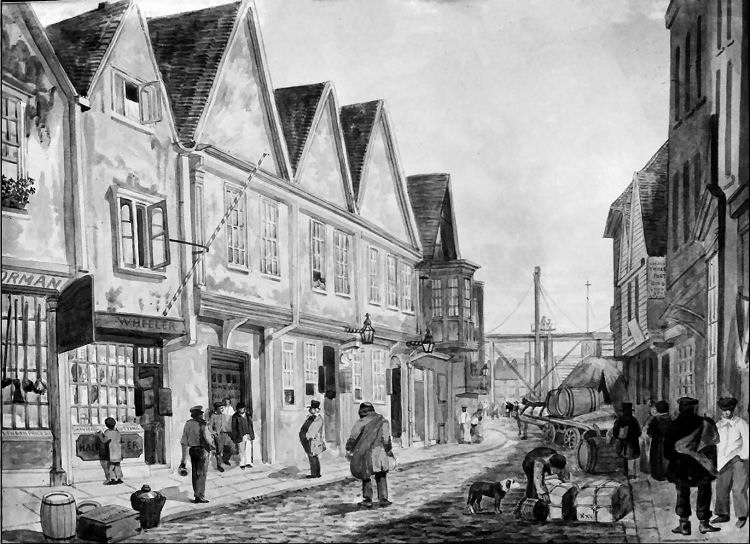
Above painting, 1855, from Medway Archives. Also showing the
"Three Post Boys" (right.) |
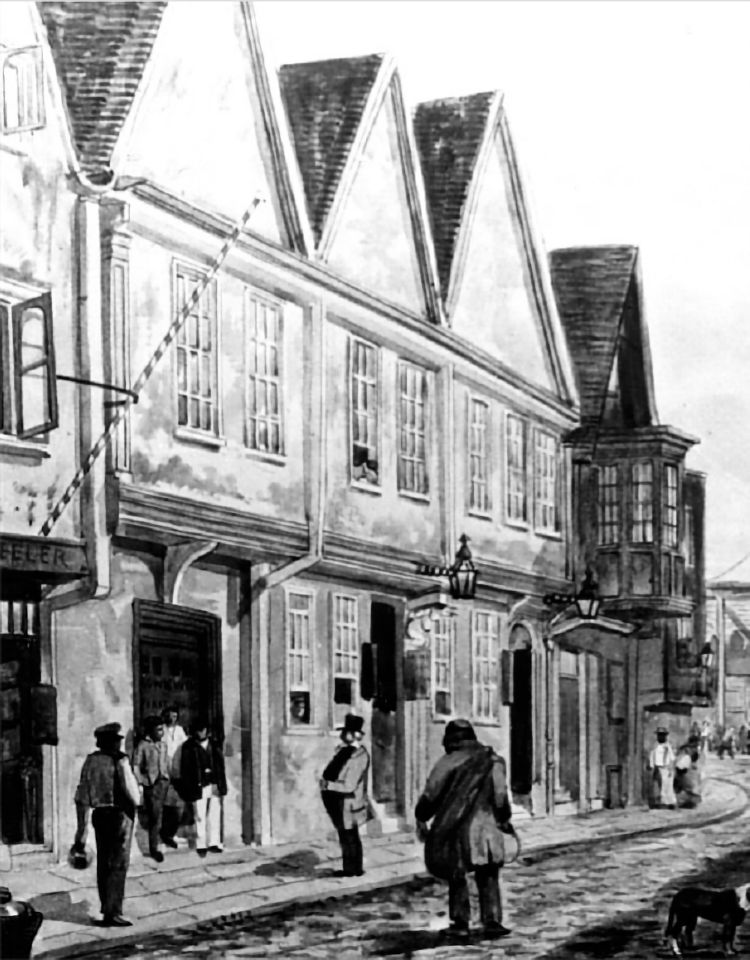
The Crown Inn in 1855, with the new bridge under construction in the
distance (detail from a photograph in the Couchman collection, DE4
02/4/1, taken from a watercolour by John Wykeham Archer (1806-1864)
belonging to the Bridge Wardens).
The barbers shop on the left still exists (old No 214, new No 10).
The "Crown" (old No 215) and the buildings to the right of it (shop with
oriel window No 216, "City Arms"
No 217 just visible on the corner beyond) were all demolished.
My thanks to Dr James M. Gibson for information about this
watercolour. He points out to me that there is an almost identical
drawing in the British Museum (18 7 4,0314.470) -- one of a large number
of watercolours commissioned from Archer by William Twopeny (1797-1873)
and bought by the museum from Twopeny's executor, his elder brother
Edward Twopeny (1794/5-1892), in 1874 (Binyon 1898:32). |
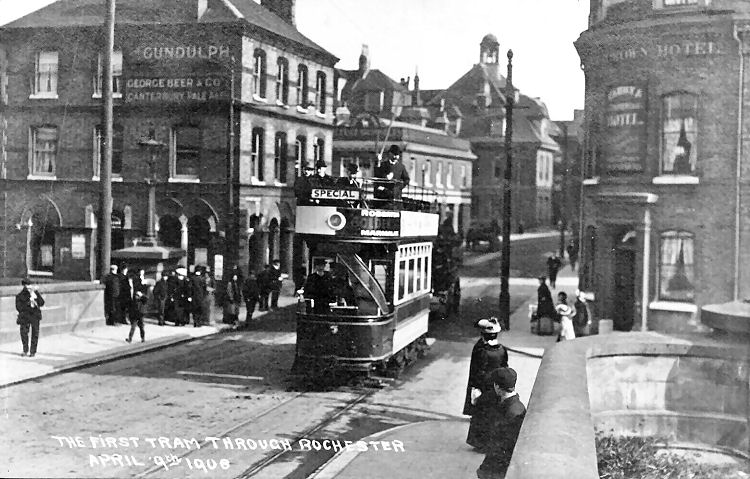
Above postcard showing the first tram through Rochester, 9 April, 1909,
also showing the "Gundulph"
(left,) kindly sent by Debi Birkin. |

Above photo, 1931. "Decorating one of the lamps in Rochester in
preparation for the great historical pageant. |

Above photo, April 1983. |
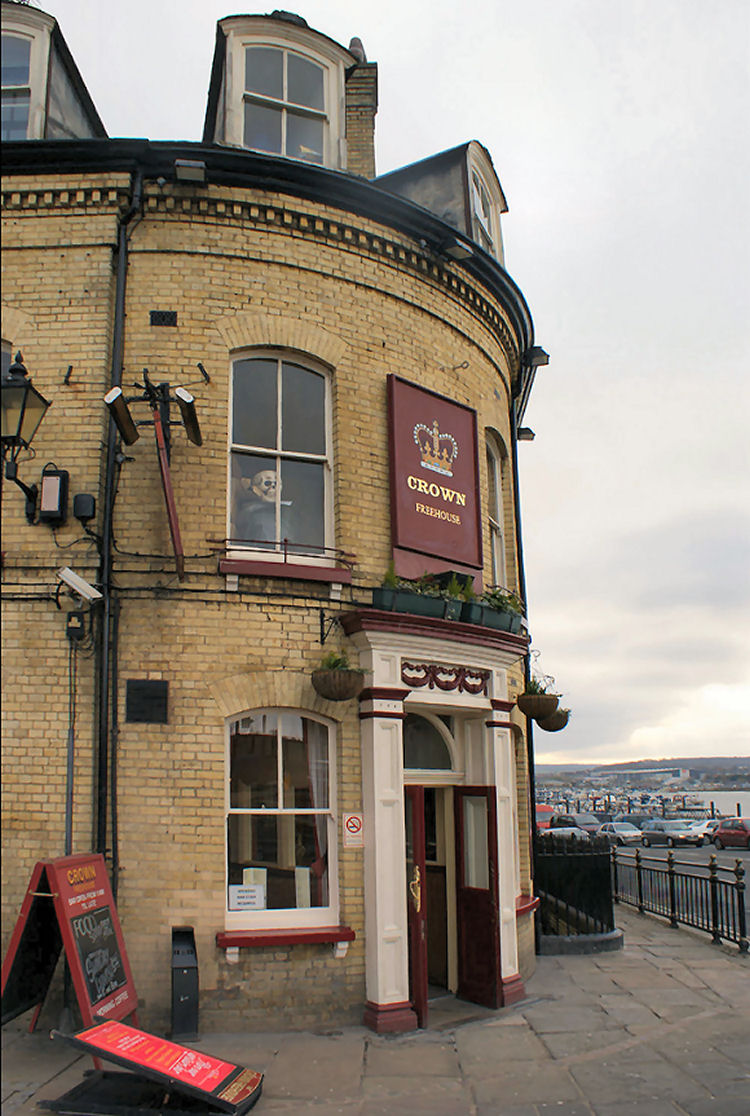
Photos taken on 28 February, 2013 from
http://www.flickr.com
by Dave Dunmall. |
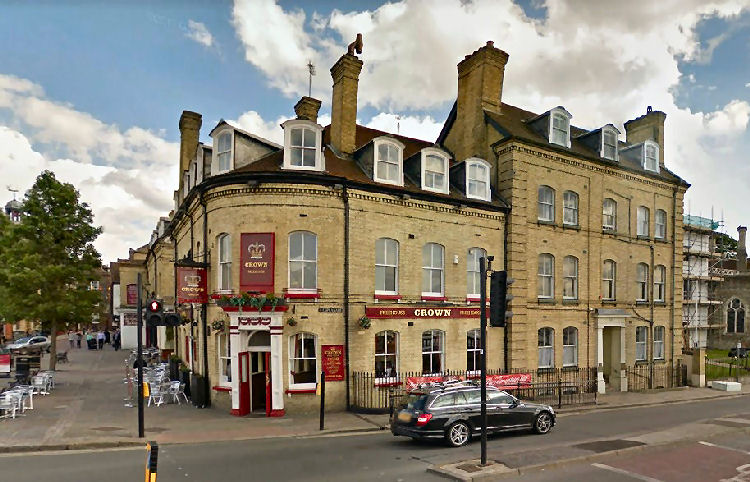
Above photo 2018, kindly sent by Debi Birkin. |
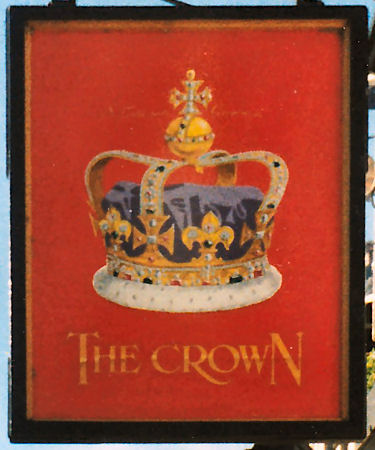 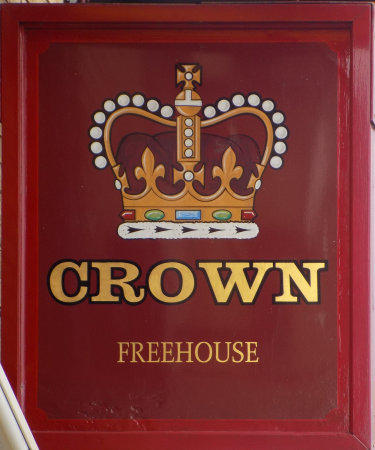
Above sign left, November 1986, sign right 2019.
With thanks from Brian Curtis and Roger Pester
www.innsignsociety.com. |
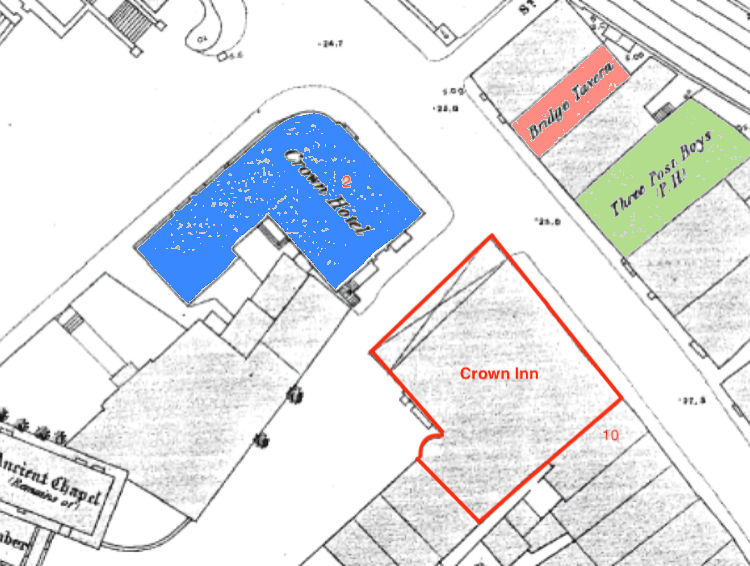
The 1:500 map was surveyed in 1861-3. It shows the "Royal
Crown Hotel" (new No 2) already in place (partly on the site of the
"City Arms,") and it also shows
the outline of the old "Crown Inn," not yet quite effaced. |
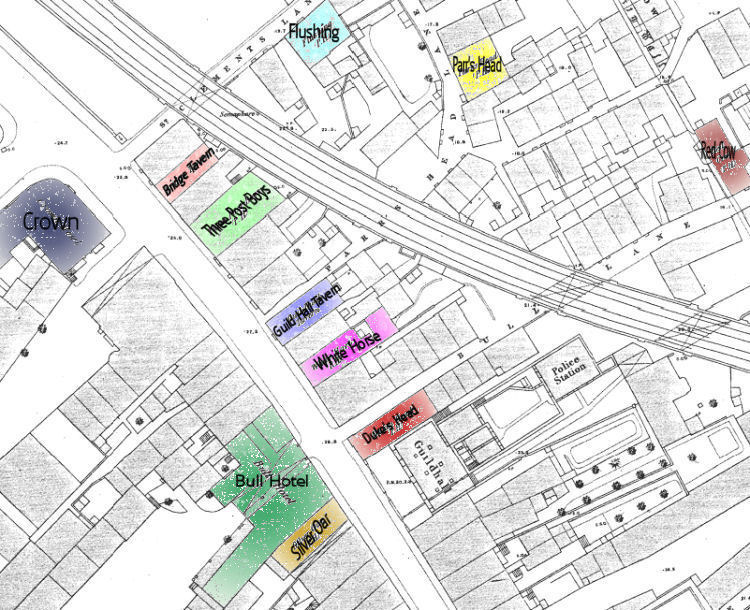
Identified on the 1866 map above as the dark blue building left. |
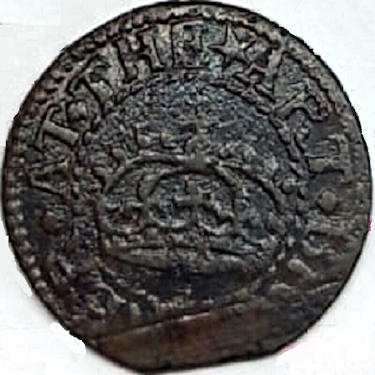 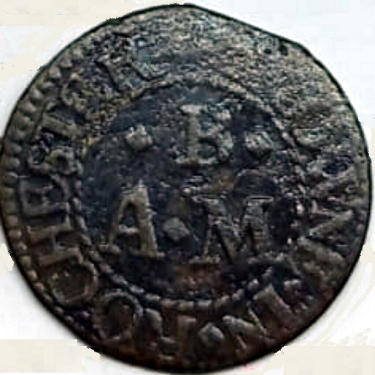
Above coins 1675, kindly sent by Rory Kehoe. |

Above drawing pre 1899. Photo circa 2024.
A crude sketch by the Historian, Edwin Harris, of The Crown Tap and
the archway over HorseWash Lane. The sketch is earlier than 1899 as it
does not feature the South Eastern Railway's arch behind it. The railway
line featured in the sketch, the London Chatham & Dover Railway used the
centre of the three bridges (now taking traffic from Strood to
Rochester). The "Crown Tap" would today be in the middle of the road in
the photo (right). Just beyond the archway in the sketch and to the
right was the infamous "Flushing
Tavern," today this would be were the brickwork begins in the photo.
For orientation both of these views are from immediately outside the
"Royal
Crown," Rochester. |
The "Crown Inn and Family Hotel," to give it its full name was a Posting
House in the High Street.
The "Crown," or its predecessor, was where Henry VIII came in secret, to
get a sneak preview of his intended fourth bride, Anne of Cleves. Bluff King
Hal's opinions of his Flanders Mare are well recorded, but those of the
landlord at the "Crown," regrettably, are not. Which is a pity, as ‘mine
host's' views in the 1980s on almost any subject are always worth lending an
ear to so says Michael David Mirams in his book "Kent Inns and Inn Signs."
From between the 1980s and around the turn of the century, the pub became
the "Norman
Conquest" but has now reverted back to the "Crown" again.
|
From the Diary of Samuel Pepys. Monday 25 September 1665.
We went to the Crowne Inne, at Rochester, and there to supper, and
made ourselves merry with our poor fisher-boy, who told us he had not
been in a bed in the whole seven years since he came to ‘prentice, and
hath two or three more years to serve.
|
|
Kentish Gazette, 9 August, 1783.
On Thursday morning died at Mrs. Fairmarsh in this city, where she
had been on a visit a few days. Mrs. Bayley, of the "Crown" at
Rochester.
|
|
Kentish Gazette, 23 March, 1792.
"Bull Inn," Rochester.
Hester Heath and Son leave to acquaint the public, that in
rebuilding their house (lately destroyed by fire) the
greatest regards has been paid so to arrange the apartments as to
render it most conveniently adapted to the
accommodation of families, and fitted in a style of neatness that
they trust will be much appreciated.
They most respectfully hope they may mentioned to the Gentlemen of
the County, that Mr. Ayres, of the "Crown
Inn," has let his house, and solicits a portion of that patronage he
so long enjoyed; and are, with the utmost
gratitude and respect, the public's most obedient humble servants.
Hester and Matthew Heath.
|
|
Kentish Gazette, 23 March, 1792.
"Crown Inn," Rochester.
Thomas Cornwall, "many years Butler to Mr. John Sawbridge Esq.) Begs
permission to inform the Nobility,
Gentry, and the Public in general, that he has taken the "Crown
Inn," of Mr. Ayres, of Rochester, and enters
upon it in a few weeks; when he humbly hopes for the favour and
protection of his friends and the public in
general; and they may depend that no care or attention shall be
wanted to give satisfaction to every person that
will do him the honour to use his house.
The flattering reception he met with at Maidstone, when he had the
honour to wait on the Gentleman of the
Grand Jury, gives him the greatest hopes of success.
|
|
From the Maidstone Journal, 3 April 1792.
"Crown Inn," Rochester.
Thomas Cornwell, many years Butler to John Sawbridge, Esq. Begs permission to
inform the Nobility, Gentry, and the Public in general, that he has taken the
"Crown Inn," of Mr. Ayres, of Rochester, and enters soon it in a few weeks; when
he humbly hopes for the favours and protection of his friends in the public in
general; and they made depends that no care or attention shall we wanted to give
satisfaction to every person that will do him the Honour to use his house.
The flattering reception he met with at Maidstone, when he had the Honour to
wait on the Gentleman of the Grand Jury, gives him the greatest hope of success.
|
|
From the Maidstone Journal, 15 May 1792.
Thomas Ayers, late of the "Crown Inn," Rochester, cannot omit embracing the
earliest opportunities for offering lodgings, with the greatest gratitude, how
much he finds himself indebted to the Nobility and Gentry who have for a series
of years honored him with their favours. He begs leave to return them his most
sincere and grateful thanks, and respectfully informs them he has resigned the
business in favour of Mr. Thomas Cornwell.
Rochester, May 9, 1792.
"Crown Inn," Rochester.
Thomas Cornwell, many years Butler to John Sawbridge, Esq. Thanks permission to
inform them nobility and Gentry, and the public in general, that he has taken
the Crown in off Mr. Ayers, of Rochester, and amply hopes for the favour and
protection of his friends, and the public in general; and they may depend that
no care or attention will be wanting to give satisfaction to every person who
wishes to him the Honor and use his house, which it will be his humble duty to
render, by every possible improvement; and further begs leave to add, that he
shall continue to have the cellar supplied with wines of the first class.
Neat Post Chaises, with able Horses, and careful drivers.
Rochester, May 9, 1792.
|
|
From the Maidstone Journal, 30 July 1793.
On Friday morning about 2 o'clock, a fire broke out in the stables of Messers
Cornwell and Smith, the "Crown Inn," Rochester, but which with timely
assistance, and the exertion of the neighbours, was happily extinguished,
without doing much damage. Some horses were hurt by the fire before they could
be got out.
|
|
Kentish Gazette - Tuesday 29 October 1793.
Crown Inn, Rochester.
Cornwell and Smith respectfully beg leave to return the most grateful
acknowledgments to the Nobility Gentry, and Public in general, for the
very great indulgence they have experienced during the time the stables
have been under repair.
They are happy to inform them that they are now finished with large and
convenience stalls, equal to any on the road; and have laid in a large
quantity of hay and corn, of the very best quality. They also beg leave
to observe, they have been particular attentive to the accommodation of
the public in procuring the oldest and best wines of the first vintages,
and take the liberty of assuring them, that every care, attention and
assiduity, will be united in them to merit the continuance of those
favours they have so liberally experienced.
|
|
From the Maidstone Journal, 19 August 1794.
Thursday, August 14.
Trial of T. Purefoy, Esq.
The prisoner stood arraigned for Murder in the usual form:- That's not having
the fear of God before his eyes, he had fired a pistol at Henry Roper, Esq. on
the 21st of December, 1788, in the parish of Gillingham. The ball from the said
pistol having entered the right side of the said Henry Roper, Esq. which
occasioned his death, &c. &c.
The indictment being red and the jury empanelled and sworn, Mr. Fielding briefly
opened the case, as stated in the indictment.
Mr. Garrow entered on a detail of the leading circumstances, in a manner which
did honour to his candour without subtracting from his impression on the
auditory. He entered, he said, with a painful degree of solicitude on a business
so awful and important in its results, to the individual who was concerned, and
to the public. However unpleasant his sensations on this occasion, he could not
compromise his duty. He could not view the transaction on which the Jury were
now called on to decide, in any shadeless deep then that of positive murder. It
was the obvious offspring of express malice; but, instead of giving his own
opinions on this subject, he would content himself with quoting those of that
elegant and scientific expounder of the Law, Mr. Justice Blackstone.
This malice propense takes in the case of the deliberate duelling, where both
parties meet avowedly with an intent to murder; thinking it their duty, as
Gentleman, and claiming it as their right, to wanton with their own lives and
those of their fellow creatures; without any warrants or authority from any
power either divine or human, but in direct contradiction to the laws both of
God and Man; and therefore the law has justly fixed the crime and punishment of
murder on them, and on their fellow beings. Yet it requires such a degree of
passive valour to combat the dread of even undeserved contempt, arising from the
false potions of honour, too generally received in Europe, that the strongest
prohibitions and penalties of the law will never be entirely effectual to
eradicate this unhappy custom; till the method be found out of compelling the
original aggressor to make some other satisfaction to the affronted party, which
the world shall esteem equally reputable, as that which is now given at the
hazard of life unfortunate, as well of the person insulted, as of him who has
given the insult.
The Jury must decide on this case according to the Law. In its application to
the facts, they might implicitly rely on the instructions of the Judge, Mr.
Barron Hotham, whose learning and humanity were equally conspicuous. They may
also console themselves in case of error, by the certainty that this application
would of course be made to that Fountain of Mercy, where an appeal on just
grounds was never yet made in vain!
The dual between Colonel Roper and Mr. Purefoy took place on the 21st of
December 1788. The interval which had occurred between the time and the present
prosecution, was not a signable to the prosecutors, as Mr. Purefoy had for the
greater part of the time being able to the kingdom.
It was not, as it would appear in evidence, a sudden recontry, but a dual
inconsequence of an agreement previously made, and under circumstances, which,
according to the authority which he had quoted, fixed the guilt of murder on the
supervisor. It was also material to consider, that the conduct of the
unfortunate gentleman at the bar was such, as if not legally punished, precluded
all idea of due discipline and subordination in the Army.
He proceeded to give in detail the circumstances of the quarrel from its origin.
In the year 1787, Major Roper was Commander in Chief of that island of Saint
Vincent's, and Mr. Purefoy was an Ensign in the 66th regiment. The latter having
obtain leave of absence, had a festive day, with some others of the junior
Officer, in which they committed such successes as occasions a complaint to
Major Roper, by whom the leave of absence was recalled. The remonstrance's of Mr.
Purefoy were made in such a style as to induce Major Roper to bring him to a
Court-Martial. By their verdict he was declared to have forfeited his
Commission, and this verdict was afterwards confirmed by his Majesty. This
sentence was difficult on undoubtedly to be borne, as breaking in on all the
pursuits of a young and ardent mind. Yet it was still the duty of Mr. Purefoy to
have submitted.
Mr. Garrow entered into a difficult narrative, which, as the circumstances were
more precisely stated in the evidence, we forbear to follow. He admitted in the
last instance, the challenge had proceeded from Major Roper, and that in the
dual which took place, no foul practice could be alleged, as everything had been
conducted in the fairest and most honourable Manner.
John Rudd, a post boy, was the first witness called on the part of the
prosecution. He lived in the 1788 at the "Crown" at Rochester. Driving on the
21st of December from Sittingbourne o hat place, he saw four gentlemen get into
a turnip field; one of these fired a pistol at an opponent, who immediately
fell; the others helped him to his carriage, and soon after two of the gentlemen
got into a chaise and four, and drove off hastily towards Sittingbourne.
This witness, on his cross examination, appeared not to know the person of Mr.
Purefoy.
John Cresy, the post-boy who drove Mr. Purefoy and his friend, on the 21st of
December, said, that at nine o'clock in the morning they were overtaken by
another carriage, from which a gentleman and alighted, and spoke to the
gentleman in his chaise. He followed their carriage, and afterwards got before
it. They afterwards stopped together, and the gentleman in his chaise got out,
taking with them a small square box. This was about three miles and a half from
Chatham. In a short time he heard the report of a pistol, and soon saw three
gentlemen supported one, and putting him into his carriage. The two whom he had
driven, got into his chaise, and desired him to make the best of his way to
Sittingbourne.
Mr. Vincent Wood, an Army Surgeon, said he resided at Chatham at the time,. He
breakfasted that morning with Colonel Roper, when he knew by sight, colonel
Slaughter, now General Stanwix, and a Mr. Brand, relation to the former. They
drove off in two carriages on the Canterbury Road. He and Mr. Brand went only as
far as the "Star" public house. The others, after speaking to two gentlemen in a
chaise, went forward. In six or seven minutes he heard the report of a pistol.
On proceeding in the direction of the report, he met Colonel Roper's servant,
and soon after found him supported by Mr. Purefoy and two other gentlemen. He
had then received a wound in his right side from a pistol ball, which had broken
his sixth rib, and lodged under his shoulder blade. His eyes were then
convulsed, and he had lost his extremities. He had no doubt but that the wound
thus received was the occasion of his death. He died in 14 hours after.
Two witnesses were then called, to lay a foundation for reading as evidence that
depositions before the Corona, of ----- Wimble, Colonel Roper's servant, since
dead. The one proved his handwriting, and the other his deceased. Mr. Williams,
the Coroner proved his signature to the deposition.
Mr. Garrow quoted several presidents, to show that a deposition before the
Coroner, taken super visum corporis, (view of the body) under such circumstances, was good evidence
- such documents were always allowed where the informant was dead, and in many
instances when he was unable to travel.
Mr. Erskine said, that though the deposition was immaterial, he should accept to
the proceeding, as one which, whatever may be the ancient presidents, had never
been adopted even recent practice. It did not appear that Wimble, whose decease
have been proved, was the identical servant of Colonel Roper. If ever the proof
of identity was necessary, it was in a charged like the present. The charge was
greatly serious, though it different widely from the sole crime of murder, from
which every sensate bosom must shrink with the utmost abhorrence. That crime,
which was well defined in the ancient law - Homiciaium quod nullo vidente, nullo
sciente, clam perpetrator. (A murder that no one sees,
no one knows, a secret perpetrator.) "A homicide, committed privately, out of the fight
and knowledge of every human being.
"I feel, said Mr. Erskine, in pursuing this arguments, and extreme degree of
agitation, though I fear no danger for my client. I cannot but remember, that
twice I have been forced into a similar situation with him, and twice have I
been rescued only by the interventions of that Providence.
"Without whose seeing not a sparrow falls.
"The ball, in both cases, was aimed by man, but directed by the Almighty.
Without that intervention, instead of my giving protection to the unfortunate
gentleman at the bar, it must have fallen to some of my brethren near me, to
have told the tale of my criminality!
"But if forced into such a situation, must I be accused of that malignity which
constitutes the foul crime of murder? No! I would not rely on the mildness of
the Judge, or the humanity of the Jury:- If any man who heard me, could
pronounce me guilty of such malignity, I would demand to be led to instant
execution!
Mr. Barron Hotham, after some further argument, decided, that the deposition
should be read in evidence; and that how far the identity of Wimble was
determined, should be left as a question to the Jury.
The deposition, when read, added but little to that what was sworn by the two
first witnesses. It stated, that the parties having got out of their chaises,
Mr. Purefoy pulled off his hat, and put on his spectacles. They stood at the
distance of 12 or 13 paces. Mr. Purefoy fired, and his master fell. The former,
who had not fired his pistol, previously spoke a few words to Colonel Slaughter
(General Stanwix) and his arm, which was then extended, immediately fell. Both
parties took aim at the same time. The other Gentleman assisted his master to
his carriage; who died on the ensuing day, without making any declaration in the
interval.
General Stanwix (the second to Colonel Roper in this art unfortunate affair) was
then called. After being sworn, he was cautioned by the Chief Baron, not to
answer any questions which might tend to criminate himself.
To the first question he replied, that he knew the late Colonel Roper, and he
saw him last at the "Star" public house on the Canterbury Road. That he was then
on the eve of expiring, in consequence of a pistol shot. That's on the
proceeding Saturday he was in good health.
Mr. Garrow then proceeded to put this pointed question whether he knew from what
hand Colonel Roper had received his death wound? and to desire him, if he knew,
to state it to the Court. The witness declined an answer to the question.
Mr. Baron Hotham was of opinion, that the answer to the question could not tend
to implicate the witness. If the Council for the Crown went further, it was
still in his power to decline an answer.
To the question, "from what hand Mr. Roper received his death wound?" General
Stanwix then answered, "from that of Mr. Purefoy. - He proceeded to state that
the latter showed all the anxiety and humanity that was possible on such an
occasion. The meeting of the parties was certainly not accidental. Mr. Purefoy
had his spectacles on when he left the chaise,. He recollected that he did not
put them on after entering the field, because he asked Colonel Roper whether Mr.
Purefoy always used glasses, when the other replied, "Yes, he is almost blind."
The prisoner at the bar had never broken his ground. He presented his pistol in
the fair and common mode. His conduct disclosed nothing like malignity. It was
proper, manly, and humane.
Major Castle, Captain Gabbote and Captain Barwell were called, to prove the
previous transactions to the in the West Indies. They stated, that when a paper,
which was not before the Court, was read on the parade, the prisoner told
Colonel Roper, that he was a coward and a scoundrel.- He was not then an
officer, as his function ceased with the reading of that paper. He, on the same
day, met Colonel Roper, on horseback, asked him whether he would meet him, and
on the refusal of the latter, shook his whip at him, and desired him, "to take
that for a flogging." They admitted at the same time that the prisoner was under
age, and through the whole of the business was violently agitated.
Some letters from Mr. Purefoy which breathed the same angry spirit, were read;
and several Masters and Waiters at Coffee houses were called, who proved that
Mr. Purefoy had posted Colonel Roper on his arrival in England. Here the
evidence for the prosecution closed.
The Prisoner being called on for his defence, said in a brief address that he
felt too deeply agitated to enter on the subject. He entertained no malice
against the deceased. He felt not the asperity of revenge. When Colonel Roper
fell, he had to lament that he himself had not fallen. It would have spared him
the agony which he no felt, and which would follow him to the last moment of his
existence. He was led by a call of honour, or more properly speaking, driven by
the tyranny of custom to an act, which in early life had embittered his
existance, but without which, he was taught to believe, that he should lose all
the consolations which society could afford him.
Many false reports had been circulated against him, but these the evidence of
general Stanwix, he was happy to find, had completely gone done away. Far from
priding himself on any superiority of weapon, he had offered Colonel Roper his
choice, and far from feeling any malignity, he had written to his family to
desire, that if was his lot to fall, no prosecution should take place. The late
challenge, he observed had come from Colonel Roper; and as some expiration for
his offence, he had already suffered nearly seven years of exile, and nine
months of close confinement.
[The latter part of this address was read from written paper by Mr. Erskine; the
feelings of Mr. Purefoy being such as to overpower his utterance.]
The Prisoner called nine most respectable gentlemen to bear testimony to his
character, most of whom had known him from early life. They all spoke to the
general mildness of his character, and the good humoured ease and aversion to
quarrel, which marked his general deportment
Mr. Baron Hotham, in a charge which did equal honour to his justice and
sensibility, went through the evidence with suitable comments on the several
particulars. - In his concluding address to the jury, his Lordship said, - It is
now a painful duty which jointly belongs to us; - It is mine to lay down the
law, and apply it to the facts before you. The oath by which I am bound obliges
me to say, that homicide, after a due interval left for consideration, amounts
to murder. The Laws of England in their utmost lenity and allows for human
frailty, extend their compassion only to sudden a momentary frays, and then, if
the blood has not had time to cool, or the reason to return, the result is
termed Manslaughter. Such as the Law of the Land, which undoubtedly the
unfortunate gentleman at the bar has violated, though he has acted in conformity
to the Laws of Honour. His whole demeanor in the dual, according to the witness,
whom you are most to believe, General Stanwix, was that of perfect honour and
perfect humanity.
Such as the law and such are the facts; if you cannot reconcile the latter to
your consciousness, you must return a verdict of Guilty. But if the contrary,
through the acquittal may trench on the rigid rules of Law, yet the verdict will
be lovely in the fight both of God and Man.
The Jury, without hesitation, returned their verdict. - Not Guilty.
|
|
From the Maidstone Journal, 15 March 1796.
Kent. To Brewers and Distillers.
Valuable Leaseholders Estates, at the Blue Houses, Sheerness, in the parish of
Minster, in the Isle of Sheppey, in the county of Kent, late belonging to Thomas
Monday, a bankrupt.
To be Sold by Auction, by Mr. Charles Turner.
At the "Crown Inn," Rochester, on Tuesday, April 12, 1796. between the hours of
12 and 2 o'clock in the afternoon, in two lots, subject to such conditions as
will be then and they're produced.
Lot 1:- Consists of eight substantial well built brick dwelling houses, with the
appurtenances thereunto belonging, situate near the upper part of the Blue
Houses, Sheerness, now let in at rent amounting to £57 4 shilling per annum;
subject to an annual ground rent of £2 10 shillings.
Lot 2:- Consists of a large, substantial, well built brick dwelling house, known
by the name or sign of the "Checkers," or "Royal Arch" Public House, situate in
the best part of the Blue Houses for trade, late in the occupation of Mr.
Monday, with 12 substantial, well built brick tenements behind the Public House,
together of the annual value of £100; subject to a ground rent of ten shillings
per year.
The above estates are held by lease for 99 years, or three lives, renewable,
upon failure of each life, upon paying a fine of seven pounds.
The Public House is a house of considerable trade for beer, spirits, &c. and
well worth the attention of any brewer or distiller.
For further particulars apply to Mr. Prall, Attorney, or the Auctioneer,
Rochester; or Mr. Burr, Attorney, Maidstone.
|
|
From the Maidstone Journal, 24 May 1796.
Died.
Thursday last night at Frindsbury, Mr. Thomas Ayers, late master of the "Crown
Inn," Rochester.
|
|
From the Maidstone Journal, 29 March 1803.
Monday morning, was married at Rochester, Mr. John Dadds, farmer, of Wingham
Parsonage, to Miss Cornwall, daughter of Mr. Cornwall, of the "Crown Inn,"
Rochester.
|
|
From the Maidstone Journal, 8 May 1804.
Messrs. Thomas Cornwell and John Smith, late of the "Crown Inn, Rochester, beg
leave to return their sincere thanks to the nobility, gentry, and the public in
general, for the very sincere countenance and support they have received for
these 12 years past, and to assure them that those favours are most gratefully
acknowledged.
Messers. Cornwall and Smith, in the same time humbly solicit the favours of
their employers and the public in general, in behalf of their successor in the
above line, Mr. William Wright, whom they have no doubt will, by his assiduity
and attention, merit their future patronage and support.
Rochester, May 3, 1804.
"Crown Inn," Rochester. William Wright, (Successor to Messers. Cornwall and
Smith, begs leave to inform the Nobility, Gentry, and the Public in general,
that he has taken the above old established house, where he most greatly
solicits their favours, and from unremitting attention, flatters himself he
shall meet with that patronage and support which the house has for many years
experienced, and which will be his anxious study at all times to merit.
Wines, &c of the first quality.
N.B. Neat Post Chaises with able Horses.
|
|
Kentish Gazette, 8 May, 1804.
MESSRS. THOMAS CORNEWELL and JOHN SMITH, late of the "Crown Inn,"
Rochester, beg leave to return their sincere thanks to the Nobility,
Gentry, and the Public in general, for the very liberal countenance
and support they have received for these twelve years past, and to
assure them that those favours are most gratefully acknowledged.
Messrs. Cornwell and Smith, at the same time, humbly solicit the
favours of their employers, and the public in general, in behalf of
their successor in the above Inn, Mr. WILLIAM WRIGHT, whom they have
no doubt will, by his assiduity and attention, merit their future
patronage and support.
Rochester, May 1st, 1804.
CROWN INN, ROCHESTER.
WILLIAM WRIGHT, (Successor to Mess. Cornwell and Smith) BEGS leave
to inform the Nobility Gentry, and the public in general, that he
has taken the above old established house, where he most earnestly
solicits their favours; and from unremitting attention, flatters
himself he shall meet with that patronage and support which this
house has for many years experienced, and which will be his anxious
study at all times to merit.
Wines, &c. of the first Quality.
N.B. Neat Post Chaise with able Horses.
|
|
Kentish Gazette, 11 May, 1804.
NOTICE is hereby given,
THAT the Partnership between us the undersigned, Thomas Cornwell and
John Smith, of the "Crown Inn," Rochester, in the county of Kent,
Innholders, carried on under the firm of Cornwell and Smith, was
this day dissolved by mutual consent. All debts due to the said
partnership concern are requested to be paid to Mr. Robert Dunkin,
of the Stamp-Office, in Rochester, by whom all demands upon the same
will he settled, as witness our hands, this 1st day of May, 1804.
THOMAS CORNWELL. JOHN SMITH.
Witness, R. Winter.
|
|
Kentish Gazette, 28 November, 1804.
Tuesday se'nnight as Thomas Wells, late post boy belonging to the
"Crown Inn," at Rochester, was shooting on the banks of the Medway
towards Maidstone's a flight of eight wild swans passed over him,
which he fired at and brought down three; he regaled acquaintance
with a supper of the fowls, and said, sold their skins, one for two
guineas, and the bother for more than £10.
|
|
Kentish Weekly Post or Canterbury Journal 19 February 1808.
DIED.
Thursday, Feb. 18, at Wingham, Mr. Thomas Cornwell, late of the "Crown
Inn," Rochester, aged 62.
|
|
From the Maidstone Gazette and West Kent Courier, 11 September, 1827.
Tolls to let.
Notice is hereby given, that the tolls payable at the Tollgates near the
"Angel Inn," in Strood, and on the New Road, leading from Rochester to
Chatham Hill, in the county of Kent, will separately be let to farm, to
the best bidders, for the term of 2 years, from the 30th day of
November, 1827, at the house of Mr. William Wright, called the "Crown
Inn," in Rochester, aforesaid, on Tuesday, 9th day of October next,
between the hours of 11 in the forenoon and 1 in the afternoon.
No person will be permitted to advance less than £5 at each bidding, and
whoever happens to be the best bidder, must, at the same time, give
security with sufficient sureties to the satisfaction of the
Commissioners of the said Tollgates for Payment of the Rent agreed for
by Quarterly Payments in Advance. The highest bidders will be required
to pay, at the time of the Letting, One Half part of the first quarters
rent and the remainder before the said 30th day of November. The present
Yearly Rent of the Tolls at Strood is £1,185, and of the Tolls at the
New Road £195.
By order of the Commissioners Edward Twopeny, Clerk.
Rochester 3rd August. 1827.
|
|
From the Kent Herald, 19 June 1828.
On Saturday last George Spendiff, about 18 years of age, a post boy in the
employee of Mr. Wright, of the "Crown Hotel," Rochester, having returned from
Dartford with a pair of horses, proceeded to the river near the Mill at Strood,
for the purpose of washing them, when, venturing too far out both horses were by
the strength of the current carried through the bridge, and, that on which he
rode becoming exhausted turned on its back, and is opposed in its struggles to
have kicked its rider, who sank almost immediately, and the body has not yet
been found. This horse was dragged to the shore by some people in a boat, and
both were saved. The unfortunate youth who has thus lost his life, hade been
there but a few days, having come from Ospringe, where his friends reside.
|
From the Kent Herald, 7
March 1833.
Death.
March 2, Susanna, widow of Mr. John Smith, formerly of the "Crown Inn," Rochester, age 81 years.
|
|
From the Kentish Gazette, 28 August 1838.
Disturbance at Rochester.
The quiet neighbourhood of Rochester was on Thursday disturbed by an
extraordinary riot and attempt on the part of a large mob of respectable
persons, composed principally of women, to execute summary vengeance on
a person named Willmett. It will be recollected that he was apprehended
some months ago for having intermarried with Miss Eliza Crisp, his
former wife, Hannah Hodgson, being alive. The defence set up was that
Hannah Hodgson was not his wife, though he had married her, because her
former husband was alive. This defence, it is said, has turned out to
have been supported by false evidence. On his acquittal he left
Maidstone in a carriage and four, with his first wife, and a girl named
Sophia Short. This Willmett used originally to live at Rochester, where
his father and he got into debt with the greater part of their
tradesmen, and took French leave of the place about five years ago. When
Willmett got out on a day rule from the Fleet he came down to Rochester
to renew his acquaintance with and marry Miss Crisp. The second wife
lives in Upper George-street, Portman-square. She, accompanied by
Willmett and his father, arrived at the
"Crown" on Thursday evening in a
hired carriage and four, ordering her dinner at eight o’clock, and in
the meantime Willmett and his father paraded up and down opposite Miss
Crisp’s house. In the interval a crowd collected, who began handling the
precious couple very unceremoniously, both of them being knocked down
and pelted with mud, struck over the head with sticks, their cloths torn
off, their watches and money stolen, and every insult possible heaped
upon them. A large number of old women assembled in Ironmonger-lane,
whither the crowd would have taken the Willmetts but for the
interference of the police, for the purpose of putting them into a
stagnant ditch. It ought before to have been mentioned that the
contusion was much heightened by the appearance of another alleged wife
of Willmett’s, who abused him very much, and still further added to the
fury of the mob. On arriving opposite the "Bull Hotel" they were nearly
torn away from the police, and Willmett managed to run up the Bull-yard,
where he was followed, and only escaped with his life by climbing over a
wall ten feet high. The old man was caught by the landlord of the
"Bull," and handed over to the police, the landlord requesting that he
might not be allowed to come there again. The landlord of the "Crown,"
where they were staying, ordered them off, and they were obliged to go
to Gravesend at twelve o'clock at night. Willmet has taken out Warrants
for the apprehension of numerous persons for assaulting him.
|
|
From an account regarding 28th August 1843. The maid and postillion of
the "Crown Inn" are witnesses at the arraignment of Richard Dadd (famous
artist) who had just committed the manslaughter of his father at Cobham
Park 28th August 1843:
"Eliza Coleman is chamber-maid at the "Crown Inn," at Rochester; has
been there six years. Monday night, the last night of Strood fair, I
remember a gentleman coming in to wash his hands I showed him into a room
up stairs, at about 10 o'clock; but did not take particular notice, he took
the candle off me, but did not speak; I did not observe his hands; he
remained up stairs a few minutes only, took the candle with him when he came
down; went immediately up stairs to empty the basin, but did not take
particular notice of the colour of the water; it was very dark, but could not
tell whether with blood or dirt. He came from the bedroom and got into
post-chaise, which he had ordered. I cannot say that the prisoner is the
same person. Mr. Calder saw him, and Charles Overy drove the chaise; I did
not miss anything. [Here the prisoner interrupted witness, exclaiming,
"I took one of your towels, I took it because it had blood on it. I tell you
I did not do it I never did it;" and after uttering several incoherent
sentences, said witness on, adding, "I won't be quiet," and looking towards
the door, said "Keep those people out I wish you would keep away."] Mr. C.
Lester said, about seven o'clock on Tuesday, 28th August last, I was
going to market, and saw a body lying in the park. I left the body in
the charge of the shepherd; saw Daws at Cobham, and told him it. I
observed a hat and stick lying on the grass. Charles postillion at the
"Crown Inn," Rochester, remembers hearing that Mr. Dadd was found in the Park; I
remember the night previous to his being found that I drove someone from
the "Crown Inn" chaise with a pair of horses, to the "George" at
Sittingbourne; I left Rochester about half-past 10.00. As was driving
down the street the prisoner said something, pulled up and asked him
what he said, he told me to drive very fast, as he was going to Dover. The
prisoner said "No; I told you to go at a good pace." Witness continued, "In
consequence of these directions, I drove quickly. I do not remember the
dress of the gentleman; he had a black hat and coat, but nothing over
the coat. When he paid me for the hire of the carriage he gave me 2s 6d.
over; I told him that was not enough, I ought to have 5s, it being so
late at night, and having driven fast; he then gave me sixpence, and then a
shilling, and asked what he should give the boy for the next stage. I
told him in answer to the question that he could not give the next postboy
less than 6s. Mr. Calder, landlord of the "Crown Inn," said that on the
28th of August a person came to the "Crown," whom I believe to be the
prisoner, his stature, although he is very much altered. When the bell
rang he went and asked him what his business was, he said he wanted a
chaise to go to Sittingbourne. [Prisoner here said "I took your towel and
threw it over the hedge a little past the "Star," because of the blood it.
I never did it I tell you I never did it." They did not proceed to a full trial since Richard Dadd lacked mental
capacity and was not responsible for his actions. He spent the rest of
his life at Bedlam and Broadmoor. |
|
Southeastern Gazette, 8 March 1853.
ROCHESTER QUARTER SESSIONS.
The quarter sessions for this city were held on Saturday last,
before the Recorder, J. 'Espinasac, Esq.
Emma Honess, 23, single woman, pleaded guilty to obtaining three
dresses and other goods, by false pretences, from Thomas Waghorn,
value £3 10s.
The prisoner had lived some time as chambermaid at the "Crown Inn,"
and subsequently used her mistress’s name to procure the articles in
question, some of which she gave away to a female friend.
The Recorder asked if anything was known of the prisoner, and on
being answered in the negative, sentenced the prisoner, who seemed
overwhelmed with shame, to five months' imprisonment, fourteen days
of which in solitary confinement.
|
|
Southeastern Gazette, 10 May 1853.
Saturday. (Before Alderman Clements and a full bench of
magistrates).
John James Sancto, landlord of the "Crown tap," was charged was
charged with assaulting Susannah Goodhall.
The defendant admitted the charge, but stated that he had taken the
girl, who was his niece, and had brought her up for the last seven
years. During that time he had had a deal of trouble with her on
account of the violence of her temper. The assault for which he was
now summoned was merely a beating he had given her with a stick, on
account of a silver knife which he suspected she had taken.
In answer to a question from the bench, the defendant said he was
quite willing to take her back again; the magistrates therefore
inflicted a nominal penalty of 1s. and costs.
|
|
Southeastern Gazette, 5 July 1853.
CITY PETTY SESSIONS.
Wednesday. (Before Capt. Burton, E. R. Coles, and W. Manclark, Esqrs).
Elizabeth Williams, a girl of the town, was charged with stealing a
watch, the property of Edward Meares.
The prisoner had been in company with the prosecutor since Sunday
night, and on Tuesday afternoon they were drinking together at the
"Crown tap," when the prisoner suddenly left the prosecutor, and
immediately after he missed his watch, which had been broken from
the guard. The watch was afterwards pawned at Mr. Blackwell’s shop
by prisoner.
Committed For trial.
|
|
From the Maidstone Telegraph, Rochester and Chatham Gazette, 23 November 1861.
Rochester and Chatham.
The wardens have decided on completing the approaches to Rochester
Bridge on the city side, which will necessitate the demolition of a
portion of the ancient "Crown Hotel," together with the "City Arms
Tavern," and the adjoining buildings. A large hotel is to be erected on
the present "Crown Inn."
|
|
South Eastern Gazette, 10 July, 1860.
IN AND NEAR ROCHESTER AND GRAVESEND, KENT.
Messrs. COBB ARE instructed to SELL by AUCTION, at the "Crown Inn,"
Rochester, on Tuesday, 24th July, 1860, at One o’clock, the
following Freehold Properties.
Lot 1. A FREEHOLD DWELLING-HOUSE, situate in Eastgate, Rochester,
containing 9 rooms, with good garden in the rear, for many years in
the occupation of Miss Balfour.
Lot 2. THREE FREEHOLD MESSUAGES or tenements, fronting the
High-street, Rochester, near the Free School, in the several
occupations of Mr. Lane, Miss Augustus, and Mr. Bayley, with good
garden in the rear in the occupation of Mr. Darby.
Lot 3. A valuable FREEHOLD PUBLIC-HOUSE, called the "Darnley Arms,"
in the village of Cobham near Gravesend, containing 2 parlours,
tap-room, kitchen, wash-house, 4 bed-rooms, 2 attics, with yard and
stabling, and cellars, in the occupation of Samuel John Gowar.
Lot 4. A PUBLIC-HOUSE, called the "Stone Horse," equal to freehold,
being held for an unexpired term of 1,000 years, situate in the
parish of Higham near Rochester, containing parlour, bar. kitchen,
washhouse, 4 bed-rooms, cellars, with small garden, in the
occupation of William Reynolds.
Lot. 5. A FREEHOLD DWELLING-HOUSE, situate at Milton next
Sittingbourne, containing 5 rooms, with blacksmith’s forge and
garden, in the occupation of John Marshall.
The 5 lots have been held for many years by Messrs. Meux and Co.,
under a lease which will determine at Michaelmas next, at a rental
of £152, and the respective undertenants have received notice to
quit at Michaelmas next.
Particulars, with conditions, may be had at the place of sale; of
Messrs. Fairfoot, Webb, and D’Aeth, Solicitors, 13, Clement’s Inn,
and of Messrs. Cobb, Surveyors and Land Agents, 26, Lincoln’s
Inn-fields, London, and Rochester.
|
|
From the Maidstone Telegraph, Rochester and Chatham Gazette, 2 November 1861.
The Annual Dinner of the Gravesend and Rochester Agricultural Society
took place on Wednesday last, at the "Crown Hotel," Rochester. About 100
gentlemen were present, and the chair was filled by T. H. Day, Esq. On
his rights sat the Mayor of Rochester, and on his left Lord Holmesdale,
M.P. for West Kent. The latter gentleman in his remarks, alluded to the
question of invasion as a reason why the army should not be reduced.
|
|
From the Southeastern Gazette, 29 May 1866.
From the Southeastern Gazette, 19 June 1866 Rochester.bmp"
LONDON, CHATHAM, AND DOVER RAILWAY MAIN LINE SURPLUS.
A FREEHOLD BEER ROUSE and a MESSUAGE, and Shop, High-Street, Rochester.
Messrs. VIGERS WILL SELL by AUCTION, at the “Crown Hotel,” Rochester,
Tuesday, June I2th, at Twelve for One o’clock, in one lot, by order of
the Directors.
The “OLD SHIP TAVERN,” No. 8, High-street, Rochester, let to Mr. Walters
on a weekly tenancy at a low rent amounting to £14 19s. per annum; also
a FREEHOLD MESSUAGE and SHOP, No. 7, High-street, Rochester, let to Mr.
Finch, on a yearly tenancy, at £26 per annum.
Particulars and conditions of sale may be had of Messrs. Freshfields and
Newman, Solicitors, Bank-buildings, Lothbury; at the “Crown Hotel,”
Rochester; the Estate Exchange, Change-alley, Cornhill; and of Messrs. Vigers, 3, Fredericks-place, Old Jewry, London.
|
|
From the
http://www.dailymail.co.uk By Alice Evans, 28 May 2017.
Cyclist is airlifted to hospital with serious head
injuries 'after a road rage row with a motorcyclist sparked when he
jumped a red light'.
A cyclist has suffered serious head injuries after an alleged road rage
argument with a motorcylist became violent, it has been reported.
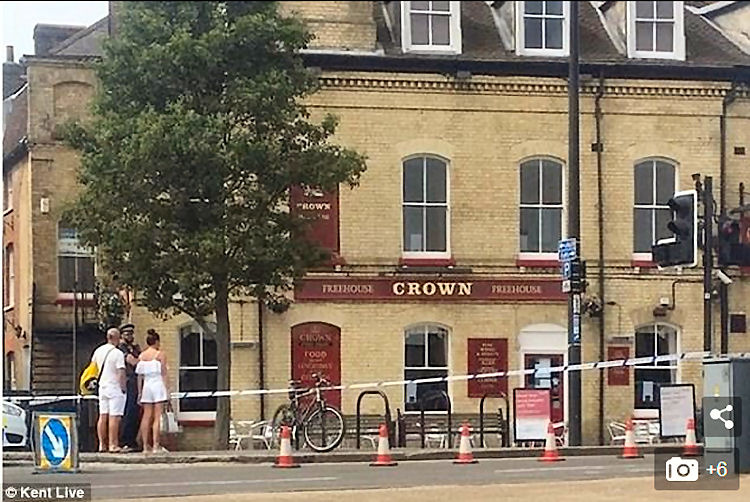
Four police cars were called out this morning and officers cordoned off
an area around the "Crown" pub in Rochester, Kent.
The cyclist, who has been airlifted to a London hospital, reportedly had
a fit after being assaulted on the busy dual carriageway.
An area outside the pub on Rochester High Street was cordoned off after
the alleged attack.
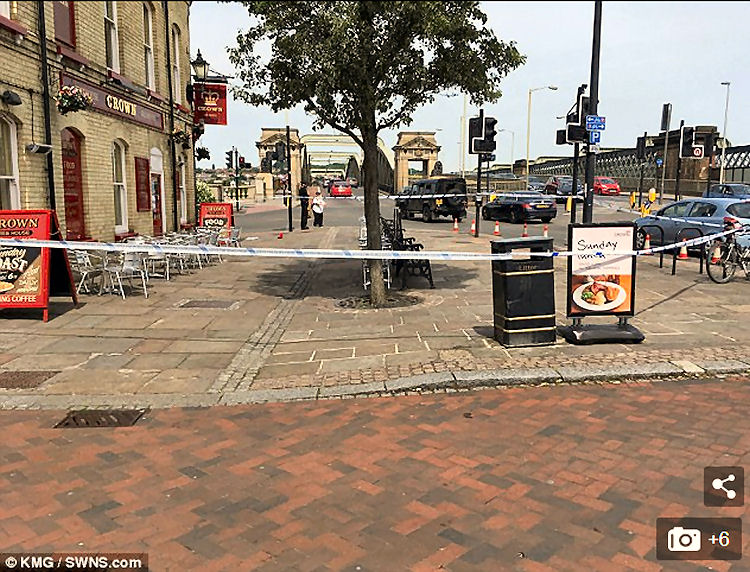
Detectives are now investigating the alleged bust-up, which happened
near the 103-year-old Rochester Bridge.
A police spokesman told MailOnline: 'Kent Police was called at 10.07am
on Sunday 28 May 2017 to a report of an assault in Rochester High
Street.
'It is believed there was an altercation between a motorcyclist and a
cyclist prior to the assault.
'Officers attended along with SECAMB (air ambulance) and the cyclist has
been flown to a London hospital with serious head injuries. Officers
remain at the scene at this time and enquiries are ongoing.'
It was reported that a man on a bike 'jumped a red light' before
allegedly being hit by a motorbike driver.
After the alleged attack the motorcyclist drove off while a member of
the public put the victim in the recovery position.
One witness, who did not wish to be named, told Kent Online that a male
cyclist jumped a red light before a motorcyclist dismounted and began
hitting him.
The witness said the victim then fell to the floor and had what appeared
to be a fit.
A member of the public put the victim into the recovery position but
witnesses said the motorcyclist drove off as a baseball cap and a
blood-stained item of clothing were left on the pavement.
The Crown Pub was open as usual as officers inspected the scene this
morning.
They tweeted: 'Open as usual! Incident outside is nothing to do with
pub.'
Officers are now understood to be examining CCTV footage of the area to
try and piece together what happened.
|
|
From the
https://www.kentonline.co.uk By Nicola Jordan, 29 October 2019.
Shepherd Neame buys Rochester's Crown pub.
A landmark town centre pub has been bought by Kent brewery Shepherd Neame.
The Crown is at the top of High Street, Rochester, looking out onto the
historic bridge and River Medway.
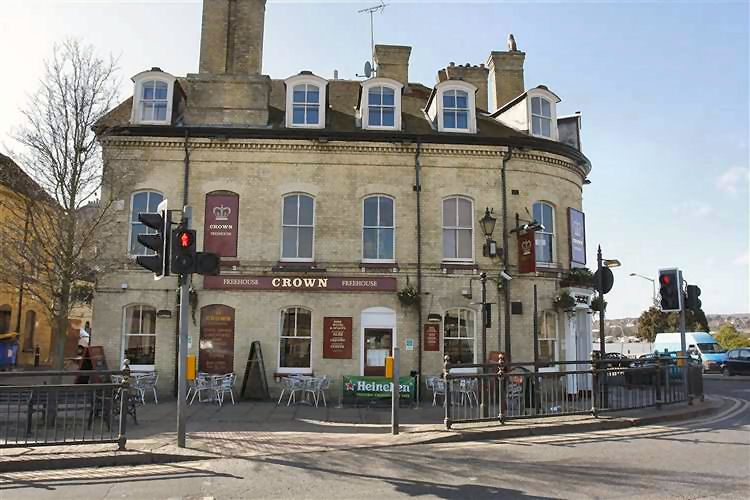
Crown Pub, Corporation Street, Rochester.
The present building dates back to the late 1700s.
It is not known at this stage what the Faversham-based brewery intends
to do with it or how much it paid.
But the guide price for the business was £1.1million.
For the past 20 years, father Steve Kray and his eldest son Pete have
been manning the pumps.
They firmly believe their hands-on teamwork has helped them survive a
series of challenges.

Steve and Pete Kray at The Crown in Rochester High Street. Picture: Chris
Davey. (12958306)
Steve, 58, has now retired and 35-year-old Pete, who started helping out
when he was 15, will continue to work at the pub as manager.
When Steve bought the pub, he closed it for six weeks for refurbishment
and reverted the name from the "Norman Conquest," adopted by the previous
owner, back to the "Crown" to be more in-keeping with the historic town.
The original pub on the site catered for royalty, including Elizabeth I
and King Charles V of Spain, before it was demolished.
Shepherd Neame's director of retail and tenanted operations, Nigel
Bunting, said: "We are always looking for opportunities to add
high-quality outlets to our estate.
"The Crown is a great pub in a fantastic location, and we are confident
it will prove a valuable addition to our portfolio.
"We look forward to working with Peter and the team to ensure The
Crown’s offer continues to go from strength to strength.”
Shepherd Neame, Britain's oldest brewer, has 323 pubs across London and
the south east.
|
|
From the
https://www.kentonline.co.uk By Sean McPolin, 27 June 2023.
The Crown in Rochester High Street set to change name and colours.
A historic town centre pub is set for a facelift, including a new name and new colours.
The Crown, at the top of the High Street in Rochester, will be ditching
its well-known shades of red for black and gold, if plans for a new look
are approved.
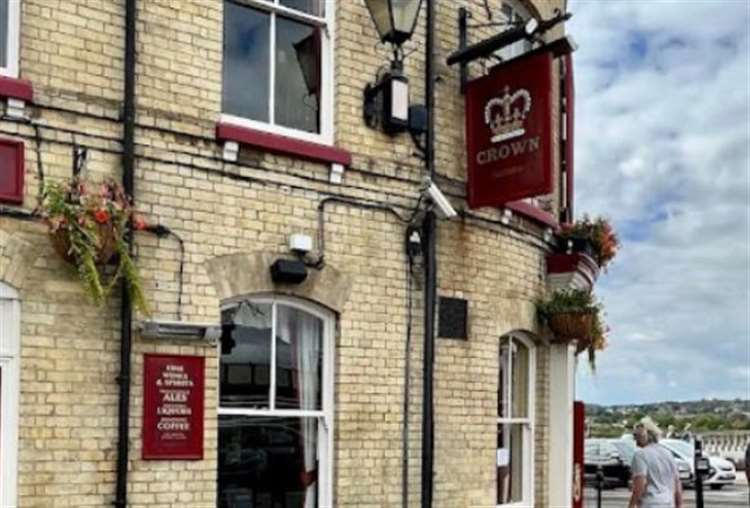
The Crown pub in High Street, Rochester, is set for a new look.
Planning documents for the boozer also reveal proposals to change its
name to The Royal Crown.
In 2019, the landmark pub by Rochester Bridge, whose building dates back
to the late 1700s, was bought by Kent brewery Shepherd Neame.
For two decades before the sale it was managed by the Krays – father
Steve and eldest son Pete – who spent £300,000 on a refurbishment.
The duo changed the name of the pub from Norman Conquest back to The
Crown.
In the 2014 Rochester and Strood by-election prompted by the the then
MP’s defection from the Conservatives to UKIP, the hostelry became the
centre of media attention.
Nigel Farage, leader of the UK Independence Party, made several visits
to the Towns to support his colleague and held press conferences outside
popping in for his favourite beer.
Reporters and TV crews converged on the town to cover the campaign – and
likewise banner-waving UKIP protestors aired their views.
Originally, the pub on the site catered for royalty, including Elizabeth
I and King Charles V of Spain, before it was demolished.
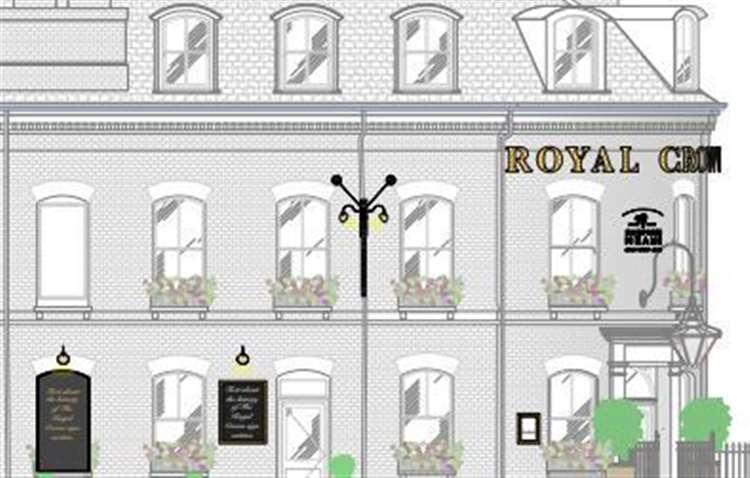
Gold letters will appear around the front of the building.
If given the go ahead, the pub will have permission to install a new
hanging swing sign, new golden letters and curved sign, a painted brick
pub logo, and three new menu signs.
Two historic information boards would also be displayed.
|
|
From the
https://www.kentonline.co.uk By Nicola Jordan, 24 September 2023.
The Crown pub in Rochester High Street shut for 12 weeks for £1.2
million facelift.
An historic town centre pub which hosted royalty centuries ago has
closed for 12 weeks for a £1.2 million makeover.
The Crown, which stands near Rochester Bridge on the High Street, is
ditching its well-known red shades for a more majestic black and gold.

A new look and new name for the historic pub is on its way.
And once reopened, the boozer, dating back to the late 1700s, is
reverting to its original name, The Royal Crown.
It was bought in 2019 for about £1m by Kent brewery Shepherd Neame which
is overseeing the massive facelift.
Shepherd Neame’s managing director Jonathon Swaine said: “We are
delighted to confirm that as part of ongoing investment in our estate,
we are undertaking a major refurbishment of The Crown, Rochester.
“Our aim is to retain and enhance the unique features of this historic
Grade II-listed building, while also introducing a stylish look and
feel.
“We are also planning to mark the relaunch by returning the pub to its
original name, The Royal Crown.
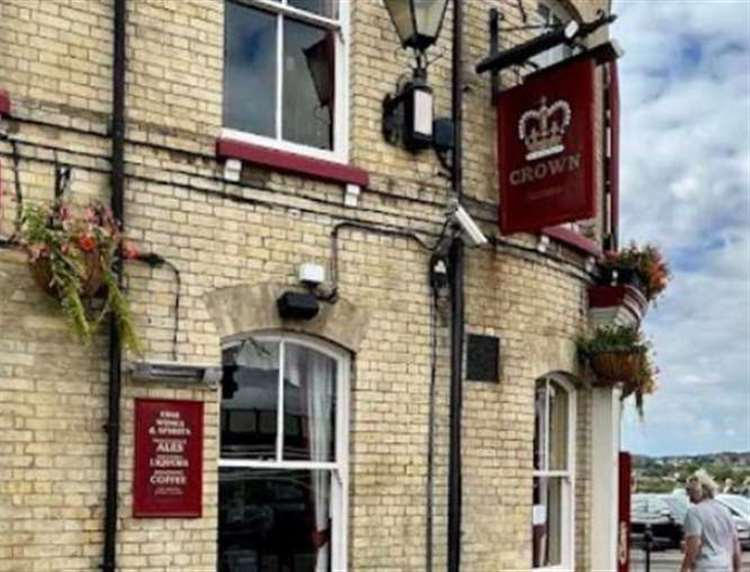
The Crown in Rochester is closed for a major makeover.
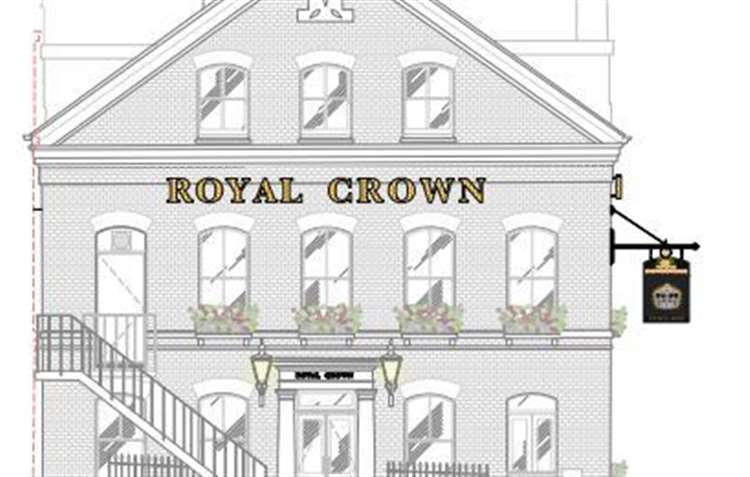
The Crown pub in High Street, Rochester, is set to be called The Royal
Crown and get a new black and gold sign.
“We closed the pub at the start of this month to begin work, and plan to
reopen to customers in November.”
For two decades it was managed by the Krays, father Steve and eldest son
Pete, who spent £300,000 on improvements.
They changed the name from Norman Conquest to The Crown and transformed
the upper floor into The Sports Bar with eight screens to watch matches
and events and two full-size pool tables.
Mr Swaine added: “As part of the refurbishment we will be undertaking a
stylish transformation of our first floor area, previously known as The
Sports Bar.
“It will continue to be a function room with its own bar and facilities,
available for private hire, and to maximise the space available we are
removing the pool table currently situated there.
“We will remain the place to watch live sport, continuing to show Sky
Sports and BT Sports.”
The pub featured in the 2014 Rochester and Strood by-election prompted
by then MP Mark Reckless defecting from the Conservatives to the UK
Independence Party.
Nigel Farage, leader of UKIP, made numerous visits to Rochester to
support his colleague and held press conferences outside the venue,
popping in for his favourite tipple.
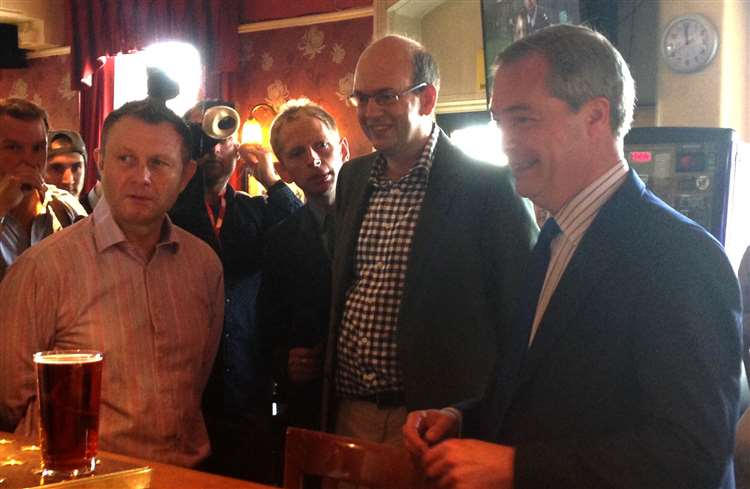
Mark Reckless and Nigel Farage in The Crown pub in Rochester.
Reporters and TV crews converged on the town to cover the campaign - and
likewise banner-waving UKIP protestors aired their views - all with the
hostelry as a backdrop.
Historically, the original pub hosted royalty including Elizabeth I and
King Charles V of Spain before it was demolished.
It was also where Henry VII came in secret to get a sneak peek of his
intended fourth bride, Anne of Cleves. |
LICENSEE LIST
BROOKER Art 1675+
WAREHAM Mr 1735+
BAYLEY 1783+
AYRES Thomas to 1792 (dec'd May 1796)
CORNWELL Thomas & SMITH John Mar/1792-May/1804
WRIGHT William May/1804-32+
 
CALDER Mr 1843- Dec/1845

WILLSON George 1847+
DUNCAN James 1851+ ("Crown Inn Tap," St Nicholas.)
SANCTO John James 1853+ ("Crown Tap")
 DUFFILL William Daniel 1911+ (age 69 in 1911
 ) )
KRAY Steve & Pete (son) 1999-2020+
William Duffill died in the "Dover
Castle," Teynham in 1924.
Probate:- of "Dover Castle,"
Green Street, Teynham, Kent to Edward David Duffill and David James Duffill
Licensed Victuallers.
The assumption could be made that his two sons were the Publicans of that
establishment – however, I have no proof other than this Probate record.
Kentish
Chronicle
From
the Pigot's Directory 1828-29
From the Pigot's Directory 1832-33-34
Census
|

