|
1 Canal Road
Strood
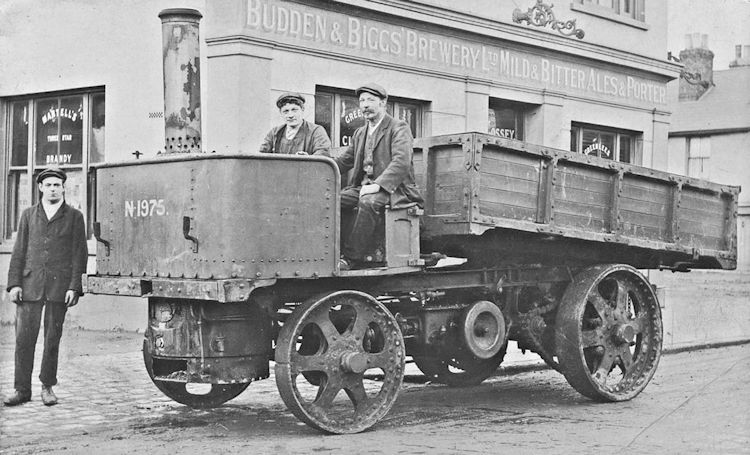
Above photo, circa 1911, kindly sent by Rory Kehoe. Showing a
state-of-the-art (for those days!) steam-powered, chain-driven, tipper
truck passing by the pub. This tipper may have been manufactured by the
nearby firm of Aveling & Porter, whose Invicta Works were located at the
lower end of Strood High Street. When this photograph was taken, the pub
was a tied house, within the in estate of Budden & Biggs' Steam Brewery,
Strood, which was famous for promoting its beers as Body Building
Beverages. |
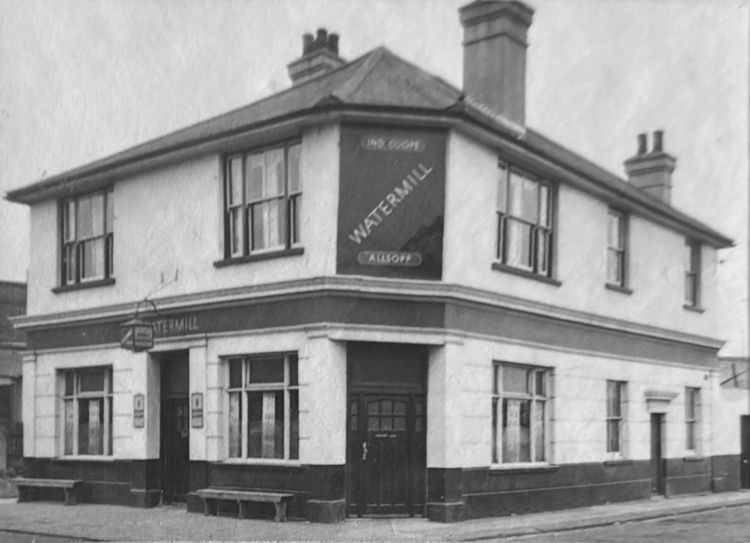
Above photo, which was used as a Christmas card from the pub circa 1943.
Kindly sent by Jordan Hook. |
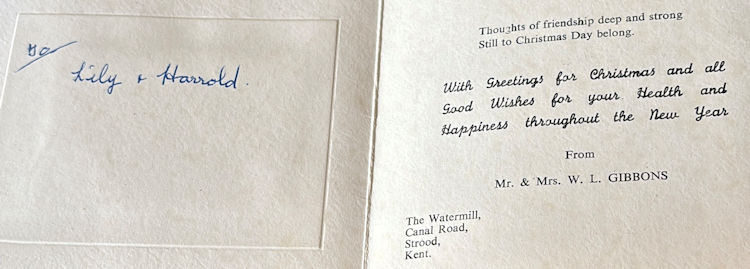
Above showing the inside of the card. That belonged to Jordan Hook's
Great Grandmother from her brother, our Uncle Will (William Gibbons). |
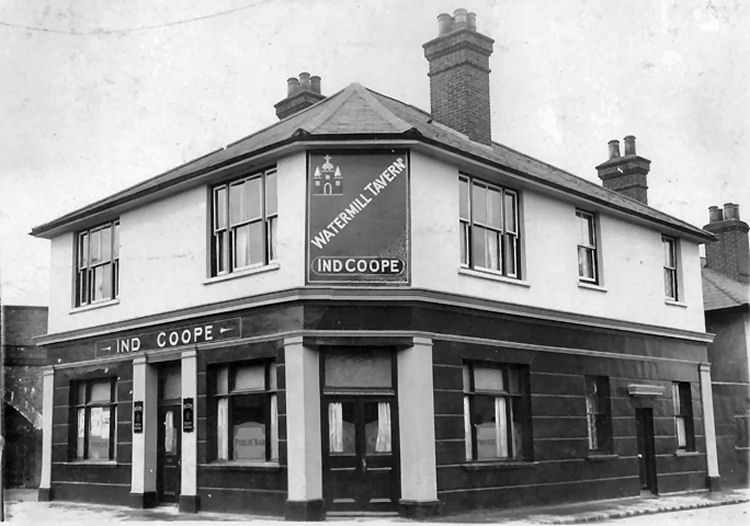
Above photo, date unknown, kindly sent by Michael Mirams. |
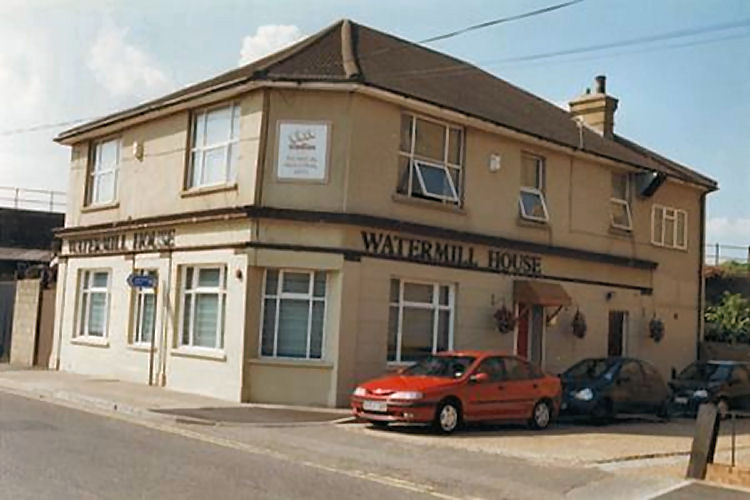
Above photo, date unknown. |
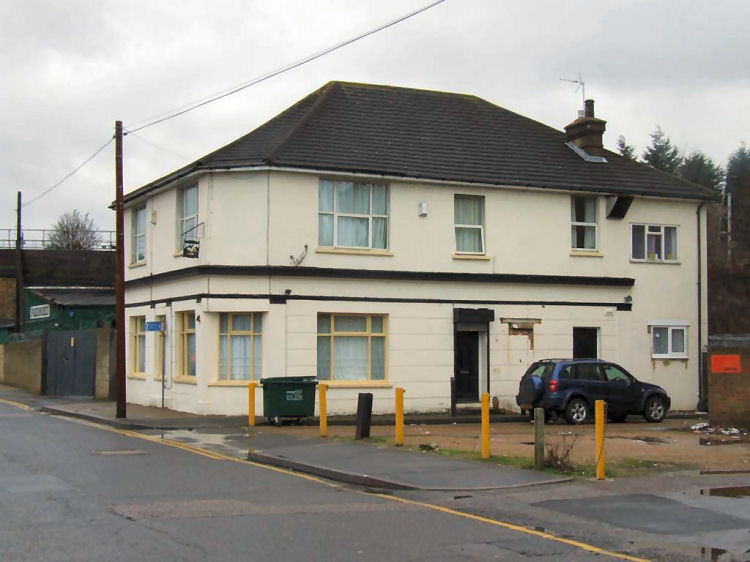
Above photo 2010 by Chris Whippet
Creative Commons Licence. |
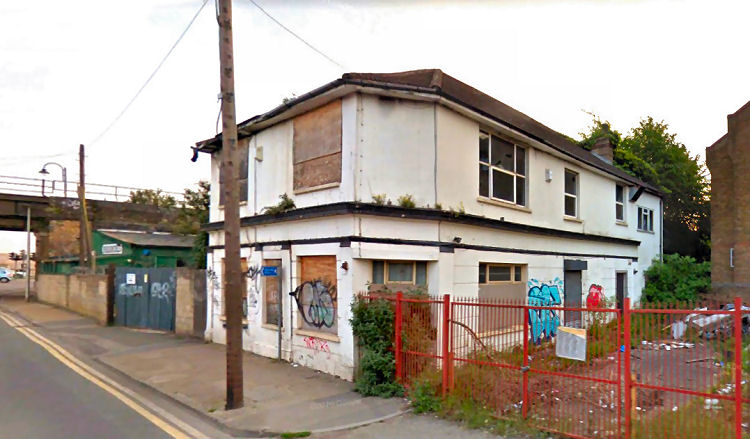
Above photo 2019, kindly sent by Debi Birkin. |
According to the book the "History of Strood" by Henry Smetham, published
1899, the first pub with this name was accidentally burnt down. Another
place of entrance to Strood fair meadow was by way of this public house, a
rather frail wooden bridge spanning the mill pond for this purpose. A Mr
Freeland was the first licensee, followed by George Roffway.
Ind Coope & Co Ltd purchased the pub from Budden & Biggs Brewery Ltd by
conveyance and assignment dated 23 March 1931. The pub held a full license.
I am informed that the building is due for demolition (2020).
|
From an email received, 29 January 2021.
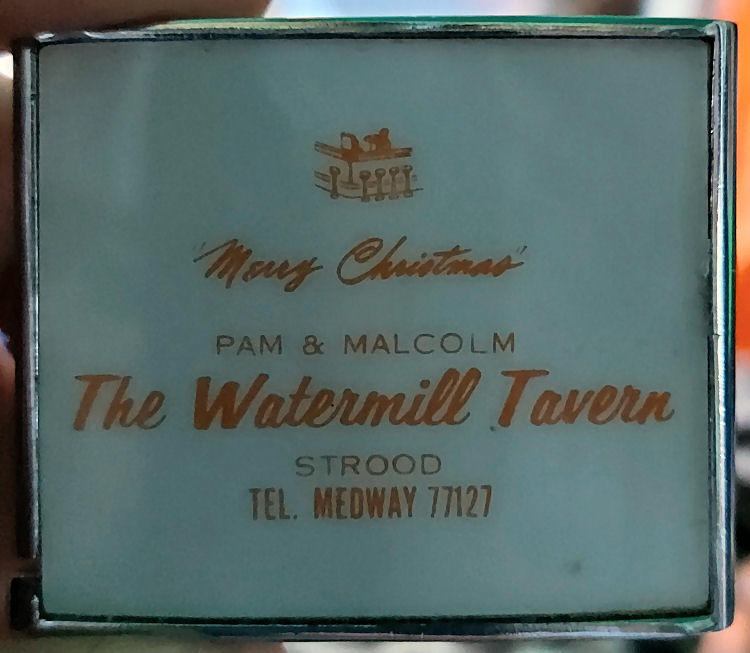
My husband and I are just going through a job lot he won on ebay
and came across this item, it is a tape measure. (Date unknown.)
Regards,
Annmarie Musselwhite. |
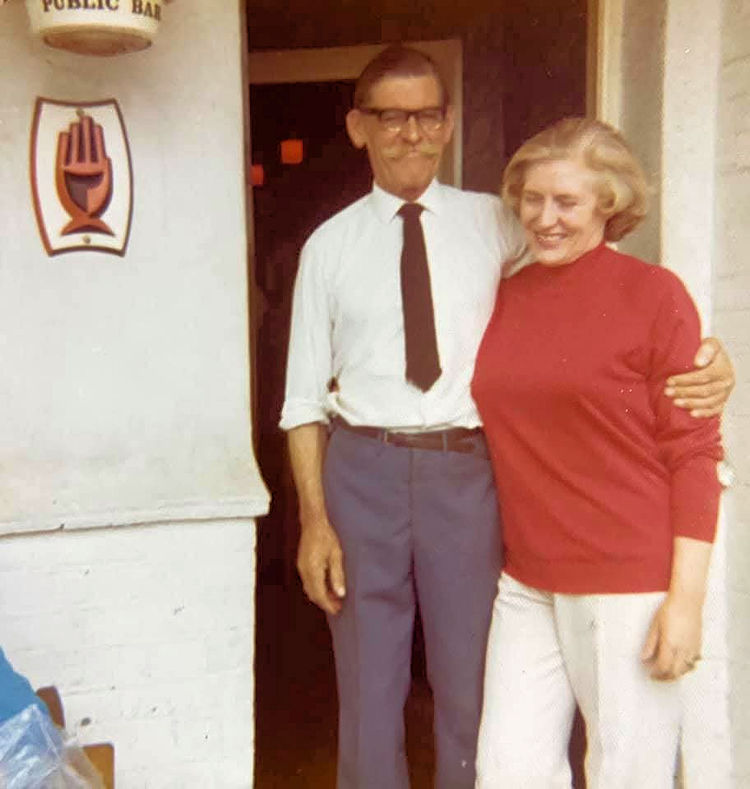
And above photo showing Pam and Malcolm, surname and date unknown,
but presumed 1980s. |
Local knowledge, further pictures, and licensee information
would be appreciated.
I will be adding the historical information when I find or are sent it,
but this project is a very big one, and I do not know when or where the
information will come from.
All emails are answered.
|
South Eastern Gazette, 15 May, 1860.
CITY PETTY SESSIONS.
Tuesday. (Before the Mayor, E. R. Coles, F. Furrell, H. Everest, and
G. Lowrey, Esqrs.)
Dismissal of One of the City Police.
James Hewitson, linen-draper, Chatham intra, was charged, on remand,
with being drunk and assaulting Police-constable Boakes. The court
was filled during the examination of the accused, the proceedings
attracting much interest.
The police-constable said he was on duty in Strood on Friday night,
and saw the defendant at the railway refreshment room about eleven
o’clock. He drank with the defendant, and also with the three
witnesses to be called for the defence. The lady serving them wished
witness to get defendant away. Witness persuaded him to leave, and
they both went to the "Water-mill" public-house, where complainant
again drank at the bar, the defendant at the time "dancing about" in
a state of intoxication. Complainant did not pay for what he had. He
left the "Water-mill" at twenty minutes after eleven, leaving the
defendant there. About half-past twelve complainant saw the
defendant again at the foot of Rochester-bridge. He was then
insulting every one that passed, and as he refused to go home,
witness put his hand on him to "shove" him along, when defendant
turned round and struck him in the eye with his fist. He then closed
with him and they struggled for some minutes, both falling more than
once. As he was down defendant kicked him three or four times in the
back. A baker named Grewcock assisted witness to take defendant to
the station-house, defendant kicking Grewcock several times.
Cross-examined by the defendant:— They were at the "Cobham"
public-house together drinking; witness had some ginger-beer.
Mr. Everest told complainant there was a discrepancy in his
evidence, as he said he did not see defendant after he left him at
the Water-mill till he saw him on the bridge, and now he admitted he
saw him at the "Cobham." Which statement was correct?
Complainant:— Both; I was persuading him to go away.
Mr. Coles:— Then what you stated just now is not true?
Complainant:— No, Sir.
Complainant said he had no witness to call, as Grewcock had
evidently been put out of the way.
The son of the landlord of the "Cobham" was called for the
complainant, but the magistrates said his evidence was unnecessary.
The defendant stated that on the day in question he had been out in
the country, and came home rather late. On going into the railway
station to leave a parcel he met the constable, when they several
glasses of ale together and left in company, a woman meeting them,
with whom complainant advised him to go home. They then went to the
"Water-mill" public-house together, where they saw Grewcock, and
remained drinking, defendant paying for what the police-constable
had. After leaving the "Water-mill" complainant induced him to go to
the "Cobham," and on his leaving that house, the police-constable
wanted to lock him up. Defendant then struck him, on which the
police-constable threw him down, but he succeeded in getting up, and
the police-constable then fell down. He had been very ill-used by
the police-constable and Grewcock.
John Swinton, railway porter, and John Wallis, switchman at Strood
junction, were called for the defence, both stating that the
constable was in liquor; Wallis saying that he tried to put on the
handcuffs; but was too drunk to do so.
Defendant said he had another witness to call who would prove that
he saw the police-constable that evening asleep in a railway
carriage, that he treated him to a cup of coffee, and that Boakes
told him he should go home and "sham Abraham."
The Mayor thought there was no necessity for any additional witness,
and the charge would be dismissed.
Mr. Coles said, as Boakes had been before suspended, more than once,
he should call the attention of the Watch Committee to the matter.
His own opinion was that Boakes was quite unfit to be a
police-constable of that city.
Boakes said, seeing the course the case had taken, he thought he
should be only studying his own interest and that of the city, by at
once resigning.
The Mayor, addressing Mr. Hewitson, told him he hoped it would be a
warning to him.
|
|
From the Southeastern Gazette, 19 June 1866.
TO BE LET.
FREE PUBLIC-HOUSE, called the “Watermill,” eligibly situated on the
Canal-road, Strood, Kent, and close to the Stations of the South
Eastern, and London, Chatham, and Dover Railways. Immediate possession
can be given.
For particulars apply to Messrs. Hills and Winch, Solicitors, Chatham.
|
|
|
LICENSEE LIST
FREELAND Mr pre 1847
ROFFWAY George 1847-58+
DOGGETT John Doggett 1861-62+ (widower age 36 in 1861 ) )
COLEY Francis Coley 13/Dec/1866 (listed as dealer & chapman, bankrupt)
BUSHELL William Smith 1871-74+

RUSSELL Ellen Miss 1878+
HOWE Albert Duppa 1881-82+ (age 31 in 1881)
BURGESS H Mrs 1891+
LEWRY Alfred 1903+

COSSEY George 1909-18+
COSSEY Ellen 1922-30+
DRAY Ethel Lilian Mrs 1938+
GIBBONS W L 1955+
???? Pam & Malcolm ???? (probably 1980s)
https://pubwiki.co.uk/WatermillTavern.shtml
http://www.closedpubs.co.uk/watermilltavern.html
From the Kelly's Directory 1903
|

