|
58 (188) High Street
St. Nicholas
Rochester
01634 880508
https://whatpub.com/kings-head-hotel
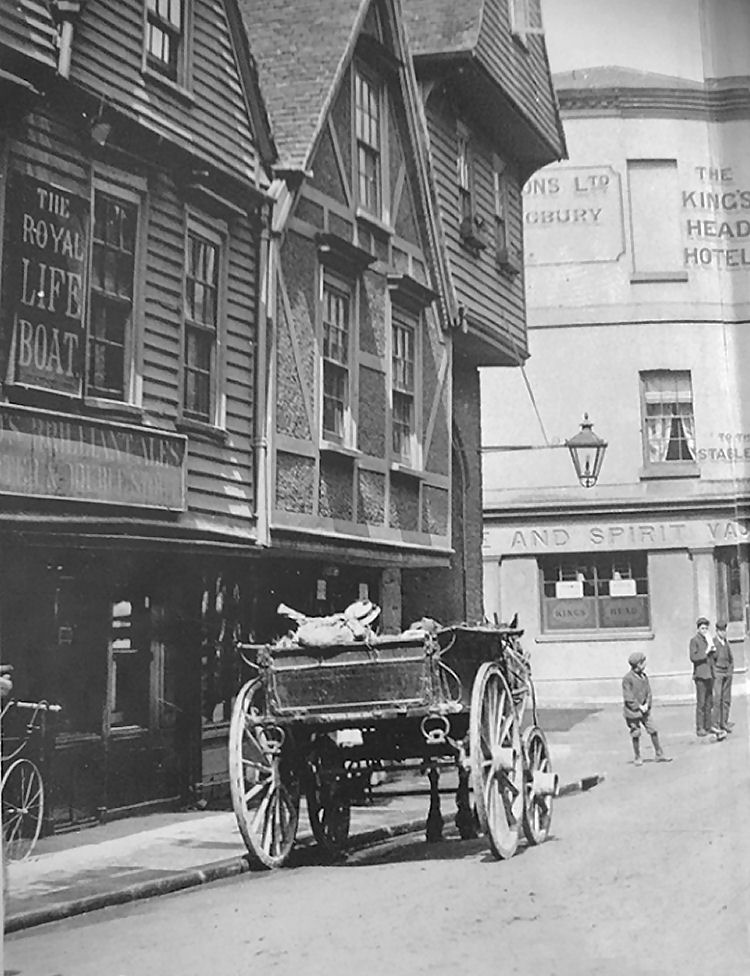
Above photo, circa 1895, kindly sent by Rory Kehoe, Also showing the
"Royal Lifeboat." |
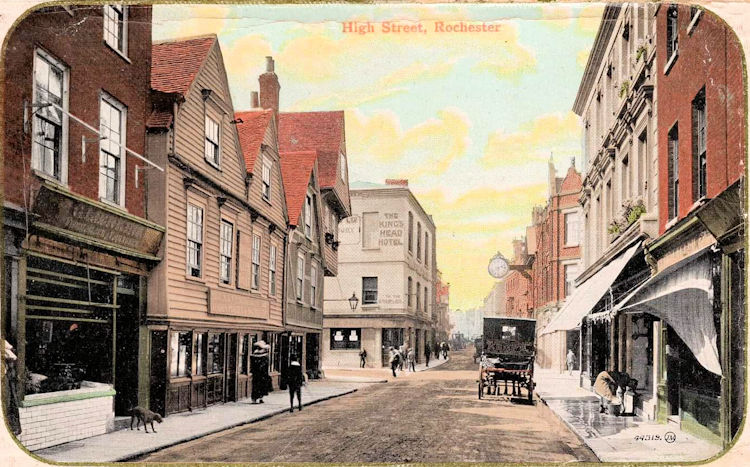
Above postcard, date unknown. |
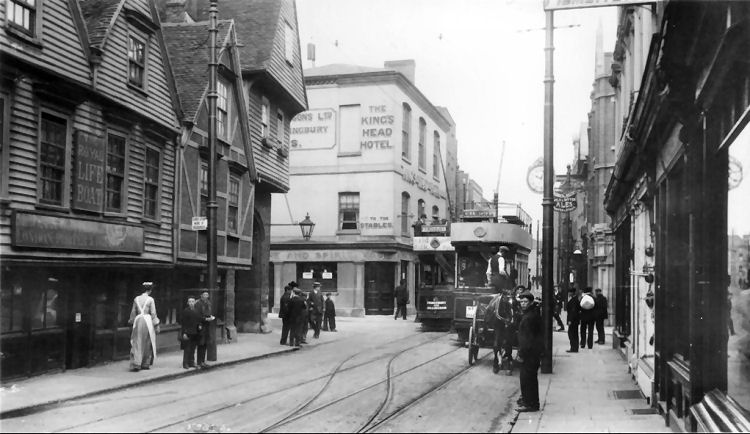
Above photo 1904, from www.Flickr.com
by Ben Levick. Also shown is the "Royal
Life Boat." (Left) |
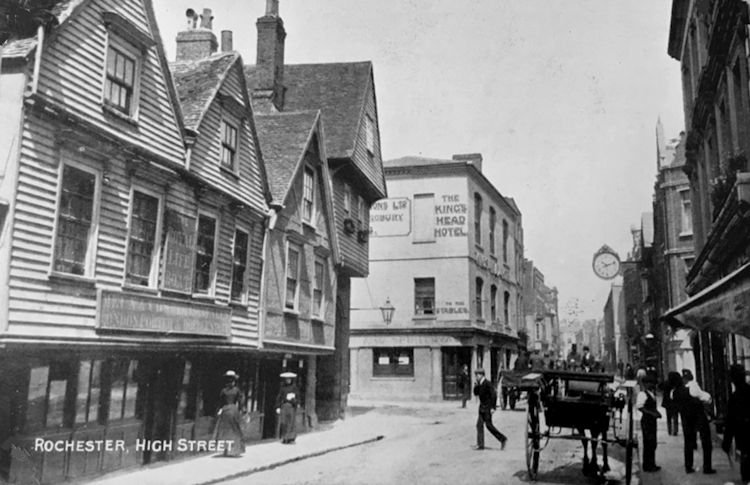
Above postcard, circa 1906, kindly sent by Rory Kehoe. Also shown is the
"Royal
Life Boat." (Left) |
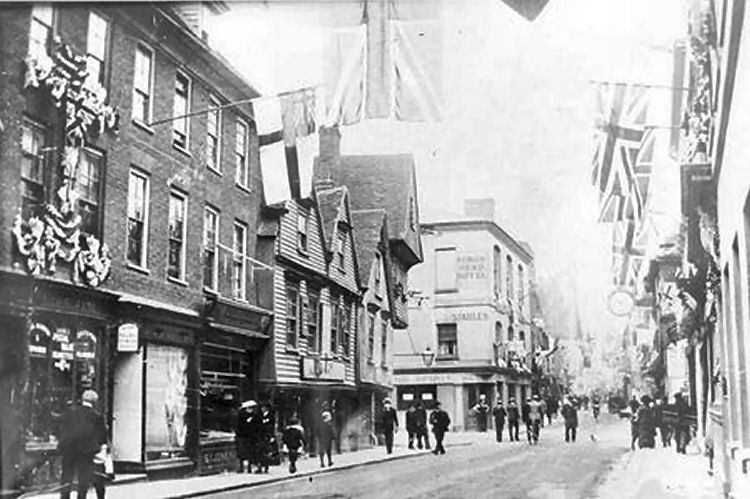
Above photo circa 1908. |
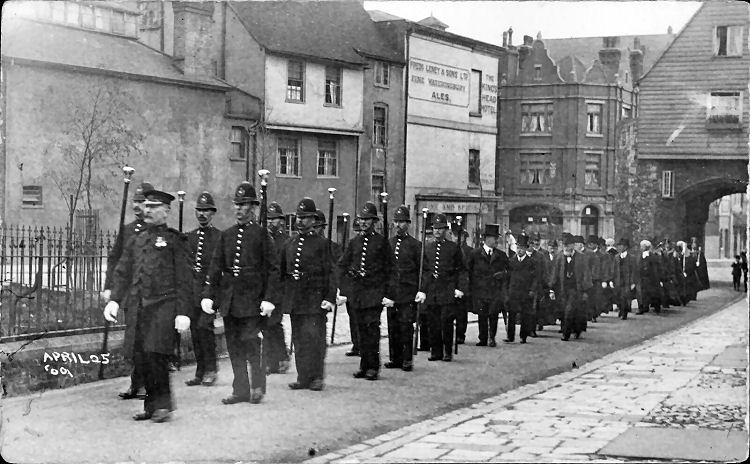
Above postcard, 25 April, 1909, kindly sent by Debi Birkin. |
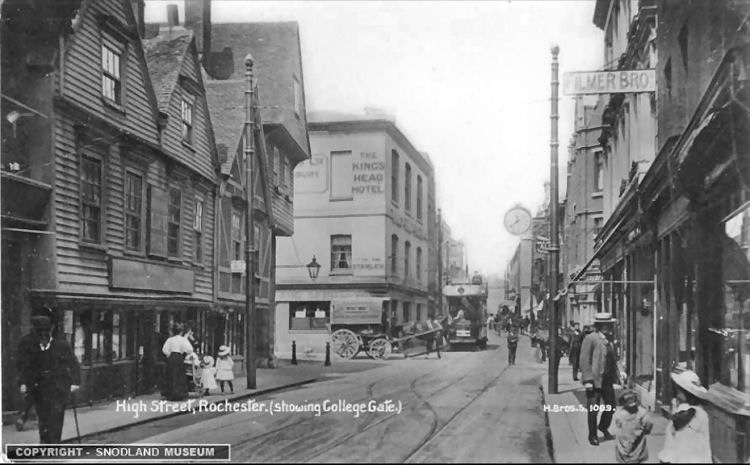
Above photo, date unknown. Kind permission from Eric Hartland. |
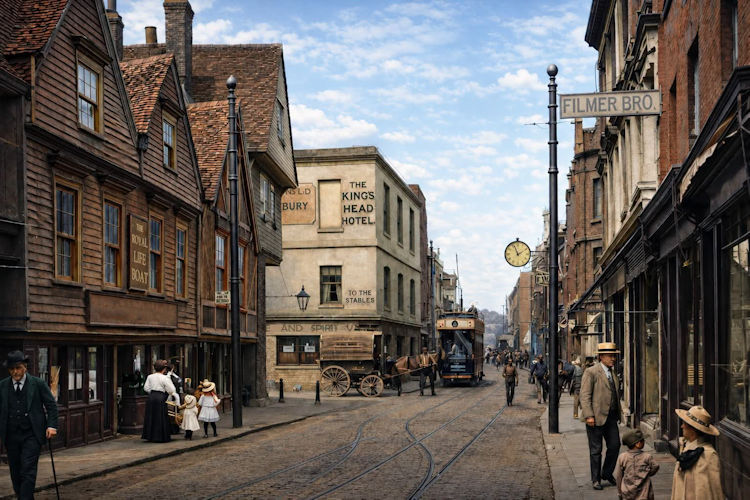
Above showing colourised version. |
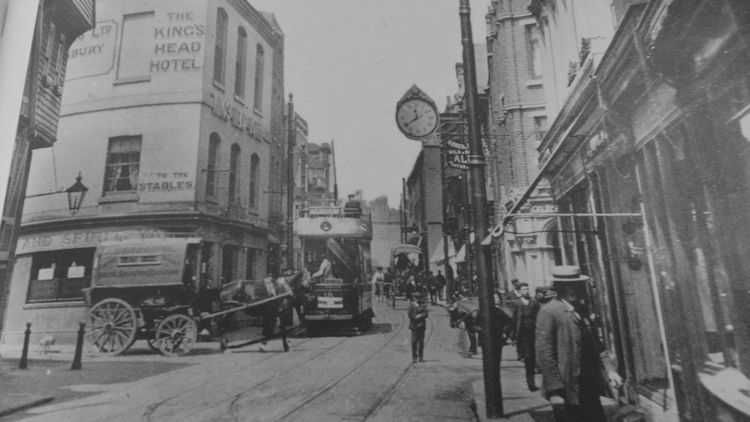
Above photo, 1910. |
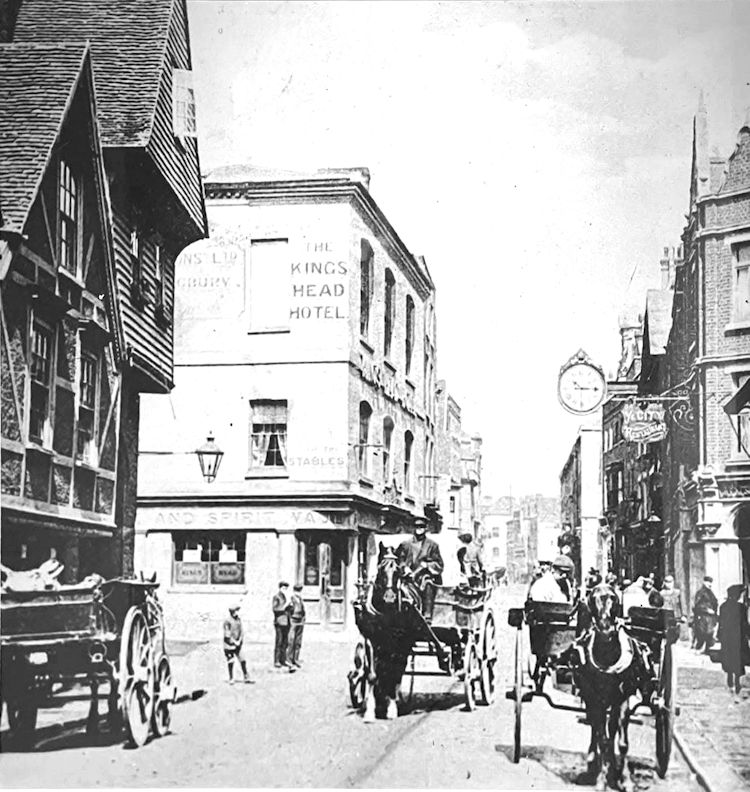
Above photo, circa 1910. |
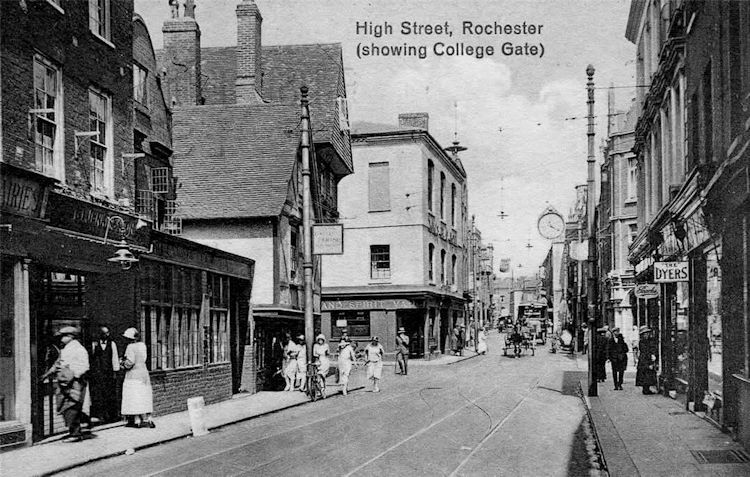
Above postcard, date unknown. |
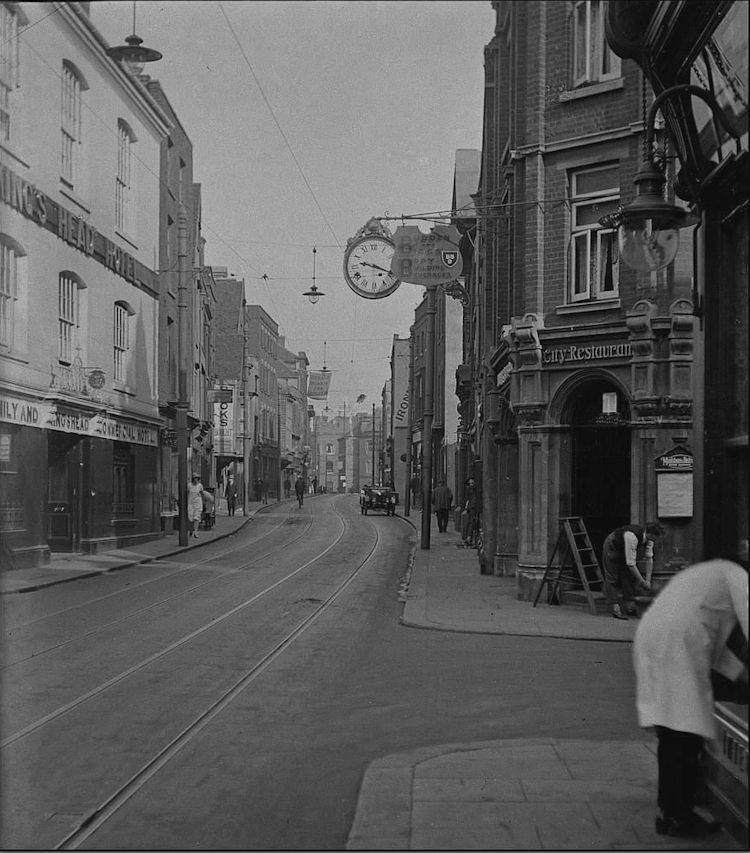
Above photo, 1920. |
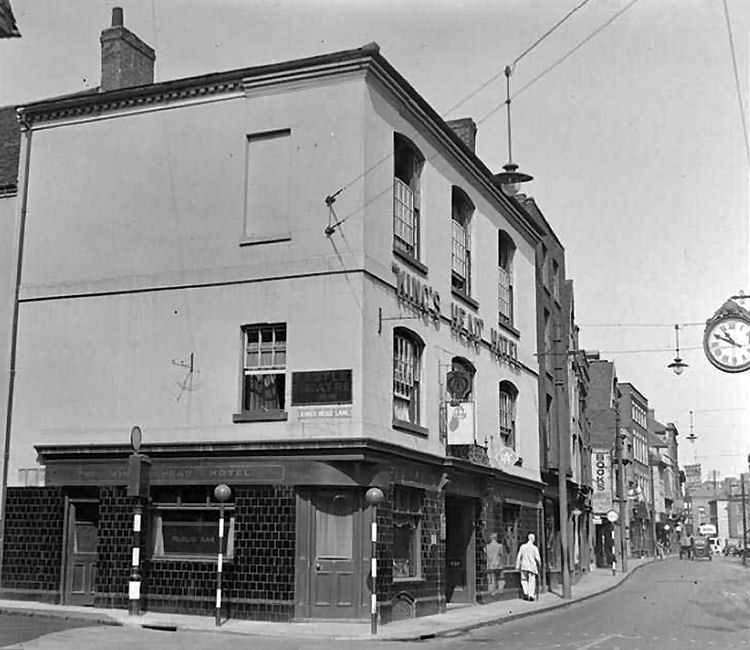
Above photo, circa 1938, kindly sent by Rory Kehoe. |
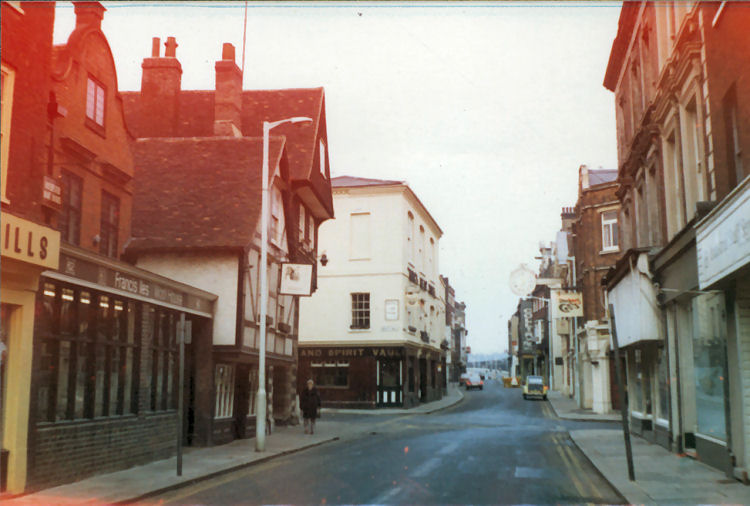
Above photo 1978, from www.Flickr.com
by Ben Levick. |
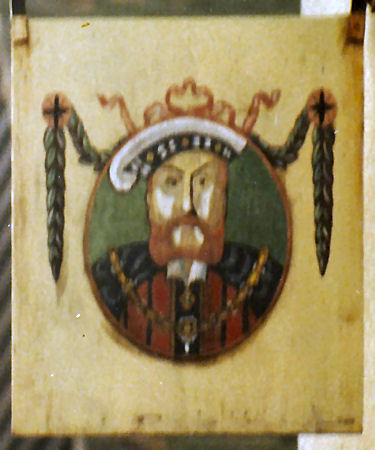 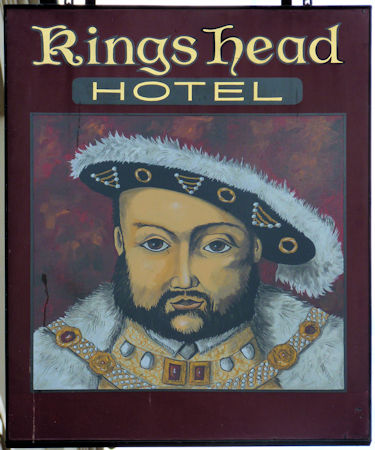
Above sign left, October 1991, sign right August 2014.
With thanks from Brian Curtis
www.innsignsociety.com. |
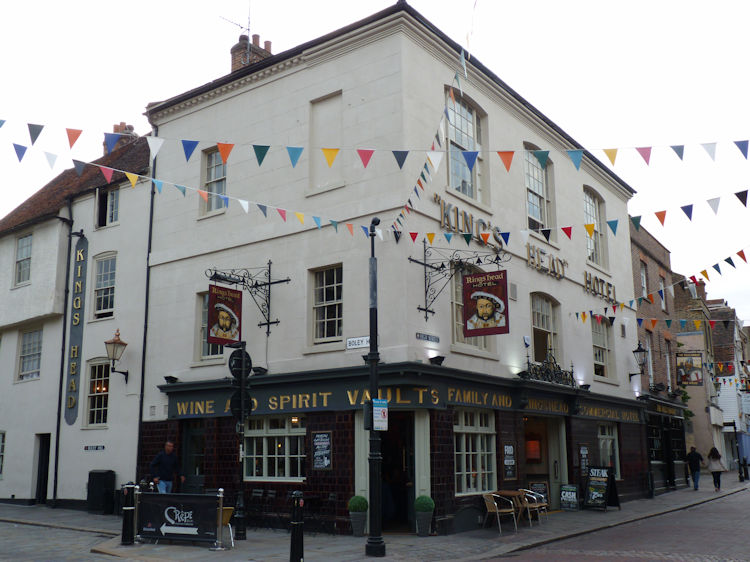
Above August 2014, kindly sent by Patricia Francis. |
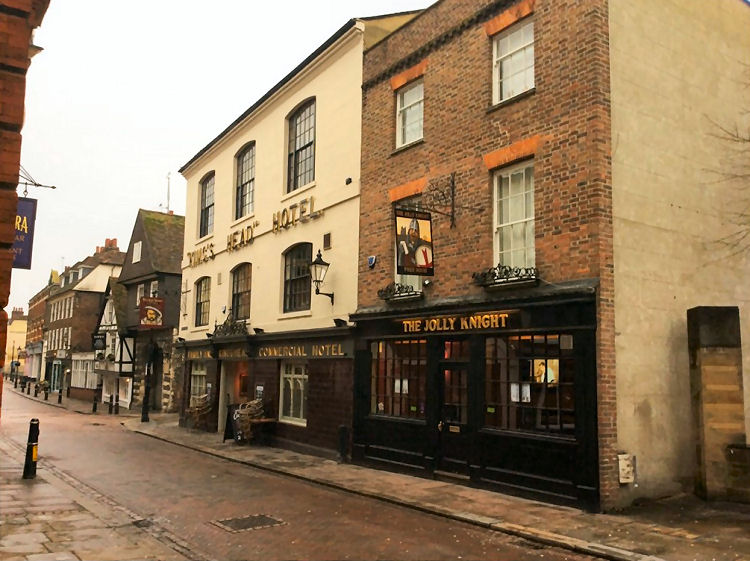
Above photo 12 February 2017, by Bill Henderson
Creative Commons Licence. Also showing the "Jolly
Knight." |
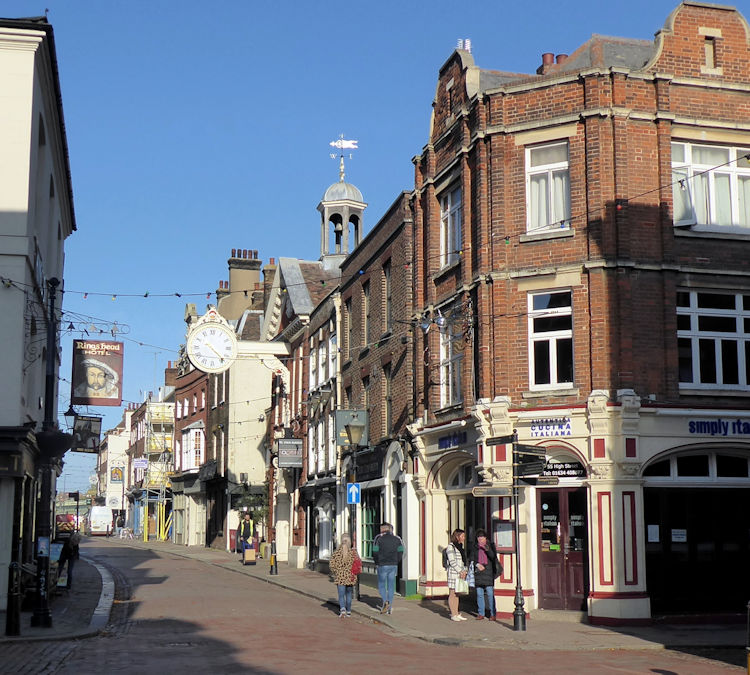
Above photo, circa 2024. Also showing the "City
Restaurant," location, right. |
There has been an inn on the site of the "King's Head" since 1490, and an
apple market was once held at the rear of the premises.
Reference has been found suggesting that it became the "County
Hotel" for a short time around 1825 to 1828.
The Medway Archives and Local Studies Centre has referenced a set of
documents, that I haven't seen yet, and is part of the Watts Charity MSS,
1579-1972.
Reference is made as follows:-
1859-1906
T32. The "Kings Arms," and Holborn
Wharf and premises, Holborn Lane [deed of 1862 includes "King's Head," High
Street and several other messuages. Particulars and conditions of sale,
1906, with plan] (11 docs.)
1720-1878
T35. Premises in Rochester and Chatham [including 4 messuages on North
side of High St., St, Nicholas, adjoining the "Kings Head," and 3 messuages
in Love Lane, St. Margaret's, Rochester; 2 messuages in Railway street, and
Room Lane Farm (63 acres) and 5 messuages, Chatham] (6 docs.)
Situated on the corner of the High Street, the "Jolly
Knight" is found on it's right, and "Ye
Arrow" round the corner on it's left, and it is said that they are
joined internally. A comment from a blogger said he believed in the 60s the
landlord of the "King's Head" created the "Jolly
Knight" and "Ye Arrow"
pubs from the "King's Head" building. Today the "Jolly
Knight" is clearly a different building to the "King's Head" but I
understand the "Ye Arrow"
is in a Victorian extension to the "King's Head."
|
Kentish Gazette, Saturday 5 January 1771.
To be LET, and entered upon immediately,
PUBLIC HOUSE, ready Furnished; known by the Sign of the "Thistle and
Crown," nearly opposite the "Kings Head Inn," Rochester.
The House is very complete, and well situated.
For further Particulars, enquire of Mrs. Rebecca Elliot, Brewer, in
Rochester, or of Mr. Lachlen Maclean, at the "Globe," Chatham.
None but Principals will be treated with.
|
|
Kentish Gazette, 26 June, 1781.
Saturday morning died Mr. Read, "Kings Head Inn" at Rochester.
|
|
From the Kentish Gazette, Friday 1 March 1793.
Hurt and Clark, late of the "King's Head Inn," Rochester.
Embrace the earliest opportunity of returning their sincere thanks
to the Nobility, Gentry, and their numerous friends, who have for a
series of years honoured them with their favours; at the same time
they respectively beg leave to inform them, that they have resigned
the business in favour of Mr. Walter Grove.
Rochester, February 25th, 1793.
Water Grove, from St. James's.
Most respectfully informed Nobility, Gentry, and his friends, but
having taken the "King's Head Inn," Rochester, he solicits it's
their patronage.
Confident that no attention, aciduity or expense, will on his part
be wanting to render his house deserving their favours, he hopes he
shall merits their countenance and support.
Neat post-chaises, coaches, &c, with able horses, and careful
drivers.
Rochester, February 25th 1793.
|
|
From the Maidstone Journal, 22 August 1797.
We are happy in finding the example of Mr. Groves, of the "King's Head,"
Rochester, and Mr. Whittaker, of the "Red Lion," Sittingbourne, who were the
first to reduce the rate of Posting on the Road to 1s. per mile, is followed by
several other Innkeepers of the County.
|
|
From the Maidstone Journal, 9 January 1798.
Early on Saturday evening, as Mr. Groves, of the "King's Head," in Rochester,
accompanied by J. Simmons, Esq., Coroner, and Mr. Slater, Coach Master, were
travelling in a post-chaise from Rochester to London, they were attacked near
Shooters Hill by two Footpads, who attempting to rob them, the gentleman
immediately presented their pistols, which unfortunately only flashed in the
pan; one of the footpads instantly fired into the chaise, shot Mr. Groves in the
head, and wounded his companions, though not dangerously, and then ran off. The
ball was not extracted from the head of Mr. Groves on Sunday night, and the
Faculty were of opinion he could not survive.
We have since been favoured with the following authentic particulars of the
above melancholy transaction.
Rochester, Monday afternoon, 3 o'clock.
Messrs. Simmons, Slater, and Grove, set off from Rochester about two o'clock on
Saturday afternoon, and about six they were stopped near the end of Carlton
Lane, by two footpads.
The man who came up first, said to the postboy, D--N your eyes stop, and
immediately fired. Slater and Simmons then jumped out; Slater followed the man
who fired, but he escaped; Simmons snapped a pistol at the others breast, but it
missed fire, and he got clear off. When they came back and saw Mr. Groves
sitting in the chaise, they said, Groves! why don't you get out, not knowing he
was wounded. Mr. Grove's got out, and walked some distance; he soon after said,
I'm wounded! They took him forward to Woolwich; he continued in his senses till
nine o'clock that evening, since which time he has not spoke; neither are they
any least hopes of his recovery. The ball went in at his temple, and lodged at
the back part of his head, and was the only shot fired.
It was generally reported in Rochester, at a late hour last night, that Mr.
Groves was dead.
|
|
From the Maidstone Journal, 16 January 1798.
Died.
Wednesday night died, at Woolwich, Mr. Groves, late master of the "King's Head
Inn," Rochester, who was shot in the head by the footpads, as mentioned in a
former Paper; and on Saturday his remains were brought to Rochester, and
interred on Sunday; Messrs. Simmons and Slater attended as Chief Mourners.
|
|
From the Maidstone Journal, 30 January 1798.
"King's Head Inn," Rochester.
Mary Grove, widow of Walter Grove, humbly begs leave to acquaint her friends and
the public in general, that she continues to carry on the business of the above
Inn, and most earnestly entreats a continuance of the favour of the friends of
her late unfortunate husband.
|
|
From the Maidstone Journal, 13 February 1798.
On Saturday five notorious offenders were examined at the public office, Bow
Street, on suspicion of having committed various felonies in and about the
metropolis, and of having robbed and murdered the late Mr. W. Groves, of the
"King's Head Inn," Rochester.
Mr. Simmons, who travelled in the chaise with the deceased, and the driver, were
examined, but could not identify the person's of the prisoners; they are,
however, detained for further examination.
|
|
From the Maidstone Journal, 17 April 1798.
Died.
Thursday died in Rochester, Mrs Durham wife of Mr. Durham, formally master of
the "Kings Head" public house, near the Quay, but had retired from business some
time past.
|
|
From the Maidstone Journal, 14 August 1798.
"King's Head Inn," Rochester, Kent.
The creditors of Walter Grove, late of the "King's Head," in the city of
Rochester, innkeeper, deceased, are desired forthwith to send accounts of their
respective debts, to Mr. Simmons, or Mr. Bristow, of Rochester, Messrs. Sarels,
Surrey Street, Strood, or Mr. Blades, of Piccadilly, Upholder, that their
respective accounts may be liquidated; and all persons indebted to the said
Walter Grove, are desired forthwith to pay their respective debts, to the said
Mr. Blades, or to Mr. Simmons, or Mr Bristow, who are duly authorized to receive
the same.
N.B. The Business of the above Inn, continues to be carried on by Mary Grove,
the widow of the deceased, who returns her most grateful thanks, to those
friends that have contributed so liberally to her support since her husband's
death, and she throws herself upon the benevolence of the public, for a
continuance of their patronage, which she will endeavour by every attention in
her power to deserve.
|
|
From the Kentish Gazette, Tuesday, 4 September 1798.
To the Nobility, Gentry, and the Public in General.
"Kings Head Inn," Rochester.
Mary Grove, widow of the unfortunate Walter Grove, who was murdered
by some footpads near Shooters Hill in January last, deems it
expedient to inform her friends, the Nobility and Public in general,
who have hitherto humoured her with their patronage, that, as it has
been most cruelly asserted by her enemies, without the least
foundation whatever, that the "Kings Head" is shut up, and she gone
away; this is to assure the world in general, that the house is
neither shut up, nor has M. Grove left it, and therefore humbly
solicits a continuance of their favours, which the cruel
insinuations of some evil-disposed persons have endeavoured to obtain
for other houses, and that, as a generous public, they will be more
ready to commiserate her distressed situation by granting her that
support which it shall ever be her study to deserve, by punctually
opening all orders, and giving general satisfaction as long as she
remains in the above Inn.
|
|
From the Maidstone Journal, 11 September 1798.
Notice.
The creditors of Walter Grove, late of the "King's Head Inn," in the City of
Rochester, in the County of Kent, Innkeeper, Deceased, are requested to meet at
that Inn, on Thursday the 13th day of this instant, September, precisely at 4
o'clock in the afternoon, for the purpose of taking into consideration, a state
of the Deceased's Affairs.
Rochester, Sept. 10, 1798.
|
|
From the Maidstone Journal, 11 September 1798.
Sales by Auction.
"Kings Head Inn," Rochester, Kent. By Messrs. Richards and Blades, on the
premises, on Monday next, Sept. 17th, and two following days, at 11 o'clock, by
order of the trustees of Mr. Walter Grove, deceased.
All the genuine Household Furniture, comprising two four post, state bedsteads
with rich cotton and dimity furniture's, window curtains and bedding; variety of
other beds and furnitures; about 50 feather beds; Wilton carpets; pier glasses;
mahogany cabinet work of all kinds, numerous domestic articles, and valuable
fixtures; China, glass, plate, extensive assortment of linen, prints, two 5th
machines, 5 post chaise, a post coach, 18 good post horses, two sows, seven
pigs, &c. &c.
To be viewed on Friday and Saturday proceeding the sale.
Catalogues may be then had as above, at the "Ship," Dover; "Lion," Canterbury;
"Lion," Sittingbourne; "Star," Maidstone; "White Hart," Gravesend; "Bull,"
Dartford; of Mr. Richards, No. 12, Knightsbridge, near Hyde Park Corner, and
Blades and Son, No. 177, Piccadilly.
N.B. The Whole may be treated for by private contract.
|
|
From the Maidstone Journal, 18 September 1798.
"King's Head Inn," Rochester.
The sale by auction of the effects of Mr. Walter Grove, deceased, at the "King's
Head Inn," Rochester, advertised for Monday September 17, 1798, and three
following days, is postponed to October 1.
Richards and Blades, Auctioneers.
|
|
Kentish Gazette, Friday 5 October 1798.
KING'S HEAD INN, ROCHESTER.
S. Holloway, (formerly waiter at the above Inn) begs leave most
respectfully to acquaint the Nobility, Gentry and Travellers in
general, that he has taken the above Inn, where they will be sure to
meet withy the best of beds and liquors. and every accommodation;
and he hopes by the most respectful attention in his house, to merit
the patronage of the public.
Rochester 25th September, 1798.
Mary Grove (widow of the late Walter Grove) offers the most grateful
acknowledgement to those who, since her husband's decease, have
honoured her with their support; and informs them, that she has
departed with the "King's Head Inn" to S. Holloway, whom she humbly
recommends to the notice of her friends, and who she is certain will
at all times receive their commands with the utmost gratitude and
respect.
|
|
From the Maidstone Journal, 9 October 1798.
"King's Head, Inn," Rochester.
S. Holloway, (formerly Waiter at the above Inn) begs leave most respectfully to
acquaint the Nobility, Gentry and Travelers in general, that he has taken the
above Inn, where there will be sure to meet with the best of beds and liquors,
and every accommodation; and he hopes, by the most respectful attention in his
house, to merit the patronage of the public.
Rochester, Sept. 25, 1798.
Mary Grove widow of the late Walter Grove, offers her most grateful of
acknowledgements to those who, since her husband's decease, have honoured her
with their support; and informs them, that she has parted with the "King's Head"
in to S. Holloway, whom she humbly recommends to the notice of her friends, and
who, she is certain will at all times receive their commands with the utmost
gratitude and respect.
|
|
Kentish Gazette 31 January 1800.
The cook belonging to the "King's Head Inn" at Rochester, underwent
the amputation of her right arm a few days since, in consequence of
a stab she received by a carving-knife from her fellow-servant; but
she seems in a fair way of recovery.
|
|
Kentish Gazette 6 April 1802.
The following melancholy affair happened at Rochester on Monday
night.
A young gentleman, son of Mr. S-----, of Woolwich, decamped from
his father a day or two before with a considerable sum of money, in
company with a female, and slept at the "Kings Head Inn" on Sunday
night; his father, with a friend, arrived early in the morning, and
finding his son was in bed sent his friend before to the room door
for admittance, during which the son hearing his father's voice on
the stairs immediately took a pistol from his trunk and discharged
its contents just below his temple. Mr. Adams was immediately sent
for who extracted the ball, but with little hopes of his recovery;
he lingered from 6 o'clock in the morning till 2 in the afternoon
when he expired.
The jury sat on his body and after a long consultation, returned
a verdict:- Lunacy.
|
|
From the Maidstone Journal, 16 November 1802.
An Old Established Freehold Public House, and Land. By Mr. Batten.
On Friday, November 12, 1802, at 12 o'clock, at the sign of the "King's Head,"
in the city of Rochester, in two lots, unless in the meantime disposed of by
private contract, of which notice will be given.
Lot 1:- A very desirable, and old accustomed Freehold Public House, called all
known by the name of the "Waterman's Arms," with the extensive Brewhouse,
Malt-house, Barn, Stables, Lodges, and other Out-buildings; large Garden and
Orchard, desirably situated in the village of Wouldham, near the city of
Rochester; together with about 12 acres of fertile marsh, meadow and arable
Land, now in the occupation of Mr. Thomas Munn, at a very low rent.
Lot 2:- A leasehold Messuage or Tenement, desirably situated in the High Street,
in the city of Rochester, near the Cathedral, held under lease from the Dean and
Chapter, for an unexpired term of 30 years; now in the tenure or occupation of
Mr. William Robbins, at a very low rent.
Particulars and Conditions may be had on application to Mr. How, at Wouldham;
the "King's Head," Rochester; and the Auctioneers, Rochester.
|
|
Kentish Gazette, 20 July, 1804.
Friday last, a post-boy, known by the name of Rapadore, was found
dead, hanging in a stable of the "King's Head Inn," Rochester.
|
|
Kentish Gazette, 13 June, 1806.
DIED.
A few days since, M. Abraham Vincent, of the "King's Head Tap,
Rochester, late of the "Two Brewers" public-house, in Maidstone.
|
|
Kentish Gazette, 16 July 1844.
DEATH.
July 4, at Rochester, of dropsy in the chest, Mr. Thomas Saxton,
landlord of the "King's Head Inn," in his 61st year.
|
|
Kentish Gazette, 6 November, 1821.
On Thursday last at the "King’s Head Inn," in this city, was put
into commotion, by a disagreement between two young gentlemen of the
neighbourhood of Rochester, of the names of M----n and G-----g,
which terminated, as we are informed, in the former horse whipping
the latter, and immediately afterwards setting off for Margate to
post him for having refused him the satisfaction of a gentleman, for
an insult in that town. It is said the circumstances which led to
the fracas arose out of an attachment which Mr. M. had conceived for
a young lady of respectability, whom he had pursued, and was then
pursuing, with suremitting diligence and zeal, and that Mr. G. had
taken umbrage, and desired him to desist, without assigning any
cause, or without appearing to be authorized so to do either by the
lady or her friends, and imputing to Mr. M. unworthy motives. Stung
to the quick by Mr. G's insinuations and assertions, an exchange of
cards was offered Mr. M. and declined by Mr. G. Mr. M. having no
friend at Margate, in whom he could confide, immediately set off for
Chatham, and after riding all night, was on his way back,
accompanied by his friend, when he accidentally met with Mr. G. at
the above place. The friend of Mr. M. instantly waited upon Mr. G.
to urge an apology, or get him to name a friend, through whom a time
and place might be arranged for giving the satisfaction due to his
wounded honour; instead of Mr. C. complying with this request, he
absolutely refused, and repealed the offensive matter. We are
informed that Mr. M. is the son of a professional man, and Mr. G.
that of a deceased Gentleman; it was therefore to be expected that
the former would not submit to an indignity from the latter, and
especially as they were in both respects respectably connected.
|
|
Southeastern Gazette, 6 September 1853.
CITY PETTY SESSIONS.
Saturday. (Before J. L. Levy and E. R. Coles, Esqrs.)
Thomas Williams who had been apprehended for creating a disturbance
in front of the "King's Head Inn," was discharged on paying 1s.
|
|
South Eastern Gazette, Tuesday 16 March 1858.
George Webster was charged with assaulting Richard Payne, who
exhibited several confused wounds on his face, which he
alleged to be the result of the defendant's violence. Mr. M.
Stevenson appeared for the defence.
The parties are both waterman engaged on the river at the Sun Pier,
and on the occasion of the assault were together at the "King's
Head Tavern," High Street, drinking, when a quarrel arose between
them respecting some old grievance, which resulted in the
defendant assaulting the prosecutor in a very savage manner.
Fined, including costs, £1 14s., and in default 1 month's hard
labour.
|
|
Maidstone Journal and Kentish Advertiser, Saturday 17 September 1859.
Kings Head Commercial and Family Hotel, High Street, Rochester.
James Flisher, respectfully announces that he has taken the above
old established house, where he hopes by
strict attention and assiduity in providing for the comforts of
those who may honour him with their patronage, to
merit that support which he respectfully solicits.
An Ordinary as usual on Market Days.
Wines and spirits of every description of the best quality.
Bass's Pale Ale and Guinness Stout.
|
|
South Eastern Gazette, 27 March, 1860.
DEATH.
On the 18th Dec., 1859, at Beaufort, Fiery Creek Diggins, Melbourne,
Mr. James Flisher, late of Gravesend, Kent, builder, and eldest son
of Mr. Flisher, "King’s Head Inn," Rochester leaving a widow and two
children.
|
|
South Eastern Gazette, 24 April, 1860.
Sheerness Guardian, 28 April, 1860.
Shocking Suicide Through Jealously.
On Saturday last, an inquest was held at the "King's Head Hotel,"
Rochester, before J. Lewis, Esq., city coroner, on the body of
Louisa Jones, aged 29, a fine young woman possession considerable
personal attractions, who committed suicide that morning.
Frances Tomkin said the deceased was a fellow-servant of hers at Mr.
K. Clements High-street, where she had lived thirteen years in tin
capacity of housekeeper.
Witness and deceased took breakfast together that morning, but
deceased did not appear more depressed in her manner than usual,
although she appeared of a rather melancholy disposition. She often
talked to witness about a young man with whom she had been keeping
company for thirteen years, and had latterly spoken of him as "that
fellow," complaining that he had not used her well. She had told
witness that the individual alluded to had slighted her, and
deceased appeared to grieve very much about it. Latterly she appeared
to be more depressed than usual. Witness saw her at half past 10
that morning, and at that time noticed nothing particular about her.
In about a quarter of an hour after deceased rang her bell very
violently, and on witness running up she found her lying on the bed,
and the deceased told her she was dying. She appeared to be in great
agony, and called out for Mr. Clements. She said she had taken
something which the boy had fetched, and again alluded to "that
fellow."
Mr. Bell, surgeon, was immediately sent for, but deceased expired in
a minute or two after he arrived.
The following letter, which was identified as being in the
handwriting of the deceased, was found in her jacket, and read to
the jury by the coroner:—
"----- ------ has brought me to this. No one but myself has known
what I have gone through with him. He has led me to believe for the
last 13 years that he would never marry any other girl than myself,
and now the time has arrived that he has been looking forward, for
he has treated me with the greatest contempt. If I had been a girl
such as ----'s cook, and others that he is with on an opportunities
of evenings. I think I should have suited him better. How can he
expect to prosper? I will never forgive him in this world nor in the
world I come. I do not think if I had been married to him I should
have been happy, for he is too fund of bad women to make a good
husband. I wish I had taken the good advice of sincere friends, then
I should not have come to this."
There had been something more written on the half sheet of note
paper, which had been torn off.
Thomas George, errand boy in the employ of Mr. Clements deposed that
about 11 o'clock that morning the deceased sent him to the chemist’s
for a pennyworth of essence of almonds, and two pennyworth of oxalic
acid. The essence of almonds was for pastry, andl the oxalic acid
for cleaning the articles in the kitchen. Witness was frequently in
the habit of fetching the acid for deceased.
Mr. Bell, surgeon, said he was sent for that morning, and went
immediately to the deceased, whom he found dying, he asked her if
she had taken oil of almonds, when she replied "No," and made a
remark about "the boy." In a minute or two afterwards she died. The
quantity of oxalic acid deceased swallowed was very large, half an
ounce. The jury returned a verdict that the deceased committed
suicide during a fit of temporary insanity.
|
|
South Eastern Gazette, 18 December, 1860.
THE LATE FATAL ACCIDENT TO THE REV. GEORGE DAVIES.
The inquest on the body of the Rev. G. Davies, the particulars
connected with whose melancholy death were detailed at length in
this paper last week, took piece at the "King’s Head Hotel" on
Tuesday last, before J. Lewis, Esq., the city coroner, and a highly
respectable jury of house-holders, of whom Mr. T. S. King, late an
alderman of the ward, was the foremen.
The circumstances attending the death of the deceased have created
profound sensation in the city, the Rev. gentleman having been
almost universally known, not only in Rochester but in the
neighbouring towns, his duties as presiding magistrate at the
Rochester county justice-room bringing him into intimate contact
with all classes of the population. The inquiry instituted by the
coroner created a great deal of interest, the most extravagant
rumours having been circulated respecting the cause of the accident
which deprived the Rev. magistrate of life.
The Coroner, after the jury had been sworn, remarked that they were
all so well aware of the reason of their being assembled that there
was no occasion for him to address any observations to them. He
might, however, be allowed to remark that he had seen decease's
nephew soon after the death had been announced, and he had left it
entirely in his hands whether there should be an inquest or not. As
some observations had been made respecting the accident, he (the
Coroner) had deemed it advisable to hold an inquest. Neither he nor
the jury, however, would prejudge the case, but would
dispassionately consider the evident which would he adduced, without
allowing their feelings to interfere. They one and all regretted the
melancholy death of such a well-known and respected character as the
deceased, and he was sure that feeling was universally experienced.
Mr. Prall said he appeared to watch the case on behalf of Mr.
Austen, baker, who was ready to afford the jury every facility
during the inquiry, and to produce any witnesses who might be
required.
Mr. W. H. Nicholson, brother-in-law of the deceased, also attended
to watch the case.
The Coroner and Jury then proceeded to the late residence of the
Rev. gentleman, to view the body, and on their return proceeded to
examine the witnesses:-
James Bell Jardine, M.D., who spoke in every low tone, was
understood to say that the deceased was brought into his surgery,
High-street, at about three o'clock on Saturday afternoon and laid
upon the floor, where witness found him. On examining him he found
him pulseless and cold, the symptoms being those which would arise
from concussion of the brain. Witness, on examining the head, found
a depression at the back of the skull, as if from a violent blow or
fall. After giving deceased some stimulants he slightly revived, and
was then conveyed to his residence in a cab, where be expired the
same evening about eight o'clock. On instituting a subsequent
examination of the body, witness discovered a severe contusion on
the left arm, presenting the appearance of an injury from a severe
blow. The sleeve of the coat deceased wore was also torn. Witness
had no hesitation in saying that death arose from concussion and
compression of the brain, the result of a violent blow, as if from a
fall.
Henry Hills, Chatham-hlll, seaman, said:— I was passing through
High-street, Chatham, at about a quarter past three on Saturday
afternoon, and observed the deceased come out from the shop of Mr.
Giles, poulterer, and after calling a dog which be had with him,
proceeded to cross the street to the opposite side. Deceased had
arrived about half way across when a horse and cart belonging to Mr.
Austen, baker, came up at a gallop in the direction of Rochester. I
called out to deceased, as the horse and cart were coming along
without a driver, the horse having taken fright. Deceased did not
appeer to hear me shouting to him, nor yet to perceive his danger.
The cart then came close upon him, and the wheel struck him on the
left shoulder, which caused him to stagger round and fall along the
gutter, the back of his head striking against the pavement kerb
stone. When the near wheel struck the deceased be had reached to
within a foot of the opposite pavement. The horse was stopped near
Mr. Austen's premises.
During the examination of this witness a reporter for one of the
penny papers, who had frequently been addressing observations to the
jury rear him, was requested by Mr. Frail to desist, and not
interfere with the duties of the jury; such conduct was very
irregular.
The Coroner said he must request that the jury ware not spoken to
during the time they were engaged in the inquiry.
Eventually the individual rebuked was removed bv the superintendent
of police away from his close proximity to the jury, and the
proceedings were resumed.
John Knight, the driver of the cart which caused the accident,
having been cautioned not to say anything which might tend to
incriminate himself, deposed that he was in the employ of Mr.
Austen, baker, Chatham-intra, for whom he had worked three years,
and was delivering the bread on Saturday afternoon. The horse in the
cart on that day was not the one usually used by him. Witness had
been long accustomed to the management and driving of horses. On
Saturday afternoon witness was engaged in delivering bread at
Chatham barracks, having the horse and cart standing on the
officers’ terrace. During the time he was away, a period of about
two minutes, he heard the horse start off, when he immediately ran
towards it, but the horse was then running down the hill by the side
of the residence of General Eyre. Witness called to the sentry to
stop it, but he could not see any one attempt to do so, and the
horse and cart were soon out of sight, witness never seeing it until
it had reached the stable. On all former occasions the horse had
always stood perfectly quiet during the time he was delivering
bread, and in the opinion of witness it was a safe horse to be used
for such a purpose. The horse would "jib" sometimes, but but never
moved off; it was a good-tempered animal. Previously to going to
Chatham barracks that day witness and his master had driven the
horse round Troy-town. The animal was quiet when touched with the
whip. Whilst in Troy-town on Saturday morning the horse "Jibbed"
once. Witness had never known it attempt to start before. There was
no band playing in the barracks at the time, neither was there any
one near the horse, and witness was at a loss to account for its
taking fright on that day.
At this stage of the proceedings a painful sensation was created by
a messenger arriving for one of the Jurors (Mr. Searles), whose wife
had been seized with a fit, and was not expected to live.
Tbe Coroner said he hardly knew whether he could let the juror go,
for the inquiry was not yet completed, there being, as he
understood, other witnesses yet to be called. Unfortunately he had
only sworn 13 jurors, and if Mr. Searles went they would have to
commence the inquiry de novo. (Afresh) He, however, would adjourn the inquest
for a few minutes for Mr. Scarles to proceed to his wife.
The inquest was adjourned, and in abont a quarter of on hour Mr.
Searles returned and informed the coroner that his wife was in a
very dangerous state, and therefore he hoped he should be released
from serving any longer.
The Coroner said be hardly saw how he could, unless the jury were
satisfied with the evidence as for at it had been taken, and had
agreed to their verdict several of the jury said they saw no
necessity whatever for prolonging the investigation; they were
perfectly satisfied with the evidence which had been adduced, and
would rather the inquiry were closed.
An unanimous verdict of "Accidental death" was then returned.
Mr. Prall said although it was not evidence he had a certificate to
produce to the jury from Major Appleyard, of whom Mr. Austen bought
the horse, describing it as a quiet docile animal, and that it had
been repeatedly ridden with soldiers at Chatham. The inquiry then
terminated.
|
|
Maidstone Journal and Kentish Advertiser, Thursday 14 September 1893.
Obituary.
Mr. Charles Marracott, Rochester.
Charles Marracott, landlord of the "Kings Head Hotel," Rochester,
died at his residence, on Saturday morning,
from diphtheria after a brief illness. The funeral took place on
Tuesday morning in St. Nicholas Cemetery,
amidst numerous tokens of regret.
|
|
From the
https://www.kentonline.co.uk/medway By Nicola Jordan, 26 May 2017.
Generator used to power the King's Head pub in Rochester High Street for four months.
Sparks have been flying over a generator which has been installed in
Rochester for more than four months to supply power to a High Street pub.
An ongoing legal dispute with the utility company has forced the
owners of the "King’s Head" to hire the appliance.
It was initially placed in the disabled parking area next to the
"Jolly Knight" pub. But after complaints about the noise it was
relocated to a corner in the Boley Hill car park.
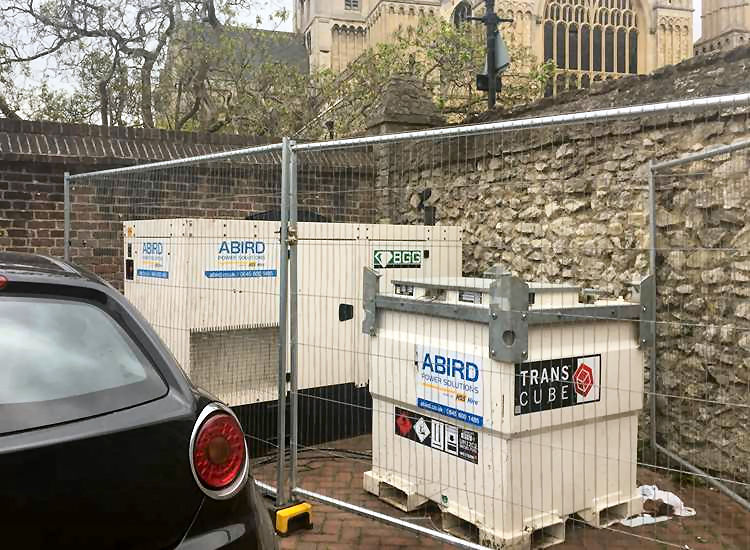
The generator has been in the Rochester car park for months.
It now looks as if problems over a bill have been resolved and the
plug on the generator could be pulled in about a week.
Iltan Uslu, manager of the pub and hotel, said hire charges had cost
thousands and “the sooner it was out the way the better”.
Mr Uslu said: “We employ about 20 people and we have a duty of care
to them and our guests including a family who live here who would
have left without a roof over the heads. The alternative would have
to close the business for six months.”
Mr Iltan has paid out a weekly fee to the council for the parking
slot.
He added: “We had not thought it would have taken so long to get
sorted. It’s been a nightmare.”
A cable connects the generator across the car park and Epaul Lane to
the pub.
Cllr Stuart Tranter, who represents Rochester, has taken on the case
on behalf of objectors.
He said: “It’s been a case of striking a balance. On the one hand it
is helping to keep a business going as well as keeping jobs, against
the safety and inconvenience to the public.
“Let’s hope the owners have got it right and this will soon all be
over.”

The cable from the car park to the pub.
Alan Moss, chairman of the City of Rochester Society, said he drove
over the cable several times a week and found it dangerous.
Mr Moss said: “It must be even more irksome to a driver who is
unfamiliar with it and drives over it at more than a snail’s pace. I
will be heartily glad to see the back of it.”
Chris Webb from Strood, said: “I first approached it at night and
there was no warning as you come down Castle Hill.
"My initial thoughts were that it was dangerous and could damage
cars along there.”
A Medway Council spokesman said: “We agreed the generator could be
moved and temporarily kept in Boley Hill car park to help reduce
noise disruption to residents.
“The cable has been covered by a rubber protector to keep the area
safe, and due to the size of the cable it does not require a
temporary Traffic Regulation Order.
“Without the generator the public house would have to close.
“We will continue to take appropriate steps to help support our
local businesses.”
|
LICENSEE LIST
READ Mr to June/1781 dec'd
HURT & CLARK to Feb/1793
DURHAM Mr pre 1798
GROVE Walter Feb/1793-Jan/98 dec'd
GROVE Mary Jan-Oct/1798
HOLLOWAY S Oct/1798+
 VINCENT M Abraham to June/1806 dec'd
ROBERTS Ann 1824+
WOODHAM William 1833+ (also baker & barge-owner)
SAXTON Thomas 1832-July/44 dec'd age 61

SAXTON Sarah 1847+
COTTON. WALTER & Co 1858+
FLISHER James Sept/1859-62+
FLISHER Eliza 1870-74+
BAKER Mr 1881+
LOGAN George 1891+
MARRACOTT Charles to Sept/1893 dec'd
VERDI Arthur John 1911-13+
LEDSON George 1918+
LEE George 1922+
CHAPMAN George Frederick 1930+
Trust Houses Ltd 1938+
KING Bill pre 2014
USLU Iltan 2017+
https://pubwiki.co.uk/KingsHead.shtml
From the Pigot's Directory 1832-33-34
|

