|
Upper Street
Hollingbourne
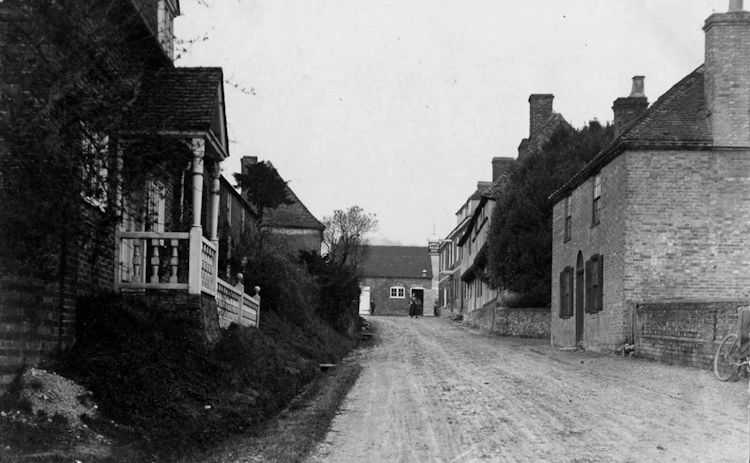
Above photo, 1904, kindly sent by Rory Kehoe. The young lady standing
outside the pub in the distance is Miss Laura (Lavinia?) Couchman,
daughter of the licensee, Henry Couchman. |
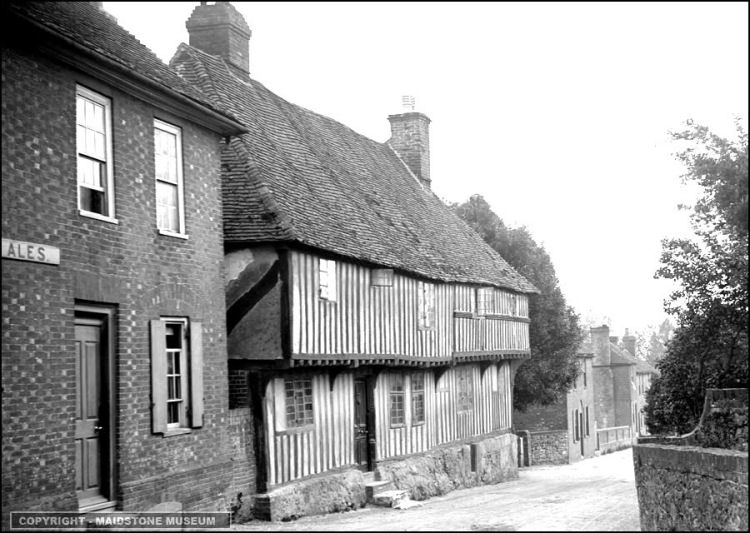
Above photo, date unknown, with permission from Eric Hartland,
showing part of the "King's Head" on the left of the photo. |
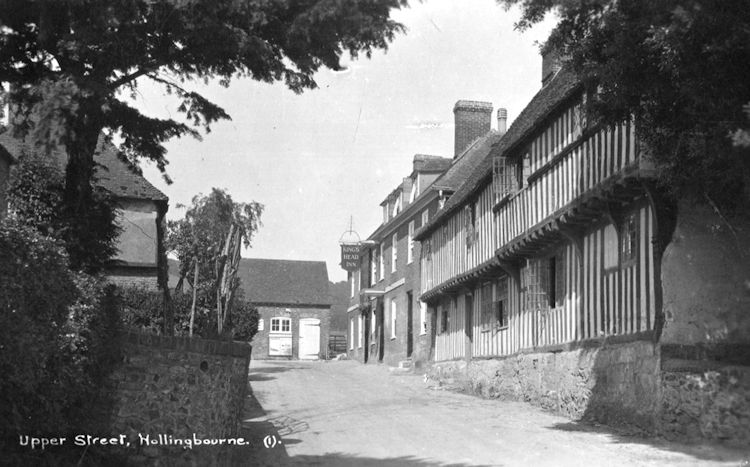
Above postcard, circa 1928, kindly sent by Rory Kehoe. |
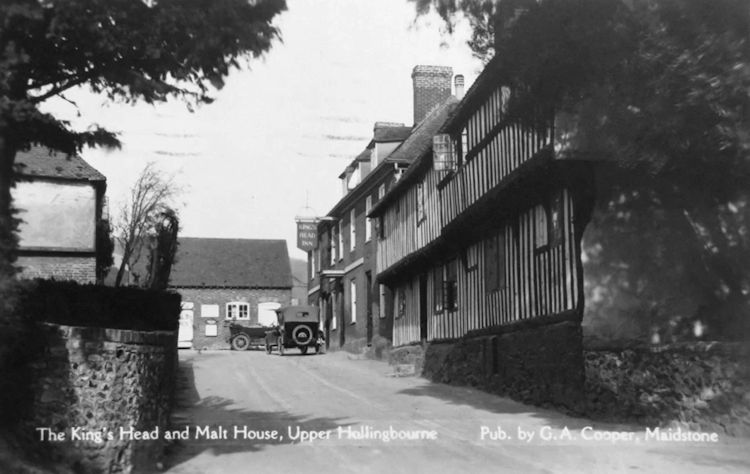
Above postcard, circa 1929, kindly sent by Rory Kehoe. The swing sign, a
5-sided shield shape, was emblematic of George Beer & Rigden's Faversham
Brewery, with most of their circa 300 tied houses having them. |
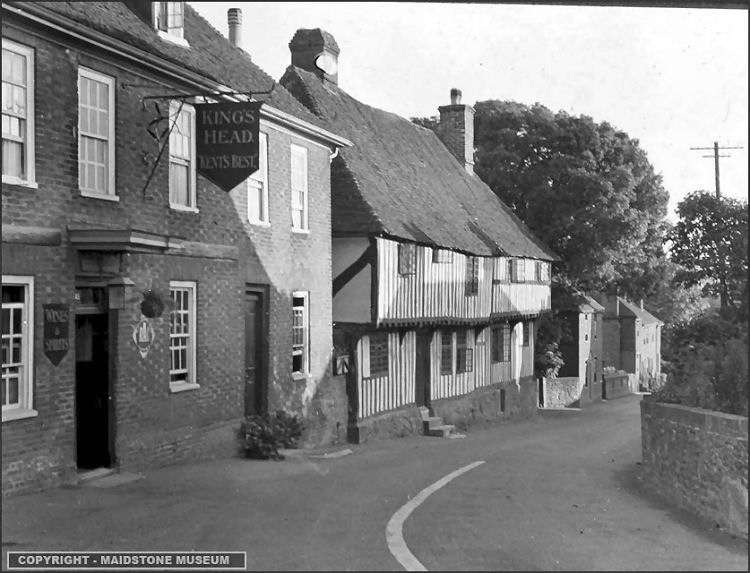
Above photo, date unknown, with permission from Eric Hartland. |
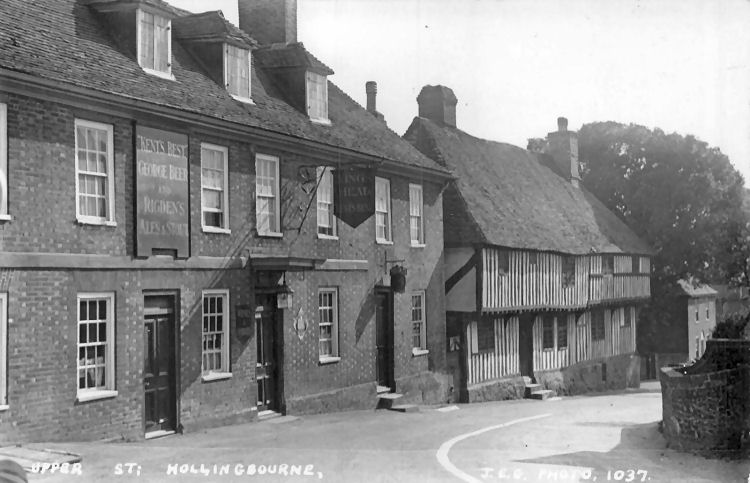
Above postcard, circa 1935, kindly sent by Rory Kehoe. |
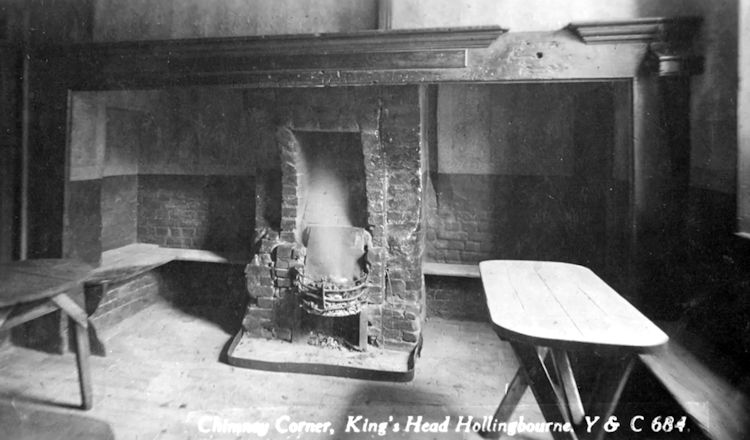
Above postcard, circa 1935, kindly sent by Rory Kehoe. It's doubtful
whether this wonderful period feature survived the devastating fire
which gutted the building in October 2022. |
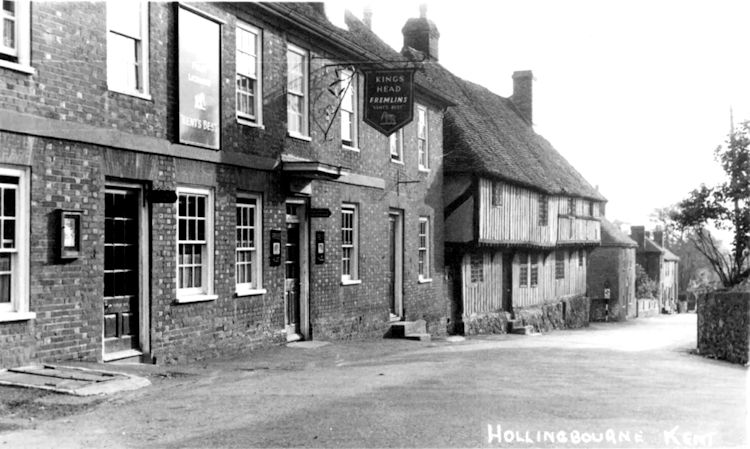
Above postcard, circa 1950, kindly sent by Rory Kehoe. Showing the
pub soon after being re-signed in Fremlin's livery, after their 1949
acquisition of George Beer & Rigden's Faversham brewery. |
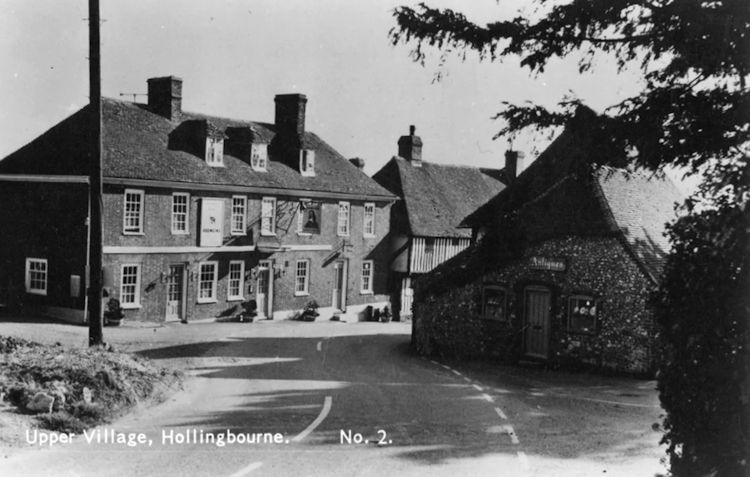
Above postcard, circa 1954, kindly sent by Rory Kehoe. With the pub
sporting a newly-hung pictorial inn sign. |
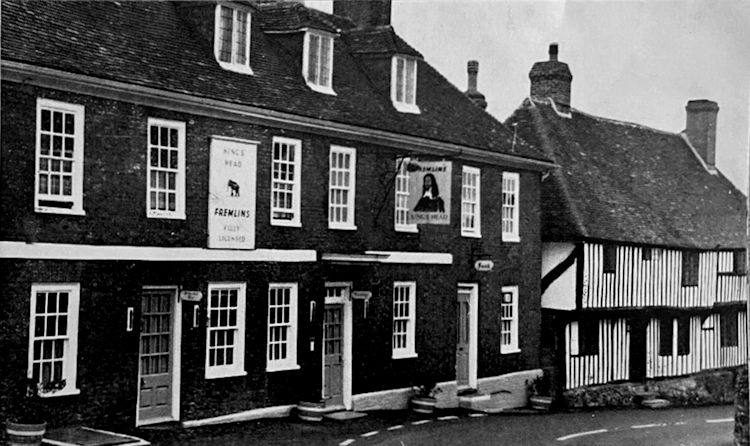
Above photo, circa 1959. Kindly sent by Rory Kehoe. From a guide to Kent
pubs, the caption reads "...An attractive 15th century inn, right on the
Pilgrims' Way, at the foot of the North Downs. In the rear of the inn is
the place where pilgrims were allowed a night's sleep. The inn used to
be called the Pilgrims' Rest and it has a most attractive interior,
including an inglenook fireplace, which has been modernised and produces
a fierce blaze which warms the whole bar. The decorations, including
horse brasses and trappings, are all in keeping with an inn of this
character..." Telephone: Hollingbourne 210. |
The pub was built in the twelfth century and was originally a farmhouse
with several acres of land. It was rebuilt in the fourteenth century on the
old foundations, possibly due to earthquake damage in the thirteenth
century. It was originally named "Ye Olde Pilgrim's Rest'e" but when George
the second became king it became the "Kings Head."
Monks used to occupy the building and brewed their own cider.
In 1975 the then owner changed the name back to the "Pilgrim's
Rest," as it stands on the Pilgrim's Way.
It is said to have a ghost dating from the nineteenth century and the
current owners, Mr. and Mrs. K. Lee have often felt a presence there.
|
Kentish Gazette 16 February 1782.
To be Sold by Auction, At the "King's Head," near Hollingbourne Church,
in the County of Kent.
On Wednesday, the 27th Day of this instant February, Between the Hours
of Twelve and Four in the Afternoon, (unless disposed of in the mean
Time by Private Contract.)
All that compact and valuable Leasehold Messuage or Tenement, and
Malthouse, and all Conveniences thereto, agreeably situated near the
Church of Hollingbourne, aforesaid, now in the Occupation of Mrs.
Elizabeth Stonehouse; together with the Garden, Stable, and every other
convenient Building thereto belonging.
All the Buildings are built with Bricks and Tiles, low taxed, and in
excellent good Repair, and may be entered on immediately, or further Particulars enquire of Mr. Henley, Attorney at Law,
Maidstone.
|
|
From the Maidstone Journal, 17 November 1795.
On the second instant, died Mr. Thomas Clifford, of the "King's Head,"
Hollingbourne; on the fourth died his daughter; and on the 9th died Mrs.
Clifford, his wife; their deaths are greatly lamented by their numerous friends
and acquaintance.
|
|
Kentish Chronicles, 20 November, 1795.
On the 2nd instant, died Mr. Thomas Clifford, of the "King's
Head," Hollingbourne; on the 4th died his daughter; and on the 9th died
Mrs. Clifford, his wife; their deaths are generally lamented by
their numerous friends and acquaintance.
|
|
From the Kent Herald, 14 August 1828. Assizes 4.bmp"
The Challock Burglary.
Stephen Cullen, alias Gig Cullen, age 25, labourer, was indicted for a burglary
in the house of Thomas Wright, at Challock, and stealing there from £330 in
guineas, half guineas, and seven shilling pieces, a shilling, and five calico
bags.
Mr. Pollock and Mr. Bodkin appeared for the prosecution.
Margaret Wright, wife of Thomas Wright, deposed that her husband was a small
farmer at Challock. On the night of the Eighth of December, she, her husband,
and servant girl, went to bed at 9 o'clock, the house having been fastened up;
about half past one in the morning she was awakened, and saw a light in the
room, and a man standing on each side of the bed; one of them had a plough
coulter in his hand, and other a club, they pulled the bed clothes about, and
both witness and her husband halloed out; she jumped out of bed, and the light
was immediately extinguished, but it was moon light, and she could still see the
men; she went to the chamber door, and one of the men pushed her back; she then
ran to the window and called out; the man at the door then stood over her with
the club, while the other was plundering in an inner room, in about 5 minutes he
came back, and said "I can't find it." Prisoner was the man who went into the
inner room; they broke open two chests in the bedroom from one of which prisoner
took a small pipkin, in which were bags of money, each containing originally £75
pound 12s. they then ran down stairs, and witness followed them; they went out
as they came in, by the back door; the staples and fastenings of the back door
were all forced out. In each of the bags of money there was a writing, to show
what each daughter had had out.
Cross-examined by Mr. Walsh.
She was not alarmed. Prisoner had on a brown jacket; her husband put the money
in the bags; she had seen it and counted it over about a 12-month before; there
was something dark on the men's eyebrows. She was positive as to the person of
prisoner.
Thomas Wright, an old man, the husband of the last witness, corroborated the
testimony of his wife in all the important particulars. The men pulled the bed
clothes about, as if playing the rogue; they did not hurt him or his wife; he
last saw the money on August 1827; it was in five bags of £75 12s. each; his
daughter Anne and Catherine had each had three guineas out of their several
portions.
Cross examined by Mr. Clarkson.
Besides prisoner, four men with taking up on suspicion of having committed this
burglary; they never swore to them; he never swore that the two men had their
faces blackened; he could not swear to the person of prisoner. Mary Mills, the
male maid servants, fastened the back door when she went to bed; she had a bed
on the landing place, by which persons must go to get into prosecutors room; she
was awakened by the men coming upstairs; they had a light with them; they both
had clubs; they went into the masters room, and she heard her master and
mistress cry out "what do you want?" and then "murder." She ran out of the
house, undressed, to a house a short distance off, and Mr. Andrews and his son
went back with her, but the men were gone.
Cross examined.
She never said any of the other four men taken were the men; prisoners face
looked blacked along his forehead.
John Mancroft deposed that his father kept the "King's Head," Hollingbourne, 10
miles from Challock. About nine in the morning of the 9th December he saw
prisoner and a shorter man come to the house, where they remained two hours, ate
some bread and cheese, and drank rum and beer; the short man had a bag of
guineas, which he took out of his pockets; there appeared to be about 50.
Witness's father sold them two players of stockings, which were paid for with a
guinea. When they left, witness followed and watched them; he saw one of them
take some silver out of the others pocket, Smith came up and joined witness; the
two men sat down under a hedge for nearly two hours, and at last one of them got
up and tore something to pieces in the road; and they then went on. Witness and
Smith picked up the torn pieces, which proved to be fragments of linen bags, a
piece of paper, and a duplicate; they lost sight of the men at Allington Hill.
Witness produced the pieces.
Cross examined.
He was positive as to the identity of the prisoner, although he never saw him
again to April; a piece of paper found had on its the name of "Holden."
Cornelius Minecraft, brother of last witness, about 11 o'clock on the 9th saw
two men in his father's tap room, but would not be positive the prisoner was
one; one pulled out a purse of gold, consisting of half a guinea and seven
pieces; there might be about 30 pieces; the other man said "don't be a b----y
fool, but keep it up;" one man was shorter than the other.
Thomas Smith followed the men with John Mancroft; he went forward, and passed
them as they sat under the hedge, for the purpose of noticing them; they had a
hat turned down, and some silver on the crown; prisoner was one of the men; they
were counting the money, and disagreeing a little. He returned and asked if they
had seen a black cow; the short one replied "D--n your eyes, you are watching
us," and got up; prisoner cried out give it him; witness got over a gate to
avoid them.
Cross examined.
He had not seen prisoner again till this day, but was positive as to his
identity.
Michael Ellen kept the "Eight Bells," Canterbury. About 9 o'clock on the evening
of Sunday the 9th December, prisoner was at his house with another man, George
Holden; prisoner wanted to have a bushel of beer, but witness would not draw it;
prisoner pulled a piece of gold, and said he was able to pay for it; Holden then
called for a pot of beer; they had some beef, for which Holden paid with a
guinea; they left about 11 o'clock; before they went witness called Holden out
of the tap room, and prevailed on him to leave his money with him; he gave
witness a bag containing "102 pounds 10s. 6dD., in guineas, half guineas, and
7s. pieces; Holden them went into a little parlor, and had half a pint of gin
with Cullen; the latter asked if Holden had paid for it, because if he had not,
he, Callum, could pay for a bushel of gin; prisoner then offered to lay witness
a wager of a sovereign that he and Holden had each a hundred pounds in their
pockets; and witness wanted to know what money they had threw 20s. on the table,
Cullen then went to Holden and felt his pocket; after which he took a big bag
out of his own pocket, and put it into Holden's; he then held up a bag and shook
it; it was quite full, and did not jingle; a man named Williams then to keep a
sovereign and the 20 shillings, and gave them to prisoner, witness was
determined to have his silver again or the bag of money, and a scuffle ensued;
he got prisoner down, and got upon him, but the other man pulled him away, and
prisoner got out of the room, next morning prisoner came again to witness's
house for a short time; witness had never seen either of them again till
yesterday. He gave Holden's money to Mr. Ridout.
Mr. Ridout, a grocer, produced the bag of money.
Henry Godmark was at Tunbridge Wells in April last, and met prisoner going
towards the Wells; he knew him, and with assistance pursued and took him at
Southborough.
Prosecutor looked at a crooked half guinea taken from the bag, and also a piece
of paper taken from the bag; he knew them both to have been in the pipkin when
it was stolen. One piece of the torn bag had on it "Charlotte," and another
"Maria," the names of his two daughters; they were also in the stolen bags.
Prisoner made no defence.
His Lordship went through the evidence with great minuteness; and the Jury
immediately found the prisoners Guilty.
His Lordship ordered him to be taken away for the present.
|
|
From the Kent Herald, 14 August 1828.
Stephen Cullen, yesterday convicted of burglary at Challock, was next put to the
bar before sentence.
His Lordship told him that his crime was the most heinous one, but taken into
consideration that he and his companion had not ill used the old people, that
circumstance and that alone induced his Lordship to spare his life. If, when the
old woman got out of bed, or the old man rose, any violence have been used
towards them, prisoner most certainly would have been left for execution. It was
not the first time he had been arraigned in a Court of Justice; therefore,
though his life will be spared, he will be sent out of this country for ever.
His Lordship then sentenced him to be transported for life.
|
|
South Eastern Gazette 14 April 1840.
LOST.
On Hollingbourne Hill, on Saturday, April 11th,
A Gold Watch, with chain, key and seal. Whoever will bring the same to
Mr. William Sage, "King's Head," Hollingbourne, shall be handsomely
rewarded for their trouble.
|
|
Kentish Gazette 31 January 1843.
MARRIAGE.
Jan 16th., at Maidstone, Mr. William Sage, of the "King's Head,"
Hollingbourne, to Mrs. Morphew, second daughter of Mr. James Rayner, of
Otham.
|
LICENSEE LIST
CLIFFORD Thomas to 2/Nov/1795 dec'd
MANCROFT Mr 1828+
SAGE William 1840-58+ (also farmer age 65 in 1851 ) )

SAGE Mary A 1861+ (widow age 55 in 1861)
SELLEN William 1862-74 (age 61 in 1871)
ALEXANDER Frederick W 1881+ (age 28 in 1881)
TAYLOR Thomas 1890+

COUCHMAN Henry 1891-1922+ (age 33 in 1891)

HODSDON Alfred 1930+
EDMONDS Cecil R 1938-39+ (age 40 in 1939)
https://pubwiki.co.uk/KingsHead.shtml
Kentish Gazette
Census
Maidstone
and Kentish Journal
From the Kelly's Directory 1903
|

